
When discussing African hunting safaris, international and US hunters often focus on well-known big game like the Big 5 or Dangerous 7—Lion, Leopard, Rhino, Cape buffalo, Nile Crocodile, Hippo, and Elephant—famous for their peril and excitement. Even the less attractive Ugly 5 earn recognition for their odd appearances. Yet, hidden across Africa are seven elusive species that challenge and educate hunters on a different level.
[DYNAMIC-BLOGTABLEOFCONTENT]
Key Takeaway
- Africa is home to many diverse species, each with only one goal in mind: Survival
- While the Big 5 may be the most dangerous, other groupings are just as fascinating or worth exploring
- Africa’s Shy or Secret 7 comprise seven of the most elusive and secretive species that skulk and survive (and thrive!) in the shadows
- The Shy 7 comprise the Aardvark, Civet, Serval, Pangolin, Large-spotted Genet, Cape Porcupine, and African Wildcat
- African hunts can comprise a variety of species, not only the most renowned or eye-catching in terms of trophies
Africa’s Masters of Disappearance
In a world where big is often seen as “best,” these species show that this is not always the case. Where boldness is often valued above subtlety, these animals demonstrate resilience by thriving away from the continent’s larger and more intimidating species. Survival is their daily reality, achieved not through confrontation, but by relying on avoidance, silence, and caution.
Perhaps this is why hunters remain intrigued by them and African hunts at times unsuccessful because of them.
These secretive seven species present a different challenge to hunters, with many game hunting enthusiasts embarking on a hunting safari and never laying eyes on these animals, even when hunting within their prime habitats. Perhaps hunters will catch a glimpse of a tail, or the rustle of leaves in a tree as an agile trophy quietly disappears into the camouflage of the surrounding veld, but these moments are brief and often missed, even by experienced hunters.
The Shy 7 test hunters as never before: From tracking and stalking to understanding animal behavior and the silences…especially the silences, for that is the world wherein these trophies reside and thrive. This is the world of African hunts, where each safari tests and challenges hunters to the limit.
The Shy & Secretive Seven
Seven species and seven unique animals, each existing secretly in the African bush. The remarkable fact is that many may pass them without seeing them, a case of hiding in plain sight in some instances, due to their exceptional camouflage skills. Let’s take a look at these intriguing specimens, seeing what sets them apart in their drive for survival in the harsh African bush and why African hunts and safaris include them.
Aardvark
The Aardvark (Orycteropus afer) is a nocturnal mammal found across sub-Saharan Africa. It is also known as the African anteater, as well as the Cape anteater, but whatever name you know it by, you know that it is one of Africa’s most elusive species. Found in sub-Saharan Africa, the Aardvark enjoys a variety of habitats, including woodlands, grasslands, and savannas. It remains a solitary creature that spends its days hiding and napping in burrows before emerging at night to feast on termites and ants. Equipped with a long sticky tongue that can reach up to 12 inches, the Aardvark uses its powerful claws and nails to rake open ant and termite hills.
This nocturnal carnivore is renowned for its exceptional hearing and sense of smell, but sight is not its strong point.
While permits are rarely granted for the Aardvark, it remains a protected species, although its numbers are listed as a species of least concern by the IUCN.

Cape Porcupine
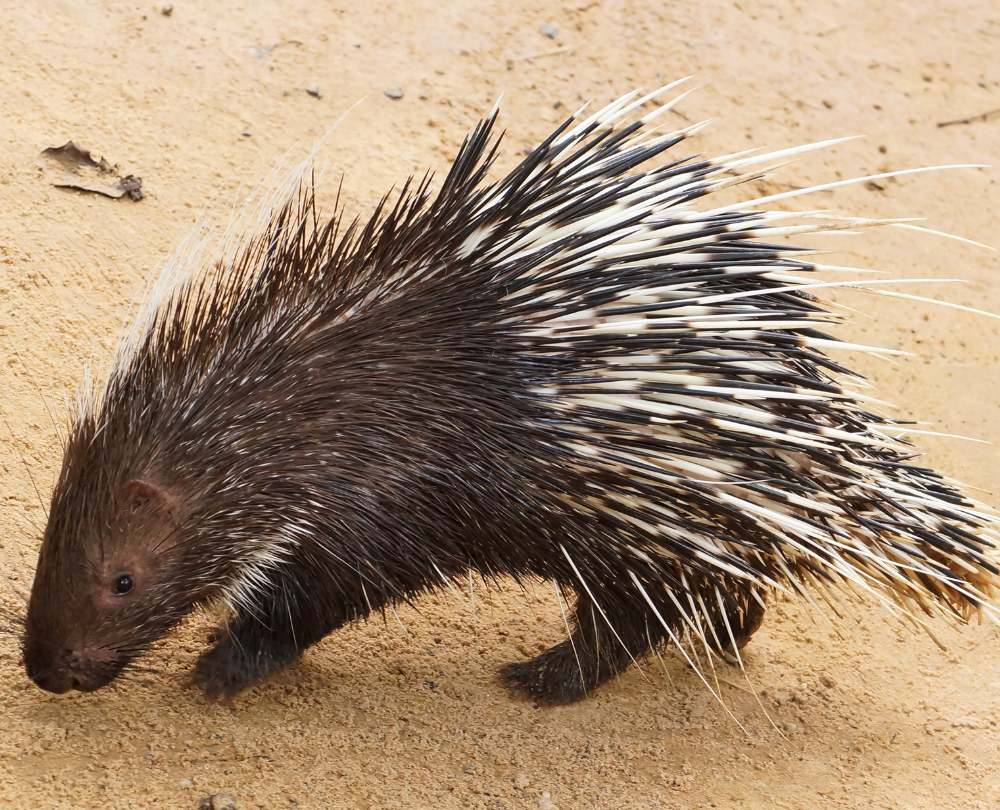
The African Porcupine (Hystrix africaeaustralis), also known as the Cape Porcupine, is the largest rodent in Africa and the world’s largest porcupine. The Cape Porcupine is a key member of Africa’s Secret Seven and inhabits the savannas, grasslands, dry shrublands, and rocky crevices in Southern and Central Africa.
This herbivorous, opportunistic rodent is a nocturnal feeder, spending its days hiding out in self-dug burrows, caves, and even Aardvark burrows.
Listed as a species of least concern by the IUCN, a TOPS (Threatened or Protected Species) permit is required to hunt them. Porcupine hunting is often opportunistic when a night hunter comes across these unusual trophies.

Large-Spotted Genet
This graceful African cat is a master hunter, often found inhabiting farmlands, woodlands, savannas, and riverine forests, where its nocturnal hunting is focused on rodents, insects, small reptiles, and birds. The Large-spotted Genet (Genetta tigrina) presents a significant challenge to spot on a night hunting safari. Night hunts can be both thrilling and testing, with the Large-spotted genet proving to be a worthy adversary. With its spotted coat, perfect for camouflage under the moonlit African sky, together with its innate agility and exceptional tree-climbing ability, this trophy proves to be an elusive and challenging prey.
Spotlights, from a vehicle or on foot, together with rodent calls, are used to flush out these intelligent members of the African cat family.

African Wildcat
The African wildcat (Felis lybica) is a small, elusive feline that resembles a domestic cat but has longer legs and a tawny coat marked by bold stripes and spots. This feisty feline is found throughout Africa, inhabiting regions that include savannas, deserts, scrublands, rocky hills, and grasslands.
The African wildcat is valued for its rarity and challenge to hunt, with night hunting safaris using spotlights to illuminate its eyes.
No extra hunting permit is required other than a night hunting permit when targeting this feline in South Africa, and once again, the species is listed as least concern by the IUCN.

Pangolion
The Cape Pongion (Smutsia temminckii), also referred to as the Steppe Pongolion, is native to South Africa and is not allowed to be targeted on any hunting expeditions and is strictly protected by South African law.
While active mostly at night, the Cape Pongolion is diurnal in cooler seasons, seeking its fill of tasty termites and ants, on which it feeds almost exclusively. It favors regions that have an abundance of ant hills and termite mounds, including habitats such as woodlands, grasslands, semi-deserts, and scrublands throughout Southern and Eastern Africa.

Civet
The African civet (Civettictis civetta) is a small, catlike creature native to Southern and Central Africa. Its preferred habitats include savannas and forests, but as an accomplished swimmer, it often inhabits regions near water and is rarely found in arid regions. It is nocturnal, preferring to spend daylight hours hiding and resting before coming out to hunt at night.
Civet hunting is available in numerous African countries, including South Africa, Cameroon, Namibia, Tanzania, Zimbabwe, Zambia, and the Central African Republic. The Civet is listed as a species of least concern with the IUCN. When hunting this solitary and elusive mammal, be sure to keep a lookout in trees, as the Civet is extremely agile and is often found hiding in trees.

Serval
The Serval (Leptailurus serval), also known as a “tierboskat” (tiger bush cat) in South Africa’s local Afrikaans language, is commonly found on savannas where there is plenty of water. These agile mammals prefer habitats comprising bush, tall grass, and dry reed beds near streams, while also inhabiting high-altitude moorlands and bamboo thickets. While commonly found in Southern Africa, it is rare to spot them in Africa’s Northern regions.
If you are planning on hunting this elusive creature, it’s important to note that a permit needs to be procured in advance in many countries, including South Africa. Servals are hunted in a variety of methods, including from a blind, using hounds, as well as with a spotlight, and this is all dependent on where in Africa you are hunting.

The Big 5 vs Dangerous 7 vs Ugly 5 vs Secret 7
Africa is renowned for its grouping of species, with each group name aptly conveying what the groups comprise. Each group has its own appeal, its own unique characteristics and makeup, setting it apart from the others in no uncertain terms. And each group sets its own challenges for hunters seeking the ultimate in hunting safari experiences.
The Big 5
Africa’s Big 5 is seen as the five most dangerous animals to hunt on foot. As a game hunting enthusiast, hunting these trophies is almost seen as a rite of passage for hunters wanting to prove their courage, tenacity, and perseverance. Africa’s Big 5 consists of the Leopard, Lion, Cape Buffalo, Rhino, and Elephant. In terms of trophy value, these are tops!
The Dangerous 7
Closely related to the Big 5, the Dangerous 7 are the most dangerous animals that can be hunted in Africa, adding two semi-aquatic species to the Big 5. The Dangerous Seven comprises the Big 5, plus the cold-blooded, man-eating Nile Crocodile, along with the (highly underrated in terms of danger factor!) Hippo. Both these additional species are renowned for their aggression, making them a challenge to hunt and allowing hunters a certain amount of bragging rights when they have been harvested. As with the Big 5, these game hunting trophies are considered exceptional and are extremely sought-after.
The Ugly 5
While not as well-known as the Big 5 or Dangerous 7, this grouping comprises Africa’s ugliest set of species. While some hunters consider the huntable members of the group quite…shall we say unique?....others class them as quite hideous. The members of the Ugly 5 comprise Wildebeest, Maribou Stork, Hyena, Warthog, and Vulture.
The Shy 7
This group of animals is seen as being the most elusive, secretive, “living under the radar” African species. Most of the Secret, or Shy 7 as they are also referred to, are nocturnal, and therefore not easily spotted during the day while either on an African safari or during a hunt. Even in hunting scenarios, those species that are available to hunt are often seen as being opportunistic trophies and dealt with as they cross a hunter’s path. Hunting these species requires the utmost patience, perseverance, and tenacity to overcome many obstacles of night hunting.
Fascinating Facts about the Secret 7
Quill Army
Did you know that the Cape Porcupine has roughly 30,000 quills? Yes, that’s not a typo, 30,000! Quills are continuously replaced, and while many seem to think that the Porcupine “shoots” these quills for protection, the truth is that they detach on contact, making them a great and very effective deterrent. Protection isn’t always about aggression and speed; sometimes it can take the form of a well-placed quill or two to get the message across…
Defensive Tactics
Speaking of defensive measures, the Pangolin is the only mammal that is completely covered in keratin scales. They roll into a ball, which assists in protecting them against predator attacks.
Long-legged Beauty
The Civet has the longest leg-to-body ratio of any cat and enables them to easily jump almost 10 feet to catch prey. These agile and fast predators jump and catch birds in seconds,
Camo Cats
Ancestors of our domestic cats, and twice their size, the African Wildcat is a master of camouflage.
Secret 7 Night Adventures
All members of the Secret 7 are nocturnal, meaning they are more active at night than during daylight hours. For hunters, this makes the challenge even more…um, challenging?...but thermal imaging adds a hidden secret weapon for night hunting parties.
Agile Climbers
Did you know that not only are the cats in this group agile tree climbers, but there are other species too? Yep, the Cape Porcupine – despite its large size and bulky frame – climbs trees quite remarkably! This remarkable feat not only assists when they are in search of some tasty treats on high branches (think leaves, bark, buds, and twigs), but also assists them in evading predators. And come now, let’s be honest…you would not seriously be searching for a Porcupine in a tree during a night drive, would you?
Unique Markings
The Civet’s stripe markings are as unique as a fingerprint, or in animal terms, as unique as the markings on a zebra’s coat.
Conclusion
The Secret or Shy 7 represent a snippet of Africa’s most elusive species, each building a life immersed in solitude and shadowy existences to evade detection and survive against the odds. Their survival drive has led to numerous adaptations in the way they live, hunt, breed, and deal with danger. From the Civet and Large-spotted Genet with their agile climbing abilities, the Pangolin’s keratin covering, the African Wildcat’s exceptional camouflage skills, the Aardvark’s hyperacute hearing, or the Serval’s towering leaps, and the Cape Porcupine’s quill “armor,” each species is ready to flee or fight, with only one goal in mind: SURVIVAL.
Frequently Asked Questions
What are Africa’s Big 5?
Africa’s Big 5 is a group of five animals that are considered the most challenging to hunt on foot in Africa. These animals include the Lion, Leopard, Cape Buffalo, Rhino, and Elephant.
What are Africa’s Secret Seven?
Africa’s Secret Seven comprises seven animals that are extremely elusive, mostly nocturnal, and very difficult to spot or see on an African safari or during a hunt.
Which animals comprise Africa’s Secret Seven?
Also known as Africa’s Shy Seven, they include the Pangolin, Cape Porcupine, Serval, Civet, Large-spotted Genet, African Wildcat, and Aardvark.