
2 Hunters: Kudu, Gemsbok & Springbok Hunt in Namibia | 7 Days
Booking Season: 2026
Hunt Difficulty: Moderate

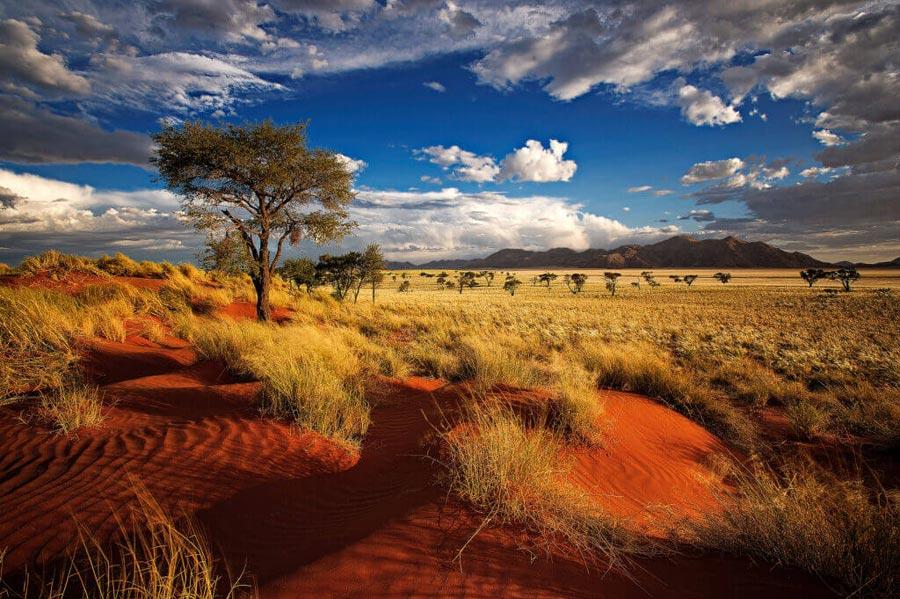
No special permits are required for kudu hunting in Namibia. The IUCN has listed the greater kudu with a status of least concern.
Kudu hunting in Namibia is defined less by finding animals—and more by what happens after you see them.
In most areas, especially the Khomas Highlands and surrounding regions, visibility is high. You will often glass multiple bulls in a single day. But this is where many hunts begin to fall apart.
Distance, terrain, and timing become the real challenge. Shots are rarely close, and opportunities are often brief. A bull may be visible for several minutes—but never actually offer a clean shot.
This creates a very different hunting dynamic compared to thicker bushveld countries. Namibia rewards patience, shooting discipline, and the ability to judge a mature bull under pressure, often at longer distances than expected.
Available Greater Kudu Hunts
2 Hunters: Kudu, Gemsbok & Springbok Hunt in Namibia | 7 Days
Booking Season: 2026
Hunt Difficulty: Moderate
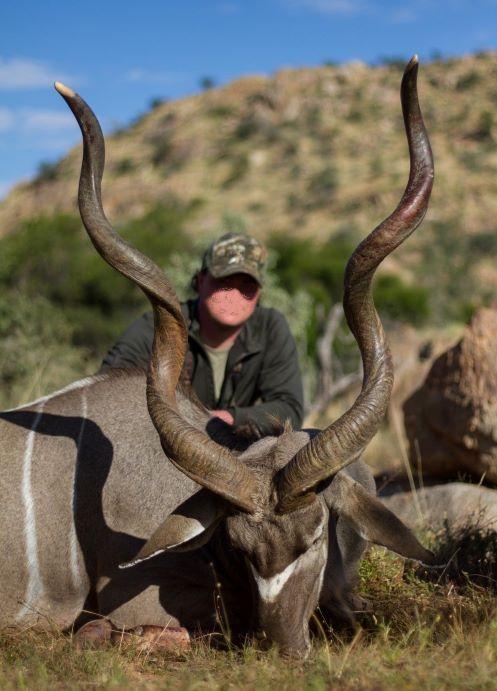
Kudu Hunting Safari with Oryx, Wildebeest, Zebra & Warthog
Booking Season: 2026
Hunt Difficulty: Moderate
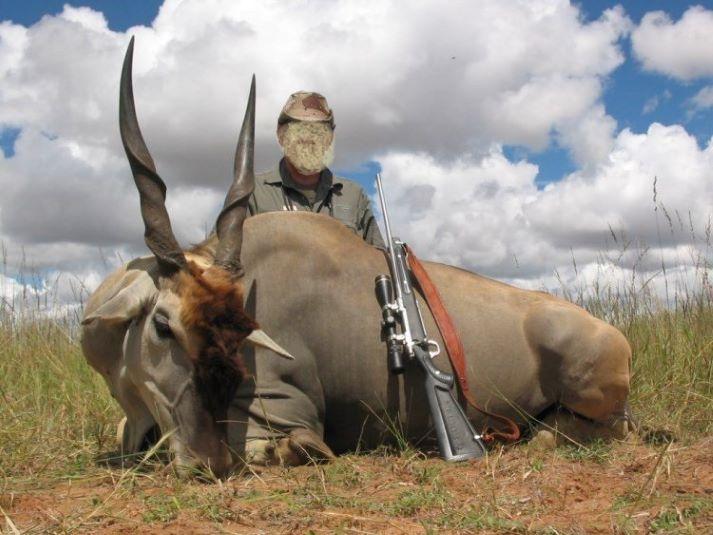
Hunting in Namibia Kudu, Cape Eland and 4 Species
Booking Season: 2026
Hunt Difficulty: Moderate

Kudu hunting for 8 days 5 species 2 x Hunters in Namibia
Booking Season: 2026
Hunt Difficulty: Moderate
African Kudu Hunt in Namibia: 8 Days Hunting 4 Species
Booking Season: 2026
Hunt Difficulty: Moderate
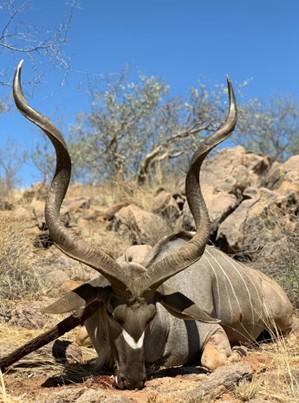
Namibia Plains Game Hunting Safari | 6 Trophy Species Included
Booking Season: 2026
Hunt Difficulty: Moderate
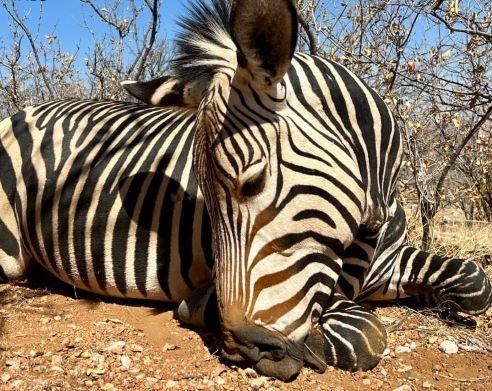
African Plains Game, Hunting 5 species in Namibia x 9 Days
Booking Season: 2024
Hunt Difficulty: Moderate
14 Days Leopard Hunting in Namibia with a Kudu & Springbok
Booking Season: 2026
Hunt Difficulty: Difficult
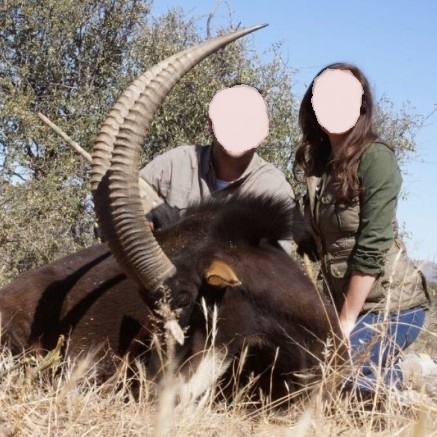
Custom Namibia Hunting Safari | 2 Hunters & 2 Observers
Booking Season: 2026
Hunt Difficulty: Moderate
Namibia Plains Game Extravaganza | 9 Species in 12 Days
Booking Season: 2026
Hunt Difficulty: Moderate
Kudu hunts in Namibia are best early in the morning, when you stalk animals as they graze or ambush them as they approach water.
Unlike thicker terrain, Namibia often presents shot opportunities at extended distances, particularly in open or mountainous areas. This makes stability and shot execution far more important than simply getting close. If the kudu is standing broadside, the ideal shot placement is about one-third of the way up the body, just behind the shoulder. This measurement should be taken from the top of the spine to the bottom of the brisket.
Because of the distances involved, even a slight miscalculation can result in a miss or poor hit. Many hunters underestimate how quickly conditions change—wind, angle, and animal movement all play a role. If the shot is slightly high, the lungs may still be hit, which is also fatal. Shooting through the shoulder is another option, as this can break the shoulder and, with sufficient bullet penetration, may also break the opposite shoulder.
If the kudu is quartering toward the hunter, the shot should be adjusted slightly forward so the bullet enters just in front of the shoulder. If the animal is quartering away, aim a few inches behind the shoulder to ensure proper penetration into the vital organs.
In Namibia, it is common to pass on marginal shots and wait for a better opportunity. This is often the difference between a clean harvest and a long tracking job across difficult terrain.
A .30-06 caliber rifle is a popular and effective choice when hunting kudu in Namibia. It provides sufficient power and accuracy for this large plains game species. It is recommended to use bullets weighing at least 150 grains.
Other suitable calibers include the .375 and up to the .458, all of which are capable of taking kudu effectively. For longer-range shots, calibers such as the 7mm or .300 Winchester Magnum are also widely used. Given Namibia’s terrain, flatter-shooting calibers tend to offer an advantage, especially when shots extend beyond typical bushveld distances.
As with any African hunting safari, shot placement remains the most critical factor.
Bow hunting is also permitted when targeting kudu in Namibia. It is advisable to speak with your outfitter for specific requirements and recommendations.
Namibia is often considered one of the best countries in Africa for kudu hunting—but not always for the reasons hunters expect.
Compared to higher-density countries like South Africa, Namibia offers a more natural, less pressured environment. You may see fewer animals overall—but the quality of bulls and the way the hunt unfolds is very different. The trade-off is simple: Namibia gives you more time to observe animals, but far fewer chances to recover if something goes wrong.
In practical terms, you’re not relying on multiple opportunities—you’re relying on making the right decision when one finally comes together.
Kudu hunting in Namibia is slower, more deliberate, and far more dependent on terrain than many first-time hunters expect.
Most hunts are built around glassing from elevated ground, identifying bulls at distance, and then planning an approach using terrain, wind, and whatever cover is available. Shot distances are often longer than expected. While some opportunities may come inside 100 yards, it’s not uncommon for shots to push past 200 yards—something many U.S. hunters are comfortable with, but often underestimate in African terrain.
You’re not rushing a shot before the animal disappears—you’re trying to create a shot that may never fully come together if the approach isn’t right.
Namibia is not a single type of kudu hunt—it changes depending on where you are.
In the Khomas Highlands, elevation defines the hunt. You’re glassing across valleys and ridgelines, often spotting bulls at distance but needing to work hard to get into position. Stalks are longer, angles are awkward, and exposure becomes a real factor.
On the western edge of the Kalahari, the country opens up. You’ll see further, but shots stretch out. You may have more time to assess a bull—but far less margin for error once you commit. In thicker pockets, things tighten up. Shots are closer, but opportunities are quicker and less predictable. It can feel similar to South Africa—but without the same number of second chances.
What catches most hunters off guard is how quickly this changes. You might glass a bull at 300 yards in the morning, and by afternoon be dealing with a 120-yard shot in thicker cover.
There’s no single way to hunt kudu in Namibia. The terrain decides everything.
Most hunts don’t fall apart because you didn’t find kudu—they fall apart after you already have.
A bull is spotted. The approach looks good. Wind feels right. Everything seems to line up. And then small things start to shift. Distance is slightly off. The angle isn’t as clean as it looked. The bull moves just enough. Or the hunter waits for something better that never comes.
Unlike higher-density areas, there’s usually no second chance. Once it’s gone, you’re starting over.
That’s really what Namibia comes down to—not finding kudu, but finishing the opportunity when it finally shows up.
Kudu in Namibia are generally less pressured—but that doesn’t make them easier.
They use terrain exceptionally well. Elevation, shadow, and limited cover all work in their favor. You can see a bull clearly at distance, then lose him completely once you start moving.
There’s a constant balance—because while you can see more, so can they.
Once a kudu picks up movement, it doesn’t need to run far. It just needs to reposition—and suddenly the opportunity is gone.
Namibia looks open—but that doesn’t mean you’re in control.
Light plays a big role. Early and late in the day, shadows can either reveal or completely hide an animal. A bull can stand in partial shade and disappear, even when you’re not that far away. As the day heats up, glare and distortion start affecting what you see—especially through a scope. Horn size, body shape, and shot placement can all look different depending on conditions.
Wind is constant. There’s very little to stop it, and small changes carry scent further than most hunters expect—especially when approaching from elevation. A lot of stalks fall apart not because the kudu was seen—but because it scented you long before you realized the wind had shifted.
You can see more—but you control less. And once that control is gone, it’s very hard to get it back.
The biggest mistake is assuming open terrain makes the hunt easier.
In reality, it removes your margin for error.
Seeing more animals doesn’t mean more opportunities. You may glass multiple bulls and still never get a shot at a mature one. Distance is also underestimated. What looks manageable often isn’t once wind, angle, and terrain come into play.
But the biggest mistake is waiting too long. Most hunters expect the situation to improve. In Namibia, it usually doesn’t. What U.S. Hunters Should Know About Kudu Hunting in Namibia. For hunters traveling from the United States, kudu hunting in Namibia can feel familiar at first—open terrain, longer shots, and a strong reliance on glassing.
But that familiarity can be misleading.
What catches many U.S. hunters off guard is how quickly conditions change once you start your approach. Distance often looks shorter than it is, wind carries further than expected, and animals use terrain in ways that are difficult to read without experience in Africa.
Most U.S. hunters are comfortable shooting at 200–300 yards. In Namibia, that’s usually not the problem. The challenge is that the opportunity rarely stays the same long enough to take that shot comfortably. A bull may be visible, the setup may look good, and everything feels under control—until something small shifts. The angle changes, the animal moves, or the wind picks you up. And just like that, the opportunity is gone.
Hunters who do well here are the ones who adapt quickly—who recognize when a situation is workable and take it before it disappears.
At first glance, kudu hunting in Namibia feels like something most U.S. hunters already understand. You’re glassing open terrain, spotting animals at distance, and setting up shots that often fall within ranges you’re comfortable shooting back home.
That’s where the similarity ends.
Back home, when you spot a mature animal, the situation usually develops in a predictable way. You have time to range, settle in, and wait for the angle to improve. In Namibia, that same situation rarely holds together long enough to play out the way you expect.
A kudu bull might be standing in the open one moment—and completely gone the next without ever giving you a clean opportunity. What catches many hunters off guard is not the distance—it’s how quickly the situation changes once you start moving.
Terrain that looked simple from a distance becomes harder to work with. Wind that felt manageable starts to shift. And the bull you thought you had time with suddenly steps into cover and disappears. This is why kudu hunting in Namibia often feels easier than it actually is. You see more, but you control less.
And that difference—between what looks familiar and what actually happens—is where most opportunities are lost.
One of the biggest habits U.S. hunters bring to Africa is the idea of waiting for the perfect shot.
Back home, that usually works. You wait for a broadside angle, give the animal time to settle, and take the shot when everything lines up the way it should. In Namibia, that same approach often leads to missed opportunities.
Kudu don’t stand still for long once something changes. They don’t need to run—they just need to step into terrain that removes your line of sight. A bull might give you a workable shot for a few seconds, then shift just enough to take it away completely. Hunters who are used to taking their time often wait for that moment to improve. They expect the animal to take another step, turn slightly, or present a clearer angle.
Most of the time, it doesn’t happen.
Instead, the opportunity fades. The angle closes. The bull moves into cover. And what felt like a situation you had under control is suddenly gone. This is one of the biggest adjustments when hunting kudu in Namibia: learning the difference between a perfect shot and a workable one.
Because in this environment, waiting for perfect is often what costs you the bull.
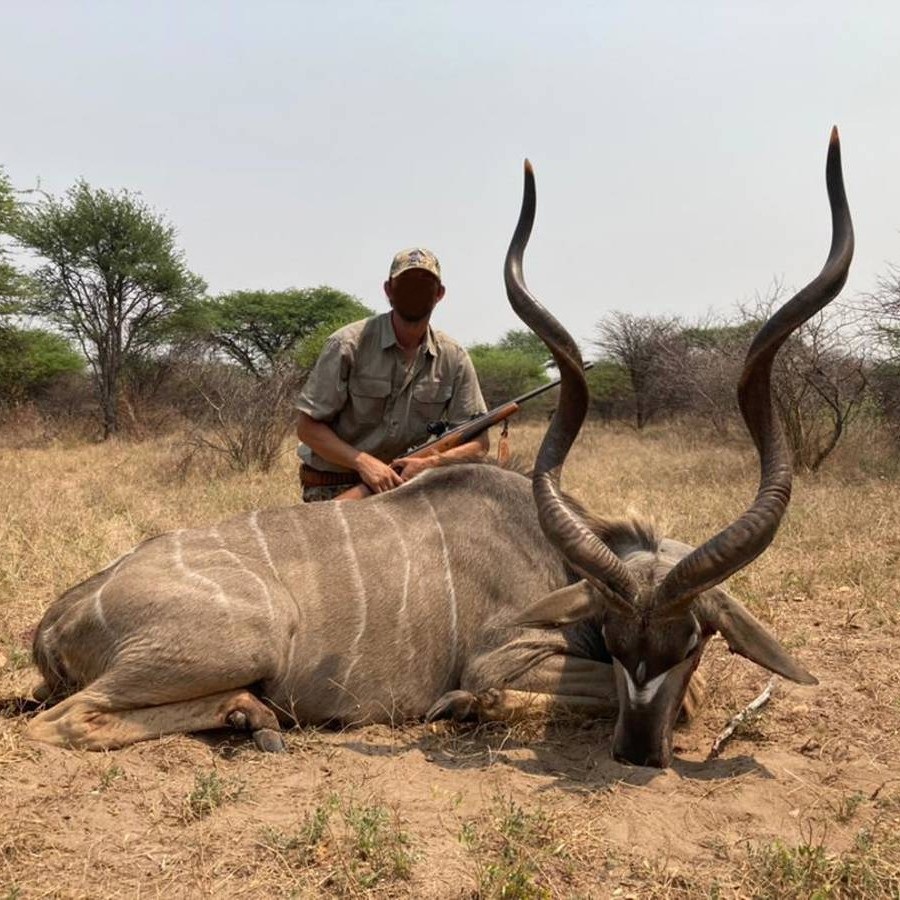
Namibia consistently produces high-quality kudu, with bulls in the 50–55 inch range being realistic in many areas.
Bulls pushing 60 inches do exist—but they’re rare, and usually come with more difficult conditions.
Judging size at distance is not easy. Light, angle, and terrain all distort what you’re seeing. Bulls can look bigger—or smaller—than they really are.
Mature bulls also use terrain differently. They expose less, move more deliberately, and rarely give you a perfect setup.
And when a big bull is in front of you, pressure builds. That’s where hesitation creeps in—and that’s usually where things go wrong.
Most mature bulls fall in the 50–55 inch range, with anything above that considered a strong trophy.
60-inch bulls are exceptional—and far less common than many hunters expect.
Namibia gives you the chance to see good bulls. Converting that into a successful shot is where the real challenge sits.
While most international hunters focus on horn size, kudu hunting in Namibia isn’t only about taking a big bull—it’s also about the meat.
Kudu venison is some of the best game meat in Africa—lean, tender, and highly valued locally.
In many areas, younger bulls are often preferred for meat quality, and locals place just as much importance on that as they do on trophy size.
It adds another dimension to the hunt. Not every kudu needs to be measured to be worthwhile.
Namibia suits hunters who are comfortable with fewer chances—but higher-quality encounters.
It works best for those who are confident shooting at distance, patient enough to wait, and able to make decisions without expecting a perfect setup.
It’s less suited to hunters looking for frequent opportunities or close-range encounters.
For the right hunter, this is one of the most rewarding kudu hunts in Africa—but it demands the right mindset going in.
Search from our range of Hunts across various popular destinations in Africa.

Book Your Hunt