
When Tamlyn and I hunted hippo in Namibia's Zambezi Region, we knew that the meat would be distributed locally. What we hadn't appreciated was just how much that one animal would mean to the surrounding community.
After the bull was recovered, people gathered to help process it. Fires were burning across the area, and by the following morning there was almost nothing left where the animal had been butchered. For us, the hunt had ended with a trophy. For the people living there, it meant food for their families.
For hunters considering a similar safari, our guide to hippo hunting in Namibia covers the available opportunities and practical arrangements. This article is about what happened after our hunt.
How a Hippo Hunt Can Benefit a Local Community
In remote hunting areas, the benefits of a safari can extend beyond the professional hunter and the outfitter. Camp employees, trackers, skinners, boat crews and other local workers may all contribute to the operation. Depending on the concession's arrangements, revenue from regulated hunting can also contribute to wildlife management and community programmes.
Meat is another consideration, particularly when a large animal such as a hippo is harvested. How that meat is distributed depends on the area and the arrangements made with local communities. It should never be assumed that every hunt operates in exactly the same way.
On our safari in Namibia's Zambezi Region, we witnessed the community's involvement firsthand. Once our bull had been recovered, local residents gathered to help process the animal. Seeing that work, and understanding what the meat meant to the people involved, gave us a perspective on the hunt that we hadn't fully appreciated beforehand.
A Lesson We'll Never Forget
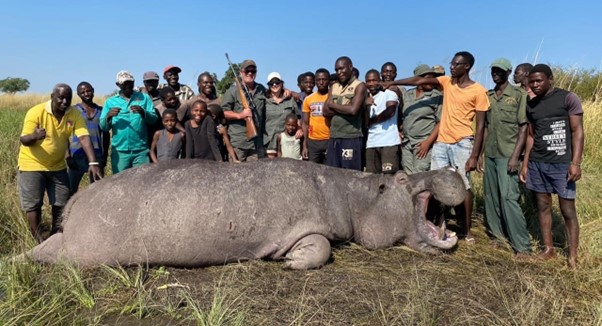
In 2022, Tamlyn and I were hunting hippo in Namibia's Zambezi Region. Once the bull had been recovered from the river, the local community gathered to process the meat. Every usable part was shared among the surrounding villages, and people worked together with remarkable speed and efficiency.
That evening, we sat around the campfire reflecting on the day's hunt. After a long silence, Tamlyn looked across at me and said,
"Do you realise we didn't just hunt a hippo today? We helped feed hundreds of people."
It was a simple observation, but one that stayed with both of us.
As darkness settled over the village, we could see fires burning in every direction. The smell of hippo meat cooking over open flames drifted through the evening air, while families gathered together and children played nearby. It was a powerful reminder that a regulated hippo hunt means something very different to the people who live alongside these animals than it does to the visiting hunter.
The following morning, we walked back to where the hippo had been processed. Apart from a small blood stain on the ground, there was almost nothing left. Every usable piece of meat had already been distributed or carefully salted and hung to dry, providing food that would last for many weeks.
That safari changed the way we looked at hunting in Africa. It reminded us that a regulated hippo hunt is about far more than a trophy. It supports conservation, contributes to local communities and, in a very real way, provides food where it is genuinely needed.
Why We Remember This Hippo Hunt Differently
I've hunted dangerous game for many years, and there are hunts I remember for the difficulty of the stalk, the shot or the trophy. This one stands apart for another reason.
Watching the community gather around that enormous hippo, then seeing how quickly the meat was processed and distributed, made an impression that has stayed with both Tamlyn and me. The trophy was important, but it wasn't the only outcome of the safari.
Every safari leaves you with different memories. Some are about the animals you pursue, others about the people you meet and the places you experience. That's part of what makes African hunting trips so rewarding. Sometimes the moments you remember most have little to do with the trophy itself.
About the Author
Pierre van Wyk is the co-founder of Game Hunting Safaris and has spent many years hunting dangerous game across Southern and East Africa. Having personally hunted hippos in several African countries and worked alongside professional hunters and local communities, he writes from practical field experience to help international hunters better prepare for their own African safaris.