
13-Day Dwarf Buffalo, Sitatunga & Forest Game Safari in Gabon
Booking Season: 2026
Hunt Difficulty: Difficult

The bay duiker is one of the more elusive antelope found in Central African rainforest, and one of the least predictable to encounter. Distributed across parts of West and Central Africa, it remains closely tied to dense forest systems where visibility is limited and movement is restricted. In Gabon, where large, uninterrupted rainforest still defines the hunting landscape, those conditions shape every encounter.
Like many forest species, bay duiker are not typically pursued as a primary objective. They exist within the same low-visibility environments that define hunting in Gabon, where time in the field and the ability to operate within the terrain matter more than targeting a single animal. For hunters traveling from the United States, where safaris are often more structured and species-driven, this can feel unfamiliar at first.
Encounters are brief, often unexpected, and entirely dependent on conditions rather than planning.
Available Bay Duiker Hunts
13-Day Dwarf Buffalo, Sitatunga & Forest Game Safari in Gabon
Booking Season: 2026
Hunt Difficulty: Difficult
10-Day Gabon Duiker and Forest Game Safari
Booking Season: 2026
Hunt Difficulty: Difficult
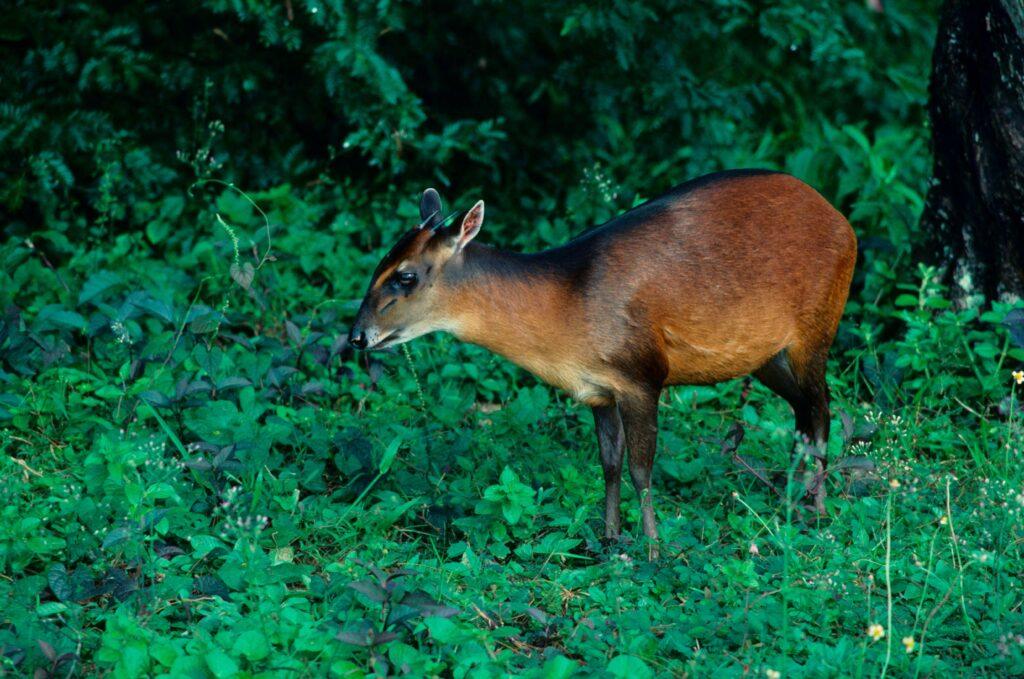
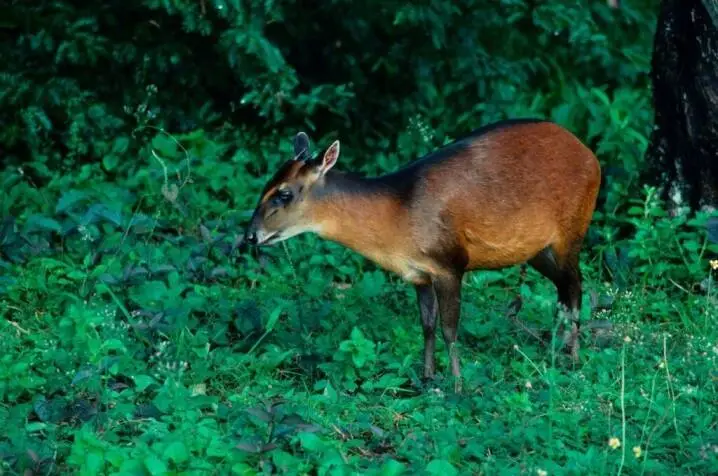
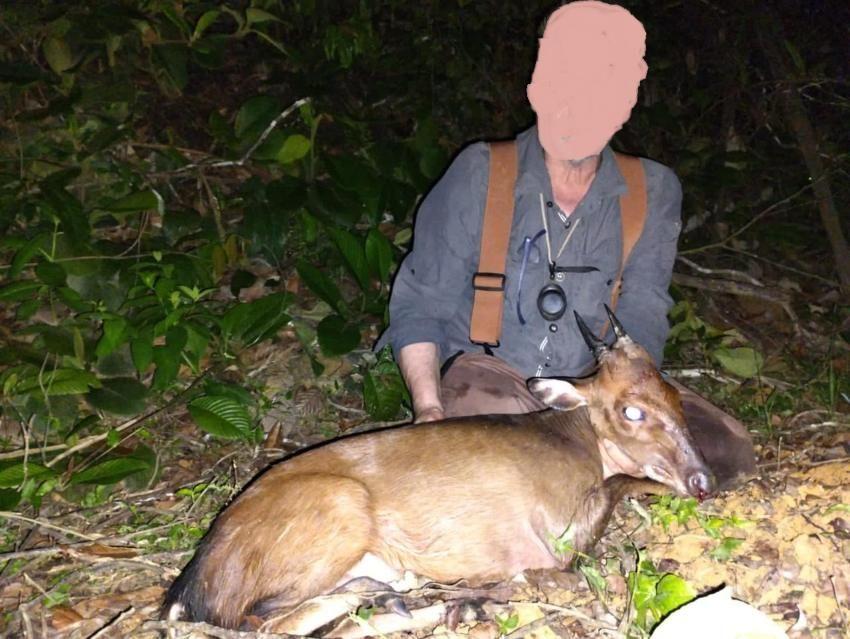
The bay duiker (Cephalophus dorsalis) is a small forest antelope known for its compact build, reddish-brown coat, and distinctive dark dorsal stripe running along its back. The name “bay” refers to its rich reddish coloration, which stands out in contrast to the darker tones of the forest floor.
Unlike larger antelope species found in open terrain, bay duiker are adapted to life within dense rainforest. They move quietly through thick understory, often remaining concealed even when nearby. They are typically solitary, occasionally seen in pairs, and spend much of their time within heavy cover where visibility is limited to only a few meters in places. This behavior, combined with the density of their habitat, makes them one of the more difficult forest antelope to observe, let alone encounter during a hunt. For that reason, they are often of interest to experienced hunters and collectors of forest species, where rarity and the conditions of the hunt are as significant as the animal itself.
They typically stand around 45 to 60 cm at the shoulder and weigh between 18 and 25 kilograms, making them well suited to moving through dense forest cover. They are considered one of the smaller antelope species found in African rainforest environments.
Bay duiker are distributed across Central and parts of West Africa, inhabiting forested regions where dense vegetation provides cover and feeding opportunities. Their range includes countries such as Cameroon, Gabon, Congo, and parts of West Africa, but the quality and continuity of habitat varies significantly.
In Gabon, large, uninterrupted rainforest systems provide one of the most intact environments for forest species. These conditions support a range of small antelope, including bay duiker, within ecosystems where human pressure is relatively low compared to other regions.
They are not animals of open ground. Instead, they are most often associated with dense understory and closed canopy forest, where heavy ground cover and limited visibility define how they move and where they are encountered. Transitional zones along forest edges and natural pathways can also hold animals, though even in these areas visibility remains restricted.
Even in suitable habitat, however, presence does not guarantee visibility. In many cases, the animal may be within close proximity without ever being seen.
Bay duiker are primarily browsers, feeding on a variety of vegetation found within the forest understory.
Their diet includes fallen fruit, leaves, shoots, and other plant material available along the forest floor. In heavy cover environments such as Gabon, feeding patterns are closely tied to seasonal availability and the natural distribution of food sources.
Like many forest antelope, they move quietly between feeding areas, often remaining within thick cover where visibility is limited.
Difficulty in encountering bay duiker is not due to scarcity alone, but to the conditions in which they live. In Gabon’s rainforest, visibility is often measured in meters rather than distance. Thick vegetation, uneven terrain, and limited shooting lanes reduce the chances of spotting movement before it disappears again.
Bay duiker move quietly through this environment, often using established paths or slipping through dense cover where detection is minimal. Encounters rarely develop over time—they happen quickly, and without warning.
In many instances, hunters only become aware of the animal after it is already moving through cover, with only a brief window to react before it disappears. This is not a species that allows for extended observation or deliberate approach. Instead, encounters are shaped by positioning within the forest, awareness of surroundings, and the ability to respond quickly when a short opportunity presents itself.
Even in areas where bay duiker are known to occur, consistent sightings are never guaranteed. That uncertainty is not an exception, it is a defining characteristic of hunting in this environment.
Encounters with bay duiker in Gabon rarely develop in a predictable way.
Most occur while moving through dense forest, often in areas being worked for other species. Visibility is limited, and detection usually happens at close range—sometimes only as the animal is already moving through cover. There is little buildup. A slight movement ahead, a shift in vegetation, or a brief outline crossing a narrow opening may be the only indication before the opportunity disappears. In many cases, the encounter is over within seconds.
This is not a species that presents itself in controlled conditions. Instead, it is encountered as part of the broader rhythm of the forest, where positioning, awareness, and timing matter more than planning. For hunters used to more structured approaches, this can feel abrupt.
It is simply how the environment dictates the experience. Compared to some rainforest hunts in countries like Cameroon, where safaris may follow a more structured pattern, encounters in Gabon tend to feel more fluid and entirely shaped by the conditions on the ground.
Hunting this rainforest is defined as much by conditions as by wildlife.
Humidity is constant, often heavy, and movement through the forest can be physically demanding. Underfoot, terrain shifts between soft, waterlogged ground and dense root systems, with thick vegetation slowing progress and limiting visibility at nearly every step.
Equipment, pace, and positioning are all shaped by these factors. Shots, when opportunities present themselves, are typically taken at close range and often in low light beneath the canopy. There is rarely time to adjust or reassess once an animal is visible. Progress through the forest is deliberate. Communication is controlled, and time in the field is measured not by distance covered, but by how effectively the terrain is worked.
For many hunters, this represents a shift from more familiar environments.
Here, success is not defined by visibility or volume of opportunity, but by the ability to operate consistently within the constraints of the rainforest. Even in well-managed areas, consistent visibility is never guaranteed, and conditions can change quickly depending on rainfall and vegetation density.
A hunting safari in Gabon is defined first by environment, and only second by species.
Time in the field is spent moving through dense rainforest concessions where visibility is limited, movement is deliberate, and progress is dictated as much by terrain as by direction. Within that setting, certain animals naturally take priority, particularly those associated with dangerous game hunts, where tracking, positioning, and sustained focus shape the structure of the safari.
Species such as forest buffalo often define that framework. They influence how areas are approached, where time is concentrated, and how decisions are made throughout the hunt. The overall pace and rhythm of the safari reflect the demands of pursuing animals in dense, low-visibility conditions where encounters are rarely straightforward.
Bay duiker do not occupy that role. They exist within the same environment and are encountered under the same conditions, but they do not determine how the hunt is structured. Instead, they remain part of the broader system, one of several forest species that may present an opportunity while moving through the terrain.
That distinction is important.
In Gabon, a safari is not built around a single outcome, but around operating effectively within a complex rainforest environment. Species such as bay duiker are encountered as part of that process, rather than as the primary focus of it.
Bay duiker are present in many of the same forest systems where hunting takes place in Gabon, but encounters are not consistent.
Unlike species that can be tracked over distance or patterned with some reliability, bay duiker move within dense cover where visibility is limited and sign can be difficult to follow. Even in areas where they are known to occur, they may pass undetected. Because of this, hunts are not typically measured in terms of success rates for this species alone.
Instead, the likelihood of encountering a bay duiker depends on time spent in the forest, the areas being worked, and the overall conditions during the hunt. Extended time in dense rainforest concessions, particularly when pursuing other forest species during hunting in Gabon, naturally increases the chances of an encounter.
For hunters traveling from the United States or other markets where safaris are often structured around a single species, this can feel unfamiliar at first. In Gabon, the experience is shaped less by targeting and more by time spent operating within the environment itself. Bay duiker are not guaranteed.
But they are part of the system, and when encountered, it is usually the result of time, positioning, and conditions aligning rather than a targeted effort.
Bay duiker are one of several small forest antelope found in Central Africa, and are often grouped with other duiker species that occupy similar environments.
What distinguishes them is not only their coloration, but the specific conditions in which they are encountered. Compared to smaller species such as blue duiker, bay duiker tend to move within slightly denser cover and are less frequently seen in transitional areas. Larger species, such as yellow backed duiker, occupy similar forest systems but differ significantly in size and behavior.
Despite these differences, all forest duiker share common traits. They are adapted to low-visibility environments, rely heavily on cover, and are rarely observed for extended periods. Encounters are brief, often at close range, and shaped by the same environmental constraints that define hunting in Gabon more broadly.
Understanding these similarities is useful, but in practice, the distinction between species matters less than the conditions in which they are encountered.
Can you hunt bay duiker in Gabon?
Yes. Bay duiker can be encountered in Gabon’s rainforest concessions, typically as part of a broader safari rather than as a primary objective.
Are bay duiker difficult to hunt?
They are considered challenging due to dense vegetation, limited visibility, and the brief nature of most encounters.
How big are bay duiker?
They are small antelope, compact in build, and well adapted to moving through thick forest environments.
Are bay duiker dangerous or aggressive?
No. They are not classified as dangerous game and typically avoid contact when possible.
Search from our range of Hunts across various popular destinations in Africa.
Book Your Hunt