
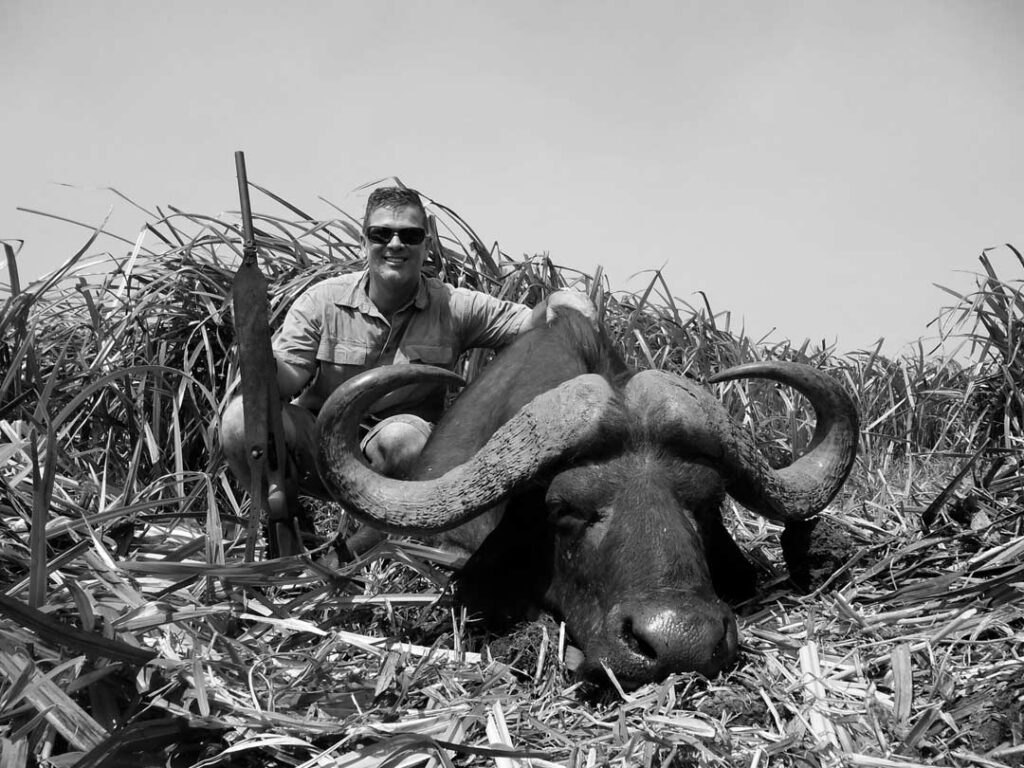
A few years ago, I received a call from an outfitter in northern Mozambique. He had a late-season opening for a Cape Buffalo Hunt near the famous Marromeu Reserve, and the opportunity was simply too good to ignore. After a quick conversation with my good friend Sheldon, we booked the safari, organised a charter flight and started planning another unforgettable adventure. If you've never been Hunting in Mozambique, it's difficult to appreciate just how wild and remote some of these hunting areas still are. This wasn't going to be an ordinary buffalo hunt, it was going to test us from the moment we stepped into the swamps.
[DYNAMIC-BLOGTABLEOFCONTENT]
The Cape buffalo adventure began with thorough planning of all the normal logistics, transport, calibers, firearm permits, and a request to ensure my last will was updated! This is a normal request when, especially Africa’s notorious black death.
We calculated that the best option was to hire a small Cessna five-seater and fly out from Polokwane, South Africa, as in these remote areas, commercial flights are not always available, even when using smaller airlines. Bush landings are not always an option, and flooding in the regions makes the terrain a huge challenge, even in a Toyota Landcruiser. I have fond memories relating to our pilot communicating with the Mozambique air traffic control as we entered the Mozambican air space. “November Charlie Yankee, with four plus one at 20,000 feet with an E.T.A. of one hour coming in from a southerly direction…” and so forth, only to be answered with an “OK” from local authorities!
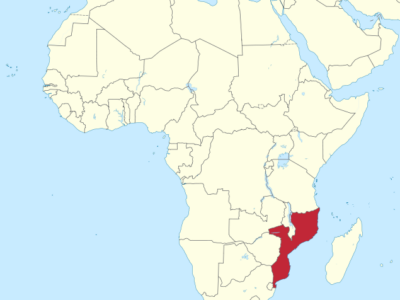
Mozambique's Buffalo Comeback
Big Game Hunting in Mozambique in recent years has become very popular. Since 1994, the number of animals has drastically increased since the nation’s civil war ended in 1992. Cape buffalo numbers had plummeted from an estimated 45,000. Unverified rumors were rife of Russian gunships firing on herds of buffalo, and sending the animals out to the canning ships. The region that once had abundant wildlife, seemed to have fallen victim to the violent struggles for power in Mozambique. Mozambican locals who once operated as poachers are now employed by many outfitters, and their bush skills, knowledge, and tracking are put to good use. Today, Cape buffalo numbers have reached over 50,000, and numbers are classified as particularly healthy. Elephants, lions, leopards, crocodiles, and hippos are readily available in the northern areas.
The cost of a Cape buffalo hunt in Mozambique can vary considerably depending on the concession, safari length, trophy fees and whether the hunt is booked as a standalone dangerous game safari or combined with other species. Before comparing safari prices, it is important to understand exactly what is included, from daily rates and trophy fees to licences, transfers and other costs that can significantly affect the overall investment.
To better understand what influences the overall cost of an African hunting safari, read our guide to African Hunting Safari Prices.
Why Mozambique Feels Different
Northern Mozambique offers a very different style of buffalo hunting from many other parts of Africa. Instead of spending long periods driving between hunting areas, much of the day is often spent on foot following fresh spoor through floodplains, swamps and towering cut grass. Buffalo can disappear into this thick cover within seconds, forcing hunters and trackers to slow the pace and read the bush one step at a time.
The remoteness of these concessions is equally memorable. Vast hunting areas, low hunting pressure and an abundance of dangerous game create the feeling of hunting truly wild country. Every stalk demands patience, every opportunity must be earned and every successful buffalo taken in this environment carries a story worth telling.
Why Cape Buffalo Command Respect
Big game hunting comes with many challenges, disappointments, and rewards. Cape buffalo are considered one of the most dangerous animals in Africa and, in my opinion, have a special place in all trophy rooms. Old bulls known as “dagga” boys, which means “mud” in local dialect are bulls that have left the herd and are generally far more aggressive, and they all seem to have permanently bad tempers.
It is a common saying that a buffalo looks at you as if you owe him a chunk of money, and you are behind on your payments! They are menacing beasts growing up to 2,000 pounds, and are one of the most popular big and dangerous game animals to hunt. Not looking like ancient warriors, buffaloes are often overlooked in favor of carnivorous predators that give the perception of being more dangerous. Do not be fooled, they are exceptionally tough animals.
A buffalo has a top speed of 80 miles per hour and will give you no warning of a charge. Nothing, except a well-placed bullet, will stop the old boy. Cape buffalo hunts are action-packed from sunrise to sunset. A buffalo will find and kill you, the hunter becomes the hunted. It is just that simple.
Cape Buffalo Shot Placement
- Buffalo Shot Placement is a third of the way up directly above the front shoulder, ensuring a heart or double lung shot.
- Head and neck shots should be avoided, as they can potentially be high-risk.
- On a charging buffalo, assuming there is no solid and easily accessible tree to climb, a brain shot is your only option when having to stop him.
- With the head bobbing up and down, and knowing that the brain is only 4.7 inches, the kill shot will need to be 15 yards away.
- The Cape buffalo is responsible for about 200 deaths annually, second only to the hippo.


Choosing the Right Rifle for Cape Buffalo
When planning your big game hunting safari, what is the best caliber to bring is always asked? I would firstly check what your outfitter has available, as in some instances it is a real pain and plenty of admin moving firearms from continent to continent. Of course, you have a special attachment and emotional attachment to “her” which is a totally different ball game!
The .375 caliber is the minimum caliber allowed for big game hunting, including the Cape buffalo. When it comes to buffalo hunting, I believe the bigger the better. Maybe a .416, .458, or a double rifle capable of shooting at least 570 grains at 2,100 feet per second. You cannot have too much stopping power on buffalo hunting in Mozambique.
When it comes to scope or not, terrain generally answers that question. Some buffalo are shot from as far as 200 yards away, and follow up for the “Coup de Grace” at 15 yards. The first prize would be able to switch from a scoped rifle to open sights. If you have any doubts, contact your professional hunter for his advice. He will know what is best.
Fitness Matters More Than Most Hunters Expect
Most hunters spend considerable time choosing the right rifle, calibre and ammunition, yet many underestimate the physical demands of a traditional buffalo hunt. In northern Mozambique, tracking buffalo often means covering long distances on foot through swamps, floodplains and dense cut grass in extreme heat. There are no guarantees that a herd will remain where it was first spotted, and every extra mile can be the difference between success and watching buffalo disappear into the distance.
Looking back, the advice from the outfitter to start training before the safari was some of the best I received. Walking regularly, improving your fitness and becoming comfortable carrying a rifle over uneven terrain will make the hunt far more enjoyable. When the opportunity finally presents itself, you'll appreciate having enough energy left to focus entirely on making a good shot.
Preparing for a Buffalo Hunt
I decided to take my .458 Remington and Loaded 500-grain monolithic tips. As my scope had a 1-8 magnification, I thought I could get a little range as needed, but it would also work if we got up close and personal. Sheldon requested to share my rifle to save paperwork, to which I agreed. The .458 Remington is exceptionally light and comes with quite a serious recoil, of roughly 70 pounds. The outfitter called a few months before the hunting safari and suggested that we practice walking over tough terrain, as we would cover plenty of distance during the hunt. These hunting concessions are huge, and not very accessible except on foot. I took his advice and started doing some buffalo hunting training.
Into the Swamps
The camp had all the usual amenities expected from a remote bush camp. No cell signal except via satellite phone, comfortable rooms, pleasant dining and bar areas. We started day one with a check that the .458 was in and on the money. She was working like a charm. I had packed 100 bullets only to find out that the maximum allowed was 40. Luckily, the local police authorities did not think checking the ammunition was on their to-do list!
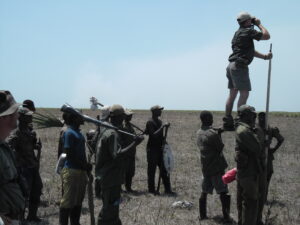
We packed our goods and were ready to leave the camp. We were a group of three hunters, two trackers, a few skinners, and staff allocated to carrying water. I thought one crew member to carry my allocated 20 liters of water was a bit excessive. We were followed at about two hundred yards by at least twenty locals, walking without shoes, food, or water. This party was around just in case we were successful, and they maybe were allocated a few “scraps” of a carcass, as allocated meat was for other local communities. It was heart breaking to see such poverty and desperation. Imagine putting in a full day’s effort while hoping to receive a few grams of intestine, brain, or stomach. Conditions in Africa are brutal.
Buffalo hunting is not for the faint-hearted. The conditions, in my opinion, were horrific or truer to a definition of a proper African buffalo hunt in Mozambique. We walked and crawled through swamps and cutgrass, which ripped at your clothes and skin. Some areas were so flat that we could not see a thing and had to lift members of the hunting group on poles to see what may be ahead.
By noon, I had almost demolished my entire water supply. I had about 5 liters left. Your body loses water quicker than you can replace it. Out here, the blazing sun is your biggest and most dangerous enemy. A short while later, we stopped abruptly, and went down flat, crawling through the cut grass. Ahead of us was a herd of about 600 buffalo strong. We glassed the herd, and the PH pointed out a few possible bulls. Honestly, all the buffaloes seemed to look the same, except obviously for the calves. We started to identify possible bulls by counting ox peckers, body stances, etc. I asked how far out, and the professional hunter said about 200 yards. I thought he was talking nonsense, as he had an interesting sense of humor. He knew I was in at 80 yards, and looked more like 300 yards. This hunting safari was becoming tricky. We agreed on a bull, and I set up my rifle. Taking a deep breath, I aimed and squeezed the trigger. Nothing beats the smell of gunpowder when safari hunting in Africa! The bull did nothing. None of the other 599 buffalo did anything either. I must have missed him by a mile and underestimated the trajectory of the bullet at that distance. My kids always laugh and say I did not miss one buffalo, but 600 buffaloes! Buffalo hunting has a way of humbling even experienced hunters. Distance, excitement and the sheer size of a herd can quickly turn confidence into a valuable lesson.
Luckily the next shot rang true. We heard the solid thud of the bullet and saw the buffalo give a slight dip. The entire herd bolted. In this environment, a wounded buffalo will usually separate from the herd, allowing easier tracking and follow up on any blood spoor. Tracking a wounded buffalo through two meters of cut grass is exhilarating! It is difficult to be silent, and visibility is poor. I suddenly remembered the request to update my will…
One must have the utmost respect for the fearless African trackers. Stalking further through the swamp, the PH suddenly raised his arm and told us to stop. Adrenalin was pumping. He whispered, “I just need to take a pee!” What, in the middle of buffalo stalk?
The Men Behind the Hunt
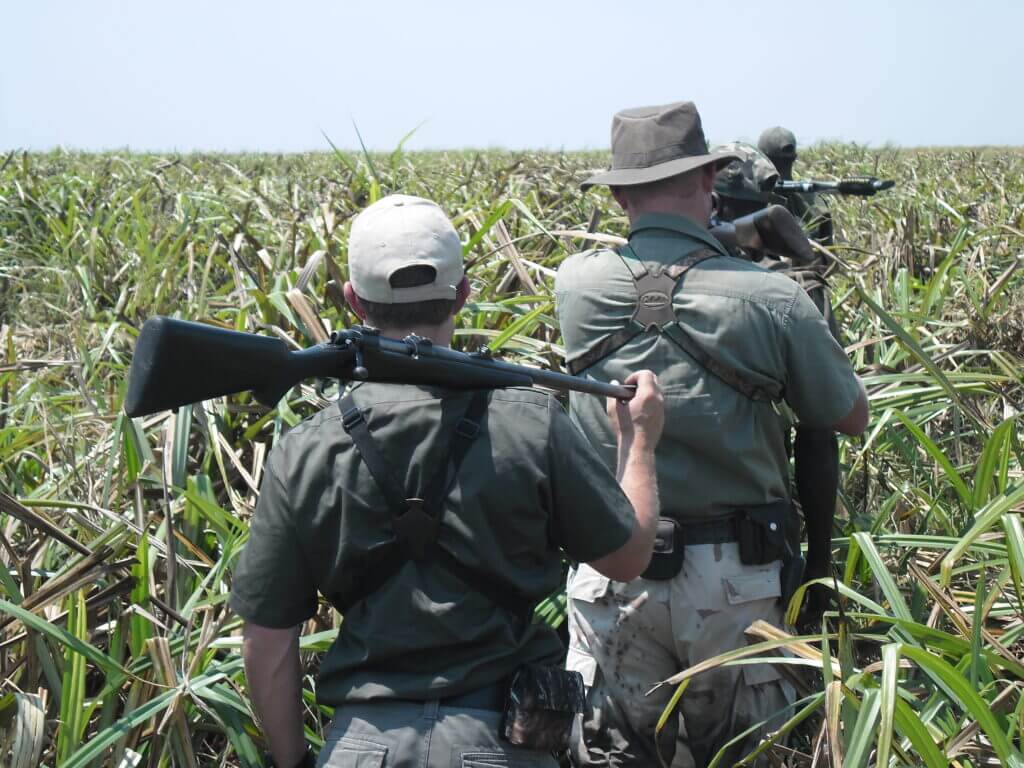
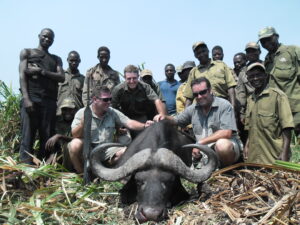
One aspect of the safari that left a lasting impression on me was the skill of the local trackers. Looking at ground that appeared almost impossible to read, they could identify fresh spoor, judge the direction of travel and quietly guide us through country where most hunters would struggle to notice any sign at all.
Tracking buffalo is rarely about following obvious footprints. Broken stems, disturbed grass, the depth of a track in soft mud and even the behaviour of birds can all help build a picture of where the herd has moved. Watching experienced trackers work is a reminder that successful buffalo hunting depends on far more than the rifle in your hands. Their knowledge, patience and ability to read the bush are often what bring hunters within range of an old bull.
We agreed due to poor conditions, that if that buffalo came out charging, we would have limited time available and thought the best strategy would be to all throw lead and try to turn him. That is exactly what happened. We found him about 100 yards out and man, was I happy. This was one of my favorite African hunts.
The .458 drew blood a few more times later that afternoon. The first when the recoil opened Sheldon’s head above the eye, and a few more to bring down his buffalo, our second Cape buffalo for the day. God was smiling down on us.
The walk back seemed like it would never end. At this point, I was delighted about putting in all the miles during the months leading up to the hunting safari. Collapsing near the Land Cruiser at sunset, my water supplies long gone, I realized how privileged I was to have this unique big game hunting experience. The ice-cold beer waiting for us in the middle of the African swamp lands proved again what a dedicated and committed outfitter this was. An absolute legend.
This hunt reminded me of a conversation I had had with the PH while hunting hippos in Namibia. The PH said they are not just professional hunters, but dream makers. Those words have always stuck with me, and this African hunt was a dream come true. Looking back, I realised a successful buffalo hunt is never just about the trophy. It's about the people who make it possible.
That night around the fire, we realized that we had hunted and been successful with both buffaloes on day one of the hunt. Deep down, I know I could not have walked another few days in those conditions.
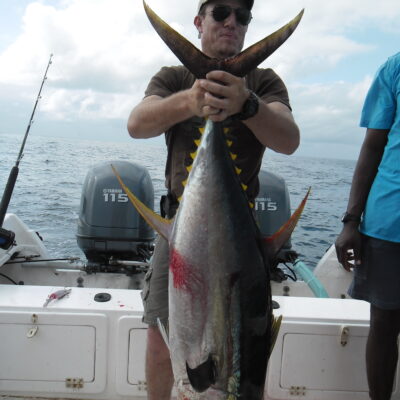
As our little plane was available, we decided that while we were in Mozambique, we might as well go deep-sea fishing. We caught some enormous yellowfin tuna and once again fed happy island residents.
Thinking About Hunting Buffalo in Mozambique?
Looking back, this safari reminded me why buffalo remain one of Africa's most respected dangerous game animals. Every hunt is different, but in the swamps and floodplains of Mozambique, nothing comes easily. Long days on foot, experienced trackers, challenging conditions and moments of pure excitement all combine to create a buffalo hunt that stays with you long after returning home.
If you're considering a buffalo safari in Mozambique, taking the time to plan the right Hunting Trips can make all the difference. The right concession, experienced Professional Hunter and realistic expectations are the foundation of an unforgettable African hunting adventure.
Frequently Asked Questions
Is Mozambique good for Cape buffalo hunting?
Yes. Mozambique is widely regarded as one of Africa's premier Cape buffalo destinations, particularly in the country's northern concessions. Large hunting areas, healthy buffalo populations and traditional spot-and-stalk hunting create a challenging safari that appeals to hunters looking for a genuinely wild buffalo hunt.
How physically demanding is a buffalo hunt in Mozambique?
Buffalo hunting in Mozambique can be physically demanding, especially in areas of floodplains, swamps and dense cut grass. Hunters may cover long distances on foot in hot conditions while following fresh spoor. Spending time improving your fitness before the safari can make the hunt considerably more enjoyable.
What rifle calibre is recommended for buffalo hunting in Mozambique?
The legal minimum calibre for Cape buffalo hunting in many African countries is the .375 H&H Magnum, although many experienced hunters prefer larger calibres such as the .416, .458 or suitable double rifles. Your Professional Hunter can advise on the most appropriate rifle and ammunition for the concession and hunting conditions.
Author:
Pierre van Wyk is the Co-Founder of Game Hunting Safaris and has spent decades hunting and working alongside professional hunters across Africa. Having pursued both plains game and dangerous game in numerous African countries, he writes from firsthand field experience, combining practical hunting knowledge with a strong commitment to ethical, conservation-based hunting. Through Game Hunting Safaris, Pierre helps hunters from around the world plan authentic African hunting adventures with experienced outfitters and Professional Hunters.