
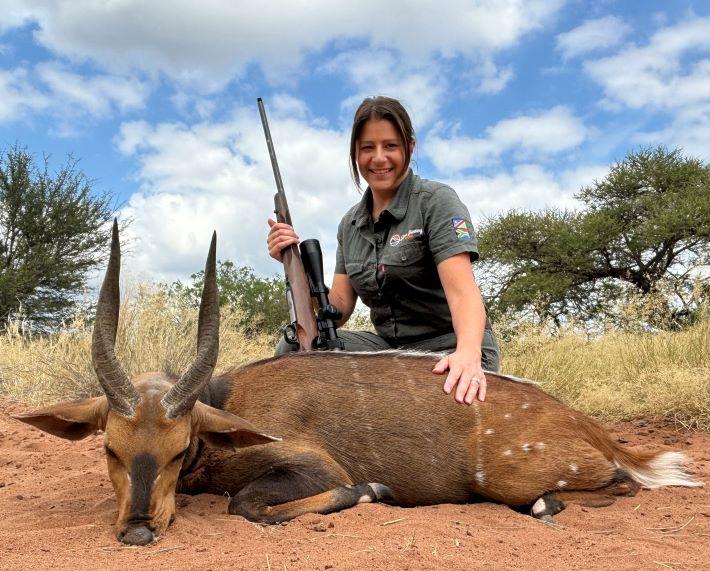
My bushbuck hunt took place in Limpopo, a region of South Africa known for its bushveld, river systems and thick vegetation where these elusive antelope can be particularly challenging to pursue. Hunters considering Hunting in South Africa will find Limpopo offers opportunities for a wide variety of game, but on this particular trip, bushbuck was firmly on my list.
We travelled north from Johannesburg towards our hunting area, watching the landscape gradually change along the way. After several hours on the road, we were getting into the kind of country where bushbuck feel at home: thicker vegetation, riverine areas and plenty of cover in which a mature ram can seemingly disappear.
Anyone familiar with Bushbuck Hunts will know that finding one and getting a shot at one can be two very different things. I knew we would need to hunt quietly, watch the wind and be patient. What I hadn't counted on was a troop of baboons, an unfortunately positioned tree and a rather large spider all becoming part of the hunt.
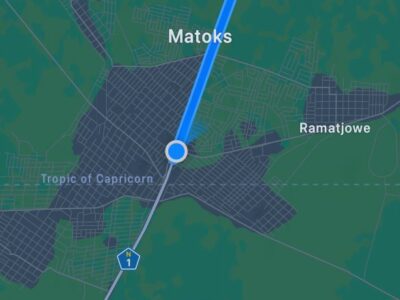
We passed the Tropic of Capricorn. The Tropic of Capricorn is the most southern latitude on the Earth where the sun can appear directly overhead. The Tropic of Cancer is currently positioned at approximately 23.4 degrees north of the Equator. The Tropic of Capricorn is 23.4 degrees south of the Equator. We continued travelling, watching the vegetation change along the way from bushveld to more lush forest like vegetation, where Bushbuck are likely to be found.
Types of Bushbuck
The Harnessed Bushbuck or Northern Bushbuck (Tragelaphus scriptus) and the Cape Bushbuck (Tragelaphus sylvaticus).
The Harnessed or Northern Bushbuck is smaller than the Cape Bushbuck it is a medium-sized antelope, widespread in sub-Saharan-Africa. A Close relative of the Kudu and Nyala, the bushbuck is an antelope which relies on vegetation for cover. The harnessed bushbuck has the most prominent markings on its body and has a clear horizontal line, as well as spots and vertical stripes.
The Cape bushbuck is the most studied species and is found from the Cape in South Africa up to Angola in the west and up through the east side of the continent towards Ethiopia and Somalia. is a lot more varied in coloration throughout its range. Only the genetically oldest populations of Cape bushbuck have clear markings, but none have the distinct horizontal line which is instead broken up into spots. Some Cape bushbuck populations have almost no markings
Bushbuck are the least social of the African antelopes. They are often seen singly, although sometimes small groups of females and their respective young are found. Bushbuck are not territorial, and except for disputes over females in estrus they are not aggressive toward one another, so in areas with good quality habitat there may be several animals in close proximity. Therefore the traditional designation of them as “solitary” is somewhat misleading. These antelope are mainly nocturnal, although they may also be active at dusk and/or dawn. The daytime is spent concealed from predators (which include virtually all carnivores their size or larger) in dense, bushy cover of the type that is usually found near rivers. Bushbuck are found in dense bush at the base of mountains or along river courses, but always close to a permanent water supply.
Bushbuck are among Africa's most distinctive Plains Game Hunts, with several forms occurring across the continent and considerable variation in appearance depending on their range and habitat. They come out at night to feed in more open areas, but never venture far from some type of cover. Bushbuck are very capable swimmers.
Did you know? The very sharp horns render the Bushbuck very dangerous when wounded.
Bushbuck will live anywhere from sea level to mountain-tops in all types of habitats from forest to sub desert terrain. The color varies depending on geographic location. Northern and western bushbuck are reddish colored with stripes and spots. Both sexes darken with age.
Males weigh 40-80 kg and stand 70-100 cm tall.
Females weigh 25-60 kg and stand 65-85 cm tall.
Horns are nearly straight with one twist close to the bottom, 26-57 cm long.
Browsers, bushbuck eat leaves and herbs, twigs and flowers of a large number of plant types. On occasion they will also consume grass.
The bushbuck is primarily nocturnal, but it is also fairly active during the day. Most of the day is spent standing, grazing and feeding and a small amount of time is spent moving about. At dusk bushbuck move toward their night range. Before dawn all bushbuck move back to their day range.
Did you know? When alarmed, individuals react in a variety of ways. If they are in forest or thick bush, they may freeze in one position and remain very still, allowing their coloring to camouflage them. The bushbuck is the only non-territorial and solitary African antelope. Neither males nor the females defend any part of their territory so many territories overlap. So I had my work cut out for me. Bushbuck hunting is not easy and these animals can be very elusive and are very skittish especially if they feel threatened.
How do you hunt a Bushbuck?
Bushbuck hunts are typically on foot, walking and stalking as quietly as possible because as soon as a Bushbuck sees or hears you he is off at a run. One also has to be conscious of the wind as these antelope have a very well developed sense of smell, so we had to walk downwind to prevent him smelling us. Baboons are a nuisance, we came across some of them while stalking a big bull Bushbuck. The baboons saw us first and started running and shouting, spooking off the Bushbuck bull and we had to start all over again.
What type of sounds do Bushbuck make?
The bushbuck barks. They also make a variety of different sounds and calls that are used for communication within their social groups. The bark, which is made by both males and females, is a distinctive, powerful, resonant sound that can travel a considerable distance. It acts as a warning signal to other members of the group of potential risks or the presence of predators.
Bushbucks may emit short, sharp snorts as an extra warning signal when disturbed or startled. Males generate a succession of grunts and groans as part of their wooing display throughout the mating season. These vocalizations are used to attract females and establish dominance over other males in the vicinity.
On the track of the Bushbuck
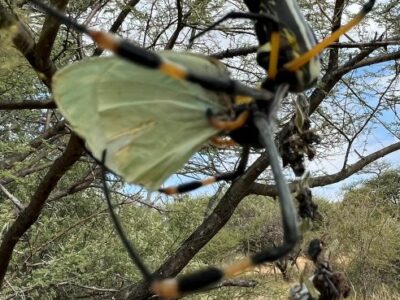
So we were back on the track of my Bushbuck and I nearly died… ok perhaps a bit of an exaggeration… I had a close call with a Golden Orb spider, it was head / face height and I almost waked straight into it. It was eating a butterfly which I saw just before I walked into it. I know, big game hunter and I am still unsettled by spiders but it is what it is and I don’t pretend not to be scared of some of the little (and not so little) critters.
The Bushbuck seemed to be aware of us and was hyper alert after already being spooked by the baboons so we tread as quietly and as quickly as possible. My PH spotted him running and threw out the sticks, my heart started pumping as I positioned the rifle on the shooting sticks, only to find that there was a rather large tree blocking my perfect shot.
What type of rifle is best for Bushbuck Hunting?
I am biased and love my 300 win mag and with this caliber you can shoot almost anything with it. However a 7mm or any 30 caliber rifle will do the trick nicely loaded with 180 grain bullets.
Shot Placement on a Bushbuck
Shot placement on a Bushbuck is the same as any other medium sized antelope and although you have a few options I don’t like taking any type of head shot as they are far too risky and if you get it even slightly wrong you potentially wound an animal that will suffer for an inordinate amount of time before it dies as a misplaced head shot wont kill the animal. I am also not a fan of the “Texas heart shot” my go to is always a third of the way up on the body, that way if you are even slightly off you potentially hit and break the leg and invariably hit the lungs or a piece of the heart. The third of the way up on the body following the front leg, is always a good bet.
The Bushbuck Hunt continues..
I am off again stalking my Bushbuck, after baboons and trees I was determined that I would not loose track of this Bushbuck. So we are tracking again, find him and set up sticks, he jumps up and runs. Thankfully not far and stops with his head down, I can see him in the scope and I’m all ready to go.
I’ve mentioned my reluctance to take a “Texas Heart Shot” and Murphy’s law when I finally get the bushbuck in my sights what option is presented….. yes, he was standing facing away. At this point it is very useful to have an experienced PH who is quietly talking to you as he is also looking through the bino’s. John says quietly to me “you see him?” I say yes but his head is down and I can only see his butt, John says wait… wait… he will lift his head ( a good PH is familiar with animals behavior and can, for the most part predict an animals next move) and next moment my Bushbuck lifts his head and is standing in the quartering away position, I can see his shoulder and take the shot.
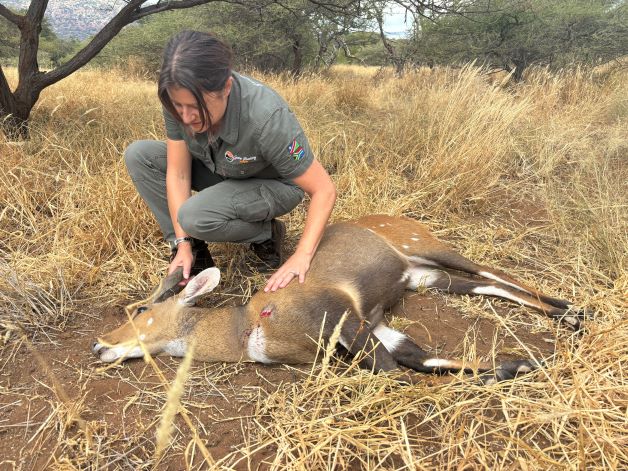
I took the shot and it was nicely placed on the shoulder, the 300 went right through nicked the heart and exited on the front left of the Bushbuck. He went down without any trouble. But still I was very cautious when approaching him.
A Bushbuck Hunt I Won't Forget
Looking back, this bushbuck hunt became memorable for far more than the final shot. Between the baboons sounding the alarm, the stalks that didn't work out and the obstacles that seemed to appear at exactly the wrong moment, it was one of those hunts where finally getting an opportunity felt properly earned.
That is often what stays with you after a safari. The hunts that don't go exactly according to plan usually produce the stories you remember best. When comparing Hunting Trips across Africa, sometimes it is worth leaving a little room in the plan for the unexpected.
Frequently Asked Questions
Are bushbuck difficult to hunt?
Bushbuck can be challenging to hunt because they spend much of their time close to thick vegetation and can disappear quickly when disturbed. Wind direction, quiet movement and patience all become important when stalking a mature ram.
What happens when a bushbuck is spooked during a stalk?
A disturbed bushbuck may retreat quickly into thick cover, sometimes bringing the stalk to an immediate end. As we discovered on this hunt, other animals such as baboons can also alert game to the presence of hunters before they have an opportunity to get within range.
What rifle is suitable for hunting bushbuck?
Bushbuck can be hunted with several commonly used plains game calibers. An accurate rifle that the hunter knows well is generally more important than choosing an unnecessarily powerful caliber, particularly when a precise shot may need to be taken quickly.
Are wounded bushbuck dangerous?
A wounded bushbuck should always be approached cautiously. Mature males have sharp horns and can be dangerous at close range when wounded or cornered, particularly in the thick vegetation they commonly inhabit. Hunters should follow the instructions of their Professional Hunter when approaching or following up any wounded animal.
About the Author: Tamlyn van Wyk is the Co-Founder of Game Hunting Safaris and an experienced African hunter. She writes from firsthand experience in the field, sharing practical insights from hunting trips across Africa.