
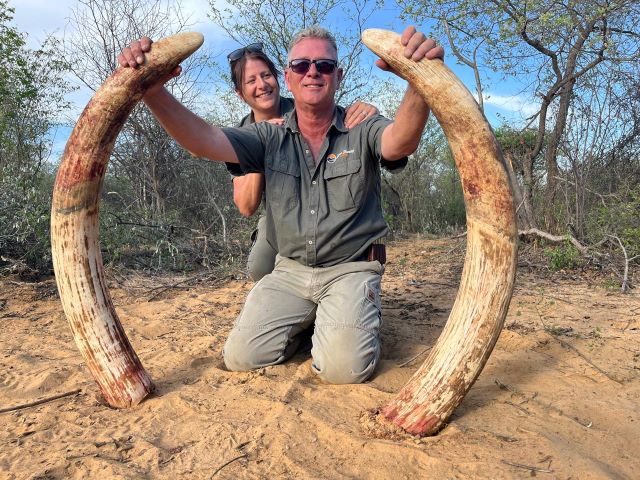
An experienced professional hunter can make a good estimate of an elephant's ivory while the bull is still standing. He has probably spent years looking at tusks, judging their length, thickness and the amount of ivory visible beyond the lip. But even the best PH is making an educated guess. The actual weight is only established once the tusks have been removed and put on a scale.
That difference can matter more than a hunter might expect. Even where the trophy fee is agreed before the safari, the recorded weight remains important for official documentation, export arrangements and recognised trophy records. And where an outfitter does use ivory-weight categories, a few pounds either way could make a difference to the final bill.
It is one of those practical details worth understanding before booking an elephant hunt in Zimbabwe. Who weighs the tusks? Is the weight recorded in camp the one that counts, or is there a subsequent official measurement? And if the figures differ, which weight becomes the official record of the ivory?
The PH's Estimate Is Not the Final Weight
There is a good reason experienced elephant hunters pay attention to more than the length of a bull's tusks. Two elephants can carry ivory that looks much the same from a distance, yet the weights may be quite different. One bull might have relatively long, slender tusks, while another carries shorter, heavier ivory with more thickness through the base. Length alone tells only part of the story.
There is also a portion of each tusk that cannot be seen while the elephant is alive. The ivory extends back into the skull, and the amount concealed is not something a PH can measure while judging a bull in the field. Even with years of experience, he is estimating the weight of something he cannot see in its entirety.
A PH might suggest that a bull carries ivory in a particular weight class, but the scales may tell a different story once the tusks have been removed. Sometimes the estimate will be remarkably close. On other occasions, the difference may surprise everyone involved.
What Happens to the Tusks After the Hunt?
Removing an elephant's tusks is a job that calls for patience as much as experience. The ivory is held firmly within the skull, and attempting to force it out before it is ready risks damaging something the hunter and PH have spent considerable time pursuing.
Where circumstances allow, one approach is to leave the head in a secure location for several days, allowing the surrounding tissue to break down until the tusks can be worked free. Much depends on where the elephant was taken, the conditions at the site and whether the head can be safely left undisturbed. Where waiting is impractical, the hunting team may instead carefully remove the surrounding bone and tissue to extract the ivory sooner. A misplaced blow or cut can leave permanent damage to a tusk.
Once the ivory has been removed, attention turns to the hollow pulp cavity at the base of each tusk. The size of that cavity varies, and it helps explain why two tusks with similar outside dimensions may contain quite different amounts of solid ivory. Remaining tissue within the cavity must also be dealt with during preparation. When the tusks have been allowed to loosen naturally, this material may be easier to remove than when they are extracted soon after the hunt.
The first weighing may take place before the tusks have completed their cleaning and drying. Some hunting operations have scales available in camp, allowing the hunter and PH to establish a preliminary weight. As the ivory is cleaned and loses moisture, its weight can change. The amount depends on the individual tusks and their condition, so an early reading should not automatically be treated as the weight that will appear on every subsequent record.
There is also the matter of units. American hunters generally discuss elephant ivory in pounds, while Zimbabwe's official records use kilograms. That conversion is straightforward, but the way weights are recorded or rounded can become important when comparing measurements, particularly where a hunting agreement specifies trophy-fee bands.
The question then becomes what happens when the ivory leaves the hunting camp. The initial weight may be of considerable interest to the hunter, but Zimbabwe has its own requirements for registering and identifying elephant ivory, separate from the measurements used by international trophy-record organisations.
How Zimbabwe Registers and Marks Elephant Ivory
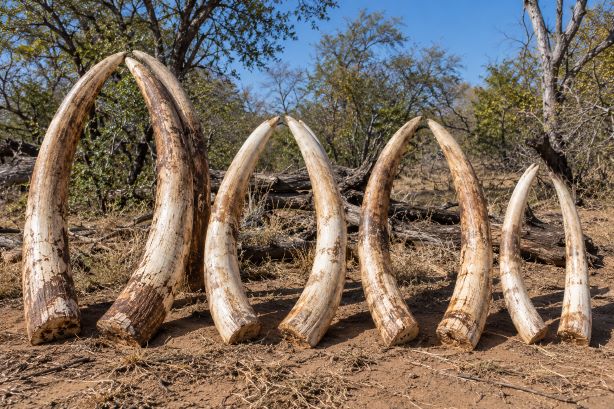
An elephant's tusks do not simply leave a Zimbabwe hunting concession with a handwritten weight and the hunter's name attached. There is an official registration process intended to identify the ivory, establish its lawful origin and create a record of the individual tusks.
Under Zimbabwe's Parks and Wild Life (General) Regulations, 1990, section 77 provides for the registration of raw ivory by a specified officer. The regulations establish a 15-day period for presenting newly acquired unregistered ivory for registration, subject to the applicable legal provisions. The officer must be satisfied that the ivory was lawfully obtained before registering and marking it and issuing a certificate of ownership.
The official identification is important because each tusk needs to remain identifiable after it leaves the hunting area. The certificate records each tusk's serial number, weight in kilograms, length in centimetres and the sex of the elephant. Those details help identify the individual tusks and provide an official record that can be checked against the ivory itself.
The ivory must also carry identifying marks. Zimbabwe's regulations provide for distinctive markings, while international requirements specify additional information, including the country code, harvest year, serial number and weight. These markings help connect the physical tusks to their accompanying documentation.
For an American hunter, those identifying marks remain relevant long after the safari has ended. Under 50 CFR §23.74, African elephant trophy ivory must carry specified identification information. Accurate markings and supporting documentation are important when the ivory is presented for international movement, although they do not replace the separate permits and approvals required for lawful importation into the United States.
For hunters interested in record books, there is another consideration. The weight recorded during Zimbabwe's registration process is not necessarily the same as a later record-book measurement.
Rowland Ward's elephant measuring rules require a minimum drying period of 60 days from the date the trophy was collected. Its elephant scoring system considers the weight of both tusks, and the measurement must follow its prescribed procedures.
Safari Club International handles elephant ivory somewhat differently. Its June 2026 policies allow stamped ivory weights or accepted export documentation to support elephant entries, even where the usual 60-day drying period is not reflected in the recorded weights.
A pair of tusks can therefore have an early camp weight, a registered weight and a later record-book measurement, each established for a different purpose. None should automatically be treated as the figure used to calculate the hunter's trophy fee. That depends on the hunting agreement.
How Are Elephant Trophy Fees Agreed in Zimbabwe?
On many elephant hunts in Zimbabwe, the hunter agrees to a trophy fee before the safari begins. If the agreement provides for a fixed fee, that is what the hunter pays, whether the bull eventually carries 35-pound tusks or something much heavier. Finding an exceptional elephant does not automatically mean receiving a larger bill.
The outfitter's financial obligations to the concession holder or wildlife authority are separate from the trophy fee agreed with the hunter. What the outfitter pays and what he charges his client do not necessarily follow the same pricing arrangement.
How an outfitter structures his prices is a commercial decision, subject to the conditions under which he operates. Some Zimbabwe elephant hunts are advertised with different trophy fees according to anticipated ivory weight. Others are offered at a fixed fee, regardless of what the bull eventually carries. Neither approach should come as a surprise to the hunter once the safari has begun.
Where the trophy fee is fixed, the recorded ivory weight will not ordinarily change what the hunter owes. It remains important for registration, identification, export documentation and any subsequent record-book entry. Where the agreement uses weight categories, however, the hunter should know which tusk or measurement determines the price, and what happens if the final weight falls outside the anticipated category.
What Should the Hunter Have in Writing?
Most hunters spend plenty of time discussing the hunting area, the chances of finding a good bull and what the safari will cost. Those planning a hunting safari in Zimbabwe should also understand what happens to the ivory after the hunt. It is worth having that conversation with the outfitter before leaving home, particularly if the tusks are intended for export or entry into a recognised record book.
Start with the trophy fee. If it is a fixed amount, the agreement should make that clear. If the outfitter uses ivory-weight categories, the hunter should know which measurement determines the price and what happens when the actual weight differs from the original estimate. Neither arrangement is complicated when everyone understands it beforehand.
The hunter should also know who is responsible for arranging the official weighing, registration and subsequent documentation. Will the outfitter provide the recorded weights and identification details once the ivory has been registered? If the tusks are going to a taxidermist or dip-and-pack facility, who will keep the hunter informed as they move through the process?
For an American hunter, it is also worth confirming who will coordinate the Zimbabwe export documentation and what responsibilities remain with the hunter and his U.S. import agent. An officially registered pair of tusks is not, by itself, a guarantee that the ivory can legally enter the United States.
None of this needs to become a lengthy negotiation. A few clear answers before the safari can prevent confusion afterwards. The PH's judgment tells you what you may be looking at in the field, but the records establish what was taken. Knowing who is responsible for those records is simply part of planning a properly organised elephant hunt.
Frequently Asked Questions About Elephant Tusk Weights
When Hunters Refer to a 50-Pound Elephant, Is That Per Tusk or Both Tusks Combined?
When an elephant hunter talks about a 50-pound bull, he generally means tusks weighing around 50 pounds a side, often going by the heavier tusk, not 50 pounds between them. The two tusks rarely weigh exactly the same, and an elephant described as a 50-pounder might have one tusk weighing 53 pounds and the other 47 pounds.
For official records and trophy measurements, the individual weight of each tusk matters. It is always worth asking whether a quoted ivory weight refers to the heavier tusk, an estimated average or the combined weight of both tusks.
Can an Elephant Qualify for Rowland Ward If One Tusk Is Much Heavier Than the Other?
Yes. Rowland Ward's record-book requirements for African savanna elephant recognise qualifying weights for either an individual tusk or the combined weight of both tusks. Under its published minimums, a single tusk weighing at least 70 pounds or a pair with a combined weight of at least 120 pounds can meet the weight threshold.
This means an elephant with one exceptionally heavy tusk may qualify even when the other is smaller or has been damaged. The tusks must still meet Rowland Ward's applicable measurement, identification and entry requirements.
About the Author
Pierre van Wyk is the co-founder of Game Hunting Safaris, specialising in African hunting safaris. Drawing on his personal hunting experience and close relationships with professional hunters and outfitters across Africa, he provides practical advice to help hunters make informed decisions when planning their safaris.
Professional Hunter Review: The Zimbabwe elephant-hunting procedures described in this article were reviewed by Lindon Stanton of Mbalabala Safaris, an established Zimbabwe hunting operation dating back to 1987.