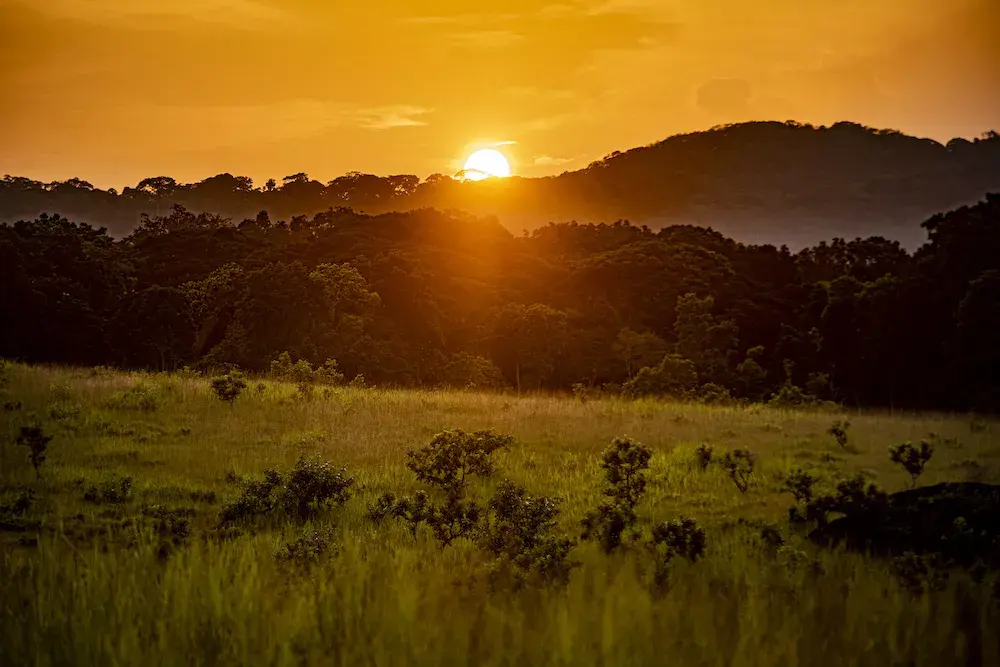
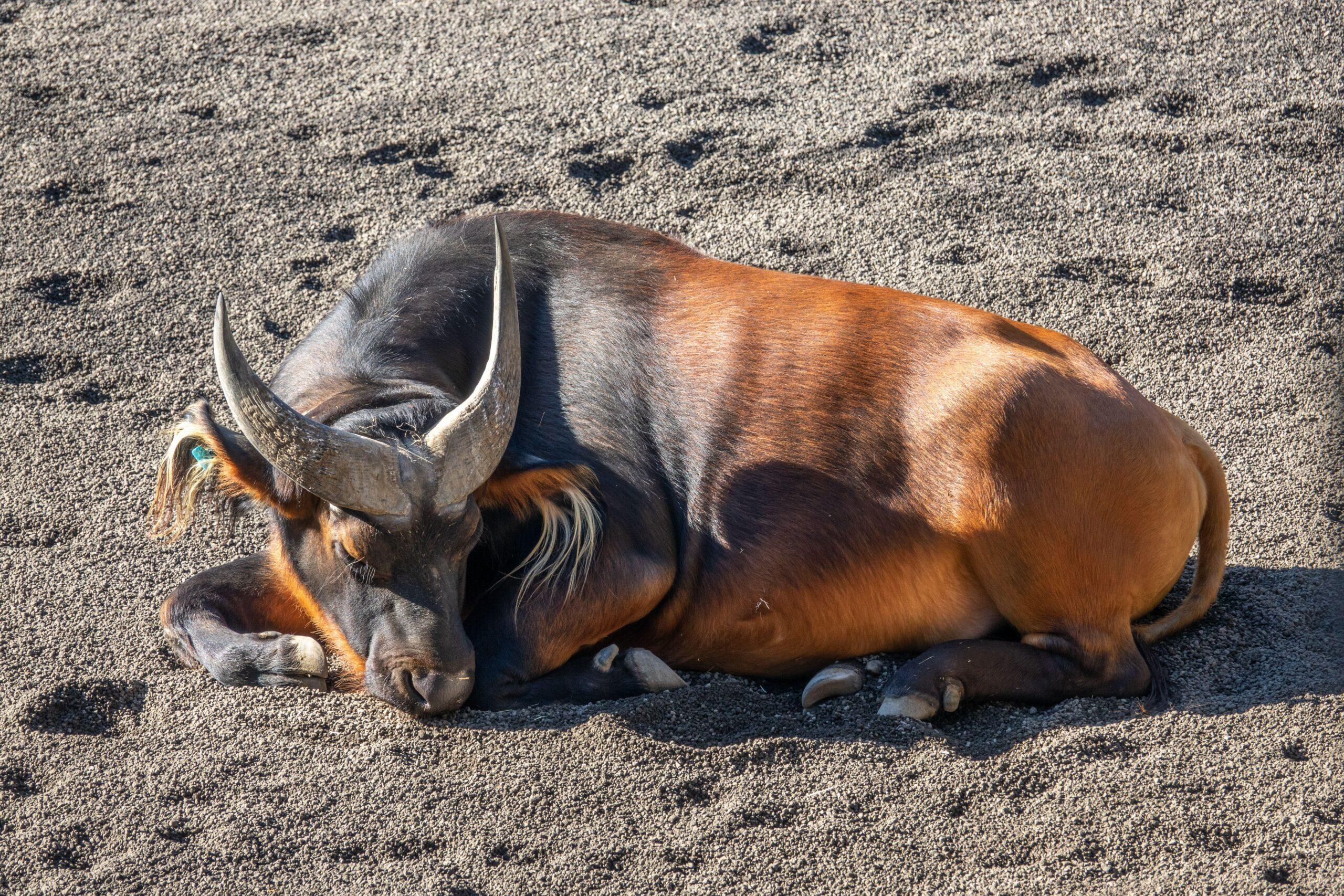

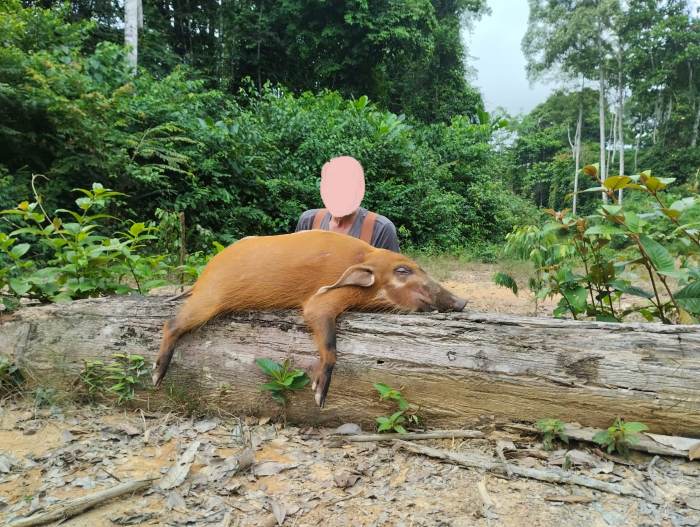
13-Day Dwarf Buffalo, Sitatunga & Forest Game Safari in Gabon
Booking Season: 2026
Hunt Difficulty: Difficult

Forest buffalo hunting in Gabon is not what most hunters picture when they think about buffalo in Africa.
There are no wide floodplains, no long glassing sessions, and no predictable herd movement across open ground. What you find instead is dense, layered rainforest—low visibility, heavy cover, and animals that spend most of their time inside it. That difference matters from the start. Most hunters arrive expecting a version of Cape buffalo hunting, what they find is something far less predictable.
Within the broader structure of hunting in Gabon, safaris are shaped by terrain first and species second. Forest buffalo exist inside that system, moving through thick vegetation and swamp margins where encounters are close, often brief, and rarely planned in the way most buffalo hunts are.
This is not a variation of Cape buffalo hunting. It is a different hunt entirely, one defined by environment, not expectation.
Available Forest Buffalo Hunts
13-Day Dwarf Buffalo, Sitatunga & Forest Game Safari in Gabon
Booking Season: 2026
Hunt Difficulty: Difficult
The forest buffalo is a smaller, darker subspecies of African buffalo found across the dense rainforests of Central and West Africa. In Gabon, it occupies some of the least disturbed habitat remaining on the continent, and its behavior reflects that environment. These animals are not built for open country.
They live in tight, low-visibility terrain, thick forest, swamp edges, and narrow clearings where movement is restricted and cover is constant. Herd sizes are typically smaller than those seen in savanna systems, and animals tend to use vegetation more deliberately, holding inside cover rather than moving across exposed ground. That changes how they are encountered.
Unlike Cape buffalo, which are often located at distance and approached with time to plan, forest buffalo are more likely to be found at close range. Visibility may be measured in meters, not hundreds of yards, and animals can disappear into cover almost immediately if pressured. They are also less predictable in how they use the landscape.
Movement is influenced by subtle changes in water, pressure, and feeding conditions within the forest. There are no consistent “setups” in the traditional sense—no open riverbanks or grazing patterns that can be relied on day after day. For hunters coming from more familiar buffalo environments, this is where the adjustment begins. The animal is still buffalo, still dangerous, still capable of reacting aggressively, but the conditions under which it is hunted are very different.
This is where most confusion starts, and where most expectations go wrong.
On paper, forest buffalo and Cape buffalo belong to the same species group. In the field, they behave differently enough that the hunt itself changes.
Cape buffalo hunting is typically associated with more open environments, savanna, woodland, or floodplain systems where animals can be located at distance and approached with some level of control. Visibility allows for planning, repositioning, and clearer shot opportunities. Forest buffalo remove most of that.
In Gabon, visibility drops, movement slows, and the environment begins to dictate every decision. You are not glassing animals across open ground. You are working through vegetation, following sign, and closing distance without knowing exactly when or where the encounter will happen. That uncertainty carries through to the final stages of the hunt. Shot opportunities tend to be shorter, angles less defined, and positioning harder to control. Encounters can develop quickly, sometimes with limited warning, and the margin for hesitation is smaller.
What does not change is the level of danger. If anything, reduced visibility and tighter terrain increase it. A buffalo encountered at close range, inside cover, is not a lesser animal. It is simply being hunted in conditions that favor it more than they favor you.
That is the real difference, not the species alone, but the environment it lives in.
Another point of confusion comes from how buffalo are classified across Africa, particularly in West and Central regions. Forest buffalo are not the same as the buffalo found in West African savanna systems, even though they are closely related.
Both fall under the broader African buffalo species, but they occupy very different environments. Forest buffalo are adapted to dense rainforest, where visibility is limited and movement is restricted. By contrast, West African savannah buffalo live in more open woodland and grassland environments, where herds can be observed and approached with greater visibility. That difference in habitat affects how they behave.
Savannah buffalo are more likely to be encountered in larger groups and in terrain that allows for longer-range observation. Forest buffalo tend to remain within cover, move through tighter spaces, and rely more heavily on vegetation for concealment. This matters less for classification and more for how the hunt unfolds.
A buffalo in open country allows for time, planning, and adjustment. A buffalo in dense forest does not. That is why forest buffalo hunting in Gabon feels fundamentally different—not because the animal is unrelated, but because the environment shapes everything around it.
Within the broader landscape of African buffalo hunting, Gabon occupies a very narrow and often misunderstood position.
Most buffalo hunts take place in southern and eastern Africa, where Cape buffalo are pursued in more open environments. Countries like Tanzania, Zimbabwe, and Mozambique offer established systems built around visibility, access, and a degree of predictability. Hunters can locate animals at distance, plan approaches, and work within terrain that allows for adjustment.
Gabon operates outside the structure of most traditional African buffalo safaris and has become increasingly respected amongst hunters seeking authentic dangerous game hunts within remote rainforest environments. Very few areas in Africa still offer buffalo hunting under these conditions where thick equatorial forest, swamp margins, and dense vegetation dictate every aspect of the hunt.
Here, buffalo hunting takes place within vast rainforest concessions where terrain, not species sets the terms. Movement is slower, visibility is extremely limited, and access through the forest can be physically demanding. Animals exist within large, intact wilderness areas where encounters are far less predictable than in open savanna systems, making each opportunity hard-earned and entirely dependent on the realities of the environment.
Gabon is not designed to compete with traditional Cape buffalo destinations, and that difference is exactly what defines its value
Most hunters approach buffalo hunting with a clear picture in mind.
Wide terrain. Glassing from distance. Herds that can be located, followed, and approached with time to plan the final stages of the hunt. Even when conditions are challenging, there is usually a degree of visibility and structure that allows decisions to be made with some control. Gabon removes most of that.
In rainforest conditions, visibility collapses quickly. There are no extended sightlines, no elevated vantage points, and no reliable way to observe animals before committing to an approach. Movement is guided by terrain and sign, not by what can be seen ahead. Encounters develop differently. Instead of building toward a planned opportunity, they tend to appear suddenly, often at close range, sometimes with limited warning. A herd may be detected through sound, movement, or sign before it is ever clearly visible. By the time a shot presents itself, there is rarely time to adjust or reposition.
That shift changes the entire feel of the hunt. What is methodical elsewhere becomes reactive here. Success depends less on setup and more on awareness, positioning, and the ability to respond when a brief window opens.
In Gabon, the terrain dictates the pace from the moment the hunt begins. There is no covering ground quickly or scanning large areas for movement. Progress is controlled, often slow, and shaped by the structure of the forest itself. Hunters move along natural lines, game trails, swamp edges, and narrow clearings where visibility opens just enough to read sign and move forward. Tracking is the foundation of the hunt.
Sign is rarely obvious. Tracks can be broken by soft ground, water, or vegetation, and progress often depends on small details, disturbed soil, bent stems, or subtle shifts in how the forest has been recently used. It is not always clear where animals are going, only that they have passed through. As distance closes, everything tightens.
Wind becomes harder to read under canopy. Sound carries unpredictably. Movement slows further, and communication becomes minimal. In many cases, hunters know they are close before they ever see the animals. When contact happens, it happens quickly. In many cases, you hear the animal before you see it—movement in heavy cover, a branch shifting, or the sound of something larger than expected moving just ahead
A buffalo may appear through gaps in vegetation, partially visible, moving or standing within cover. There is rarely a perfect angle or a clean, open shot. Branches, shadow, and uneven ground all affect what is possible in the moment. Opportunities are short. There is usually a narrow window to identify the animal, confirm position, and take the shot. Waiting too long often means losing the chance entirely as the animal moves back into cover. This is where the hunt separates itself most clearly.
It is not about distance or visibility. It is about handling close-range situations where the environment limits time, space, and margin for error.
Buffalo are already classified as dangerous game. In Gabon, the conditions amplify that classification. The risk does not come from size alone—it comes from proximity and environment.
In dense forest, encounters happen closer. At that distance, there is very little separation between observation and reaction—what you see is often already within range. Visibility is restricted, and animals can move through cover in ways that limit reaction time. A buffalo that decides to stand, circle, or push back does so in terrain where movement is constrained and options are limited.
That changes how every approach is handled. There is less room to reposition, less time to assess, and fewer clear shooting lanes. Decisions need to be made quickly, often with partial visibility and imperfect angles. Proper shot placement becomes critical, not only for a successful hunt but also for safety when following wounded buffalo in dense rainforest cover. Hunters unfamiliar with dangerous game are strongly advised to study the fundamentals of ethical shot placement for hunting game in Africa before undertaking a forest buffalo safari
Tracking a wounded buffalo in thick cover requires discipline, control, and a clear understanding of how the animal may behave. The environment reduces visibility and increases uncertainty, making every step forward deliberate. This is why forest buffalo hunting is firmly within the category of dangerous game hunts. Not because it is exaggerated, but because the conditions consistently place the hunter closer to the animal, with fewer advantages and less margin for error.
Seasonal timing in Gabon affects the hunt through terrain more than through buffalo presence. Forest buffalo remain within their habitat year-round, but the way hunters move through that habitat changes with rainfall, water levels, and vegetation density.
During drier periods, movement becomes more manageable. Ground conditions improve, trails hold shape more clearly, and tracking becomes more reliable. Even small reductions in vegetation can make a noticeable difference in visibility. Water systems also become more defined, which can help concentrate movement and make patterns slightly easier to interpret.
In wetter periods, the environment shifts. Swamp systems expand, ground softens, and access to certain areas becomes more difficult. Vegetation thickens, further reducing visibility and increasing the likelihood of close-range encounters with limited warning.
These conditions do not stop the hunt, but they change how it unfolds. Timing, in this context, is less about targeting a specific month and more about understanding how environmental conditions influence movement, access, and visibility. In rainforest hunting, even small changes in these factors can have a meaningful impact.
Forest buffalo are rarely hunted in isolation in Gabon. Instead, they form part of a broader rainforest hunting system, where multiple species are pursued within the same concession. This reflects how safaris are structured across the country, time in the field is prioritized over single-species outcomes, and encounters develop as part of a wider experience.
Within that structure, forest buffalo sit firmly in the category of dangerous game hunts. They are not encountered in high numbers, and hunts are not built around volume. Instead, they are pursued alongside other forest species, often within the same areas where movement, tracking, and positioning define the overall pace of the safari.
For hunters planning a trip, this is where understanding hunting in Gabon becomes important. The environment shapes everything, from species encountered to how each day unfolds in the field.
Hunting in Gabon operates within a regulated system designed to balance access with long-term conservation across large, intact concession areas. Rather than being open or loosely structured, hunting is controlled through licensed zones, defined quotas, and oversight at both concession and national levels. This framework ensures that wildlife is managed within clear limits, with pressure kept low across the areas where hunting takes place.
Forest buffalo exist within this system, but they are not treated as a high-volume species. Opportunities are limited and tied directly to specific concessions, as well as broader conservation priorities that shape how wildlife is managed in the country. For visiting hunters, particularly those traveling from the United States, this means access is not something arranged casually. Hunts are conducted through established operators who understand the regulatory environment and work within it. Permits, logistics, and in-country arrangements are handled as part of that structure.
Availability is controlled rather than flexible, and participation depends on how hunting is organized within Gabon as a whole.
This is not a hunt suited to everyone.
Forest buffalo hunting in Gabon tends to appeal to hunters who already have experience in Africa and are looking for something less conventional. It suits those drawn to rainforest environments, where the pace is slower, visibility is limited, and the outcome is never guaranteed in the way it often is in more structured hunts. It also fits naturally within safaris built around multiple forest species, particularly for clients interested in pursuing dangerous game under more demanding conditions.
At the same time, it is not an ideal starting point for first-time African hunters expecting a traditional buffalo experience. Those looking for frequent opportunities, clear visibility, or predictable setups are unlikely to find that here. The conditions are different, and the hunt reflects that from start to finish. What draws people to this hunt is not volume or simplicity, but the environment itself—and the challenge of operating within it.
Forest buffalo hunting in Gabon is defined less by the animal itself and more by where it lives. The species is present, the habitat remains intact, and the conditions are among the most demanding found anywhere in Africa. At the same time, this is not a hunt built around predictability or repetition.
Encounters are limited, visibility is restricted, and success depends on how effectively a hunter can operate within the constraints of dense rainforest terrain. For those who understand what that means, and are willing to adapt to it. It represents one of the more specialized forms of dangerous game hunting still available in Africa today.
Can you hunt forest buffalo in Gabon?
Yes. Forest buffalo can be hunted within licensed concessions under regulated conditions, though availability is limited and controlled through quota systems.
Is forest buffalo the same as Cape buffalo?
No. While they belong to the same species group, forest buffalo are smaller and live in dense rainforest environments, which significantly changes how they are hunted.
How difficult is forest buffalo hunting in Gabon?
It is considered highly challenging due to limited visibility, dense terrain, and the close-range nature of encounters.
What makes buffalo hunting in Gabon different from other African safaris?
The rainforest environment removes visibility and predictability, creating a more reactive, close-range hunting experience compared to traditional buffalo hunts in open terrain.
Is forest buffalo considered dangerous game?
Yes. Despite being smaller than Cape buffalo, forest buffalo are still classified as dangerous game, particularly due to close-range encounters in dense cover.
When is the best time to hunt forest buffalo in Gabon?
Drier periods generally improve access and tracking conditions, though buffalo remain present year-round within rainforest systems.
Search from our range of Hunts across various popular destinations in Africa.

Book Your Hunt