
Africa Hunting Trip for Dwarf Buffalo & Sitatunga Cameroon
Booking Season: 2026
Hunt Difficulty: Difficult

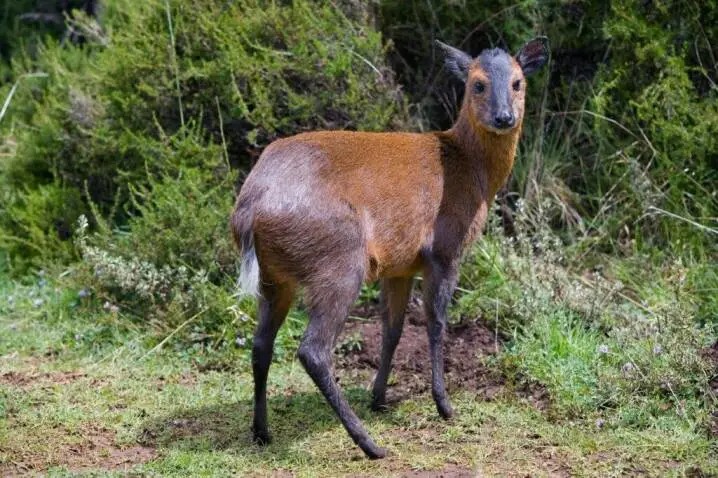
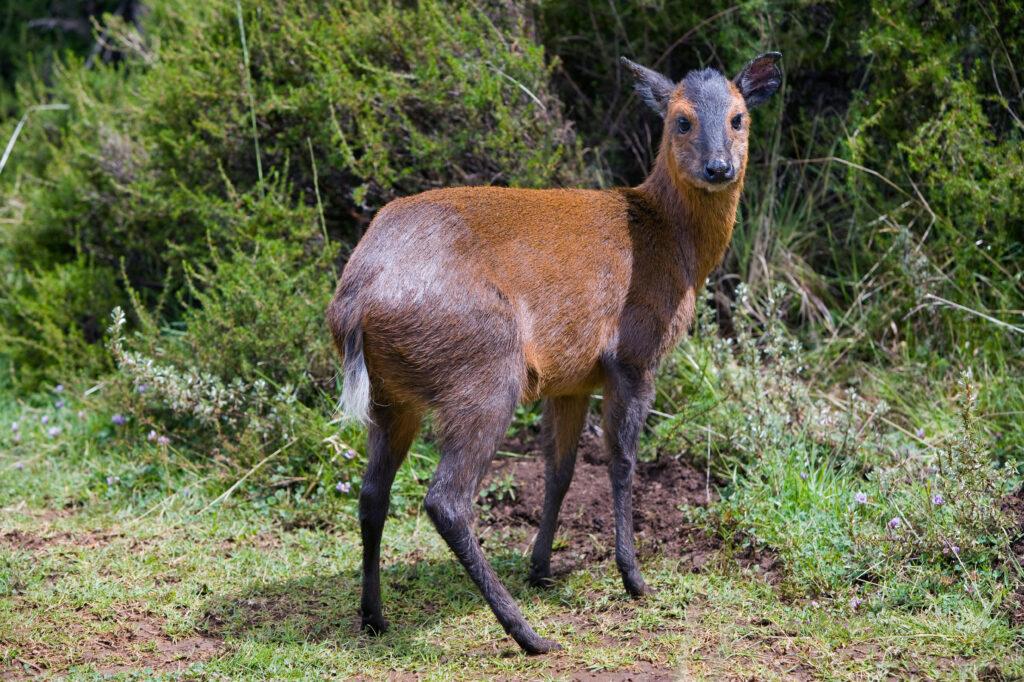
Black-fronted duikers are most often encountered in the southeastern forest concessions of Cameroon, where large, continuous rainforest still supports traditional tracking safaris. These areas form part of broader hunting in Cameroon, where multiple forest species are pursued within the same concession. Adult animals are compact and low to the ground, typically standing under knee height, with a dark brown to chestnut coat and a distinct darker patch across the forehead that gives the species its name. Both males and females carry short, straight horns, although they are often difficult to see in thick cover.
For hunters, identification matters, but behavior matters more. Black-fronted duikers move quietly through dense undergrowth, using established game trails and natural cover to stay concealed. They are rarely visible in open space and rely on stillness, short bursts of speed, and vegetation to avoid detection.
Unlike plains game, which depend on distance and eyesight, duikers stay hidden until the last possible moment. When seen, they are usually already at close range, often partially obscured and moving through narrow openings. In practical terms, recognizing a duiker in the field is less about getting a clear look and more about reacting to brief movement, a shape crossing a trail or a short window that may last only a few seconds.
Available Black-fronted Duiker Hunts
Africa Hunting Trip for Dwarf Buffalo & Sitatunga Cameroon
Booking Season: 2026
Hunt Difficulty: Difficult
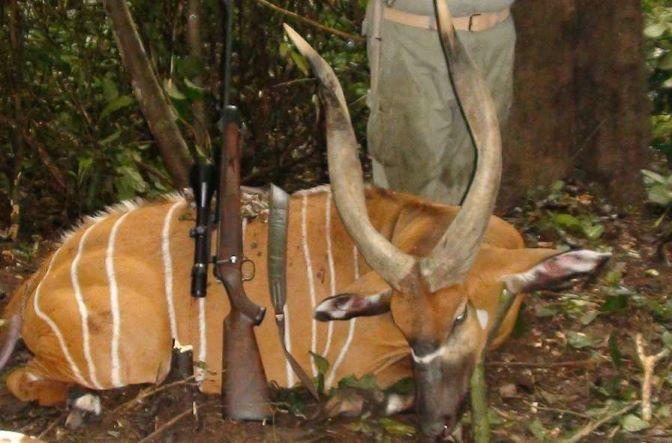
Bongo and Forest Elephant Hunting Safari (13 Days) – Cameroon
Booking Season: 2026
Hunt Difficulty: Difficult
Black-fronted duikers are most often encountered in the southeastern forest concessions of Cameroon, where large, continuous rainforest still supports traditional tracking safaris.
These areas are characterized by dense forest with very limited visibility, well-used game trails that guide animal movement, and scattered clearings and feeding areas that concentrate activity. They share this habitat with species like bongo and other duikers, which is why most encounters happen during broader rainforest hunts rather than targeted outings. Hunters typically encounter black-fronted duiker while tracking larger species, crossing trails ahead of the tracking line, or moving between feeding areas.
They are not glassed and not spotted at distance. Encounters happen suddenly, usually inside close range, and the animal often disappears just as quickly back into cover.
Black-fronted duiker hunting in Cameroon is not structured around pursuing the animal directly. Most are encountered while tracking other species in dense rainforest, particularly during bongo hunts. The hunting team moves slowly in single file, following spoor and reading sign on the ground. Because visibility is limited, attention stays on tracking rather than scanning ahead.
Encounters are typically sudden. The animal may appear crossing a trail or moving through a small opening, often already in motion when first seen. There is usually no time to prepare. The shot window is short, and the animal may only be visible for a few seconds before disappearing. Shots are taken at close range, often through narrow gaps in vegetation. Success depends on staying alert during long periods of tracking, recognizing movement quickly, and taking a controlled shot when an opportunity presents itself.
Most opportunities do not repeat. If the shot is missed or delayed, the animal is gone.
Black-fronted duiker are taken at close range, but the shooting conditions are often more demanding than they first appear. Visibility is limited, and shots are typically taken through narrow openings in vegetation. Even at short distance, branches and cover can interfere with a bullet path, which makes shot selection more important than raw accuracy.
Most hunters use light, quick-handling rifles and low-magnification optics or open sights. The focus is on fast target acquisition rather than precision at distance. While some hunters do use shotguns in dense forest environments, rifle use remains common, particularly when multiple species are being hunted during the same safari.
Shot placement must account for:
Partial visibility of the animal
Limited time to assess the angle
The need for a clean path through vegetation
As with all rainforest hunting, the priority is taking a clear, ethical shot when the opportunity presents itself rather than forcing a shot through cover.
Black-fronted duikers react differently to pressure than open-country antelope. They do not rely on distance. Instead, they use the density of the forest to break contact. When disturbed, a duiker will make a short, fast burst of movement and angle back into thick cover. Rather than running in a straight line, they change direction quickly and use vegetation to stay out of sight.
In many cases, the animal appears briefly, pauses for a second to assess movement, and then disappears. That pause is often the only shot opportunity. Once back in dense vegetation, they are difficult to relocate. Unlike plains game, they do not move into open ground where a second chance might present itself. For the hunter, the first opportunity is usually the only one.
Black-fronted duiker are not difficult because they are hard to find—they are difficult because of how they are encountered. Most sightings are brief and often partially obscured. The animal is rarely standing still in a clear lane, and there is little time to adjust once it appears. Shots are taken at close range, but that does not make them easy. The challenge is identifying a clear path through vegetation and committing to the shot before the animal disappears.
Duiker are usually taken opportunistically during larger rainforest hunts. Success depends less on targeting the species directly and more on how the hunter performs within the tracking process. Hunters who struggle tend to wait for a perfect setup. In this environment, those opportunities are rare. Hunters who do well stay alert, recognize movement quickly, and take the shot when a clear opportunity presents itself.
In practical terms, success comes down to composure and the ability to act decisively within a very short window.
Black-fronted duiker are most often taken by hunters already pursuing a broader rainforest safari in Cameroon. They are not usually targeted by first-time safari hunters or those focused only on larger plains game.
Instead, they tend to be taken by hunters who:
Are already committed to a rainforest hunt
Understand the pace and conditions of tracking in dense forest
Are interested in the full range of species available in these environments
In many cases, duiker form part of a wider species list that appeals to experienced hunters looking to complete or expand a Central African collection. Because opportunities are brief and unpredictable, success often comes down to experience, awareness, and the ability to respond quickly within the conditions of the hunt.
Black-fronted duiker are not typically the primary objective of a safari in Cameroon. Most are taken as part of a broader rainforest hunt alongside species such as bongo and other duikers.
They are not pursued in isolation, and there are rarely setups focused specifically on this species. Their value comes from the context in which they are taken. A black-fronted duiker is usually the result of time spent tracking, consistent awareness, and the ability to act on a brief opportunity.
For many hunters, taking one reflects how effectively they participated in the hunt rather than a specific focus on the animal itself.
Black-fronted duikers occur across Central Africa, but Cameroon remains one of the few places where they can be hunted as part of a structured, regulated safari.
Hunting takes place in large, continuous forest concessions where:
Tracking remains the primary method
Professional hunters work closely with indigenous trackers
Hunts are conducted over extensive, unfenced areas
This is not a controlled environment and does not offer predictable opportunities. Encounters with duiker are a direct result of time in the forest and how effectively the hunting team operates within it. As a result, Cameroon remains one of the few destinations where taking a black-fronted duiker reflects the realities of true rainforest hunting.
Search from our range of Hunts across various popular destinations in Africa.

Book Your Hunt