Designed by Hunters, for Hunters

Gaboon viper hunting in Cameroon is not a structured or commonly pursued safari objective. While this species exists in the same rainforest environments where hunting takes place, encounters are rare and entirely situational rather than planned.
Most hunters traveling to Cameroon are focused on primary species such as bongo or forest buffalo. Species like the Gaboon viper fall outside that structure and are best understood as an incidental possibility rather than a target.
For a full breakdown of how these safaris are structured, see our guide to hunting in Cameroon.
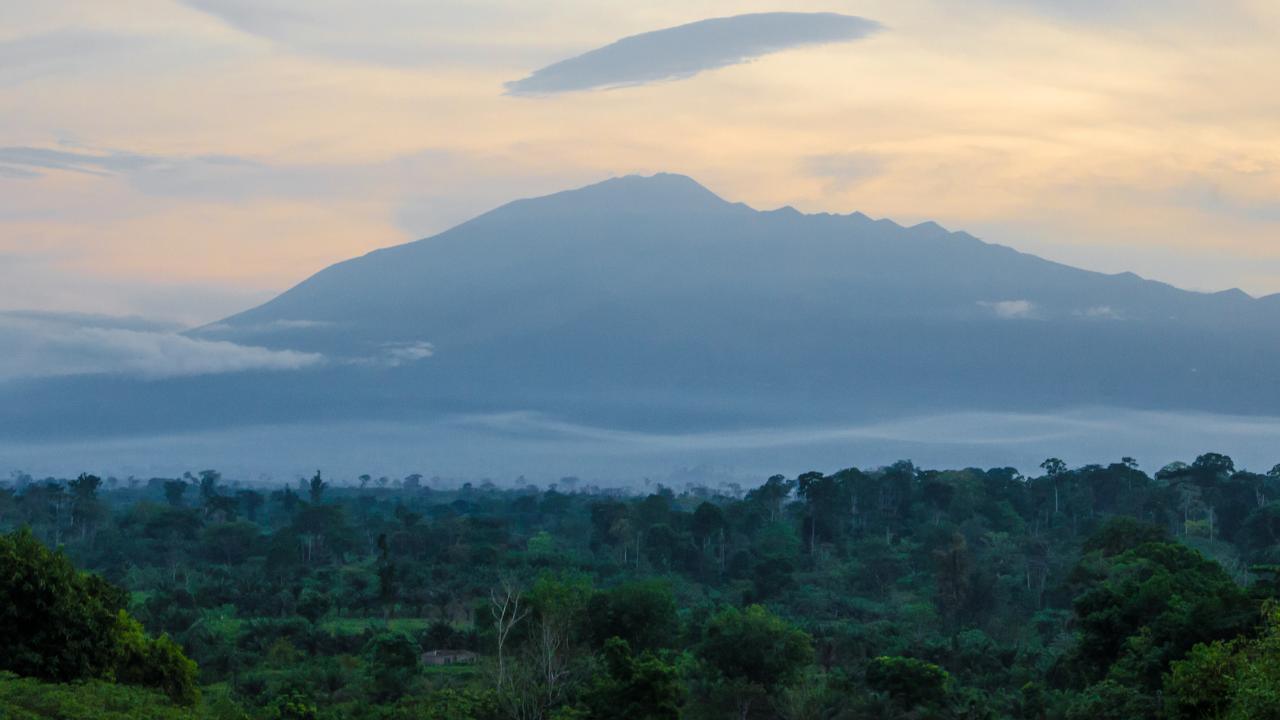
Gaboon vipers are found in the dense rainforest regions of southern Cameroon, where environmental conditions support their specialized behavior. These areas are defined by heavy vegetation, high humidity, and constant ground cover.
They are most commonly associated with dense tropical rainforest with limited visibility, forest floors covered in leaves and organic debris, areas near water systems such as streams, swamps, and floodplains, as well as quiet, undisturbed sections of hunting concessions.
Unlike larger game species, Gaboon vipers are not distributed in predictable patterns across hunting areas. Their presence depends heavily on habitat conditions, and even in suitable regions, they are rarely seen.
Gaboon vipers are not actively tracked or pursued during a safari. Nearly all encounters occur unexpectedly while moving through the forest during normal hunting activity. Hunters may encounter them while walking through dense forest during tracking, along game paths or near water source, and in areas with thick leaf cover where visibility is limited.
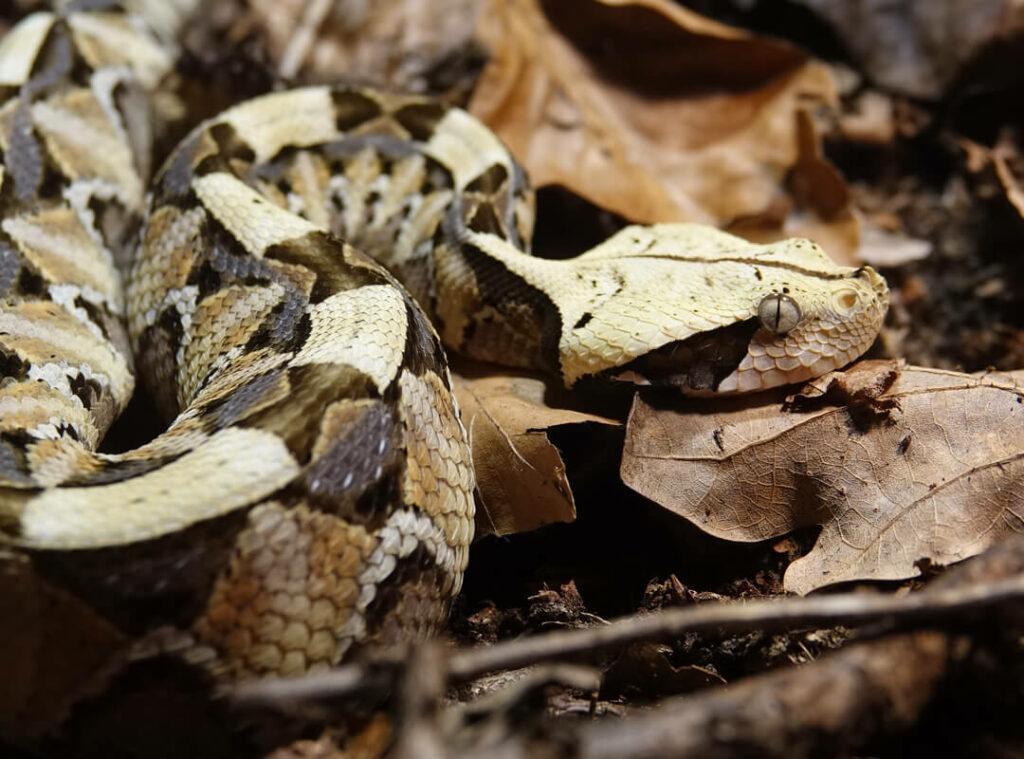
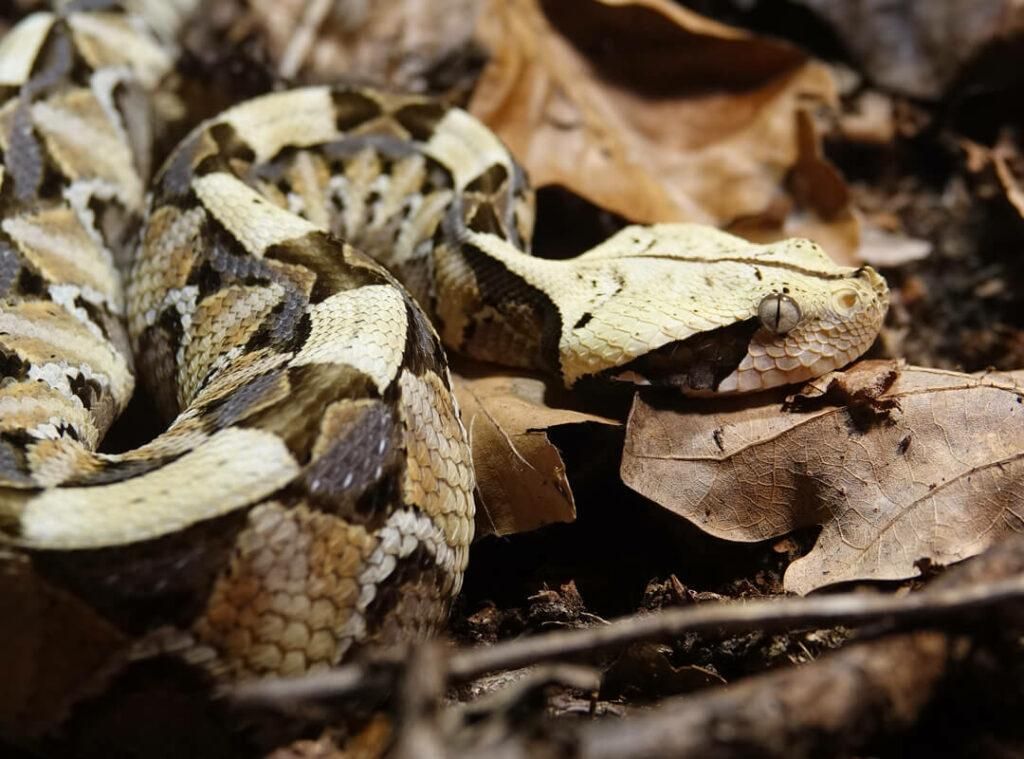
In most cases, sightings happen at very close range. Their camouflage allows them to blend almost completely into the forest floor, making them difficult to detect until a hunter is already nearby.
Even though they are not a species you plan to hunt, hunters still need to remain alert in suitable terrain. In practice, experienced trackers move slowly and scan the forest floor continuously, as movement speed and ground awareness play a major role in detecting animals that rely on camouflage. Encounters are often sudden, and awareness becomes an important part of moving safely through dense rainforest environments.
There is no reliable method for locating Gaboon vipers. Even experienced trackers do not actively search for them, and encounters depend almost entirely on chance and time spent in suitable habitat.
In practical terms, no. Gaboon vipers are not considered a realistic or structured hunting objective in Cameroon. There is no established method for targeting them, and no safari is built around pursuing this species. Their presence is tied to environmental conditions rather than predictable movement patterns. Even in areas where they are known to exist, encounters remain rare and inconsistent.
Most hunters do not travel to Cameroon with the intention of encountering a Gaboon viper. Instead, it is best understood as a highly opportunistic species that may be seen, or occasionally taken only under the right circumstances.
In reality, the majority of encounters occur during extended time in the field on dedicated bongo hunts, where hunters are moving through the type of terrain where these snakes are most likely to be present.
Unlike primary species such as bongo or forest buffalo, where structured tracking methods improve success over time, Gaboon vipers remain entirely unpredictable and are not influenced by hunting pressure or repeatable patterns.
Gaboon vipers are one of the most formidable snakes in Africa due to their size, camouflage, and venom capability. They are known for exceptional camouflage that makes them nearly invisible on the forest floor, a powerful bite with significant venom yield, and a fast defensive strike when disturbed.
Despite this, they are not aggressive animals. Most incidents occur when the snake is accidentally stepped on or disturbed at close range. In a hunting context, the primary risk comes from how difficult they are to detect in dense terrain, not from active behavior.
If a bite does occur, it is considered a serious medical emergency. Professional hunters and safari teams operating in these areas are typically trained to respond, and immediate evacuation to proper medical care is critical. Hunters should always follow the guidance of their professional hunter in these situations.
There is no predictable pattern for encountering a Gaboon viper. Encounters are more likely in dense rainforest with heavy ground cover, near water systems or humid low-lying areas, during extended time spent moving through suitable terrain. In practical terms, sightings tend to happen when hunters are moving slowly through thick forest where visibility is limited. Gaboon vipers rely heavily on camouflage and often remain completely still, which makes them difficult to detect until you are already close.
In dense rainforest conditions, visibility is often limited to just a few meters, and much of the focus is directed ahead at game sign or movement. This makes it easy to overlook what is directly underfoot. Gaboon vipers rely on this exact advantage, remaining motionless and blending into leaf litter where even experienced hunters can miss them if they are moving too quickly. Encounters are not linked to a specific time of day in any reliable way, but they are more likely when conditions keep the forest floor damp and active, particularly in shaded, undisturbed areas where prey species are present.
Even in the right habitat, the key factor is time in the field. The longer a hunter spends moving through this type of terrain, the greater the chance of encountering one, although the overall probability remains low. Even under ideal conditions, sightings are uncommon. Many hunters complete full safaris in suitable habitat without ever seeing one.
Gaboon viper encounters are relevant only to hunters already committed to a Cameroon rainforest safari who understand the unpredictable nature of the environment. It may appeal to hunters interested in the full ecosystem rather than a single species, those who value rare and unplanned encounters, and individuals comfortable operating in dense, low-visibility terrain
For these hunters, the possibility of encountering a species like this adds depth to the overall experience rather than serving as a primary objective.
This is not suited to hunters expecting a structured or outcome-driven experience.
It is not a good fit for those who want to target a specific species with a high likelihood of success, expect a predictable or repeatable hunting process, are uncomfortable with close-range encounters in dense terrain, prefer clearly defined hunting setups or controlled scenarios, and hunters who are uncomfortable around snakes or have a strong aversion to close-range encounters, as sightings typically happen at very short distance in dense vegetation and can be sudden.
Gaboon vipers do not fit into a planned hunting framework, and expectations need to reflect that.
Gaboon vipers are not a species you plan a safari around in Cameroon. They exist within the environment, but encounters are rare, unpredictable, and entirely dependent on circumstance. What makes them notable is not their role as a hunting objective, but the fact that they represent one of the more unpredictable and easily overlooked elements of a rainforest safari.
For hunters spending extended time in the field, especially in southern Cameroon’s dense forest regions, the possibility of encountering a Gaboon viper is part of the broader experience, not a guaranteed outcome.
This is not a species you hunt. It is one you may encounter. Awareness and movement through this type of terrain play a far greater role than most hunters expect.
Can you hunt Gaboon viper in Cameroon?
Yes, but only opportunistically. There is no structured or dedicated hunt for this species.
Is Gaboon viper a primary safari objective?
No. It is not targeted in a consistent or planned way.
How likely are you to encounter one?
Encounter rates are very low and depend entirely on habitat, conditions, and time spent in the field.
Search from our range of Hunts across various popular destinations in Africa.

Book Your Hunt