Designed by Hunters, for Hunters

Jackson’s hartebeest (Alcelaphus buselaphus jacksoni) is the dominant hartebeest form encountered in Uganda’s savanna ecosystems, particularly in the north of the country. Its classification, however, is more complex than most hunting references suggest. In modern taxonomy, Jackson’s hartebeest is often treated either as a regional expression of the Lelwel hartebeest (Alcelaphus buselaphus lelwel) or as part of a broader hybrid zone influenced by Lelwel and Coke’s hartebeest populations.
This means that while it may not always be recognised as a formally distinct subspecies, it remains widely accepted in hunting and field contexts as a distinct East African hartebeest form. For collectors and experienced plains game hunters, that distinction carries real value, both geographically and biologically.
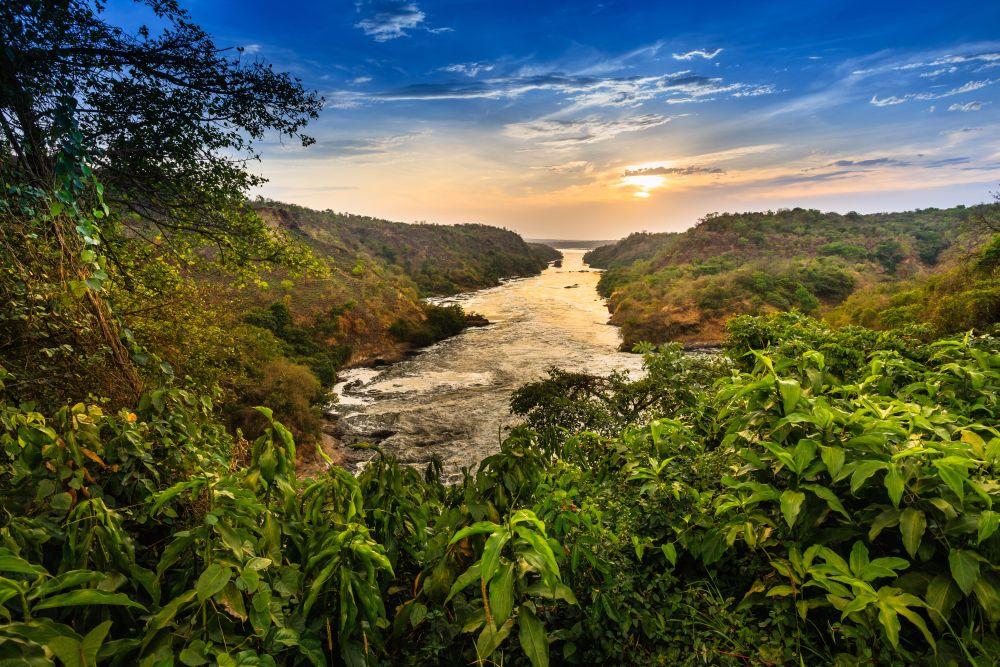
Jackson’s hartebeest hunting in Uganda is most reliably found in northern parts of the country, where large, open savanna systems still support stable populations. The Murchison Falls ecosystem remains the strongest area, particularly north of the Nile, where animals tend to display the most typical “Jackson-type” characteristics. Further northeast, the Kidepo Valley region offers a more remote and less pressured environment, with equally authentic populations and excellent natural behaviour. In both regions, hunting takes place in controlled areas surrounding protected zones, and success depends heavily on working with concessions that understand local distribution patterns.
A key detail is the gradual transition between hartebeest forms. In certain areas, especially toward the northwest, animals may show increasing Lelwel influence. For international hunters specifically targeting a representative Jackson’s hartebeest, location selection becomes an important part of the overall strategy.
Jackson’s hartebeest is a true species of open country, most commonly found in short-grass plains and lightly wooded savanna where visibility extends over long distances. In Uganda, this means broad, exposed landscapes where both hunter and animal are operating with minimal natural concealment.
Unlike species that rely on dense cover for protection, hartebeest depend almost entirely on their ability to detect movement early. They actively avoid thick bush and tall, rank grass, instead favouring areas where they can maintain a clear line of sight across their surroundings. This preference is not incidental. You’ll notice this quickly in the field—it shapes both how they behave and how they need to be hunted.
This creates a hunting environment where visibility works both ways. While animals are easier to locate at distance, closing that distance becomes significantly more challenging. Hunting Jackson’s hartebeest is therefore less about concealment and more about controlled exposure, careful positioning, and disciplined movement across open terrain. Animals are frequently encountered on slightly elevated ground, where they gain a visual advantage over their surroundings, or in areas where grazing conditions are particularly favourable. Recently burned sections, heavily grazed patches, and zones of fresh regrowth consistently attract feeding animals and should be prioritised when planning a hunt.
Wind direction becomes a critical factor in these open environments, but it is the use of terrain that often determines success. Subtle features such as shallow depressions, low ridgelines, and gradual undulations in the landscape provide the only real opportunities to approach undetected. Successful stalks rarely follow a direct line and instead require indirect routes that keep the hunter below the animal’s line of sight for as long as possible.
Because there is little margin for error, this style of hunting rewards patience and precision. Small mistakes, particularly unnecessary movement or skyline exposure, are quickly detected and usually end the opportunity. When approached correctly, however, these same open conditions allow for highly controlled, deliberate shot placement once the final position is achieved.
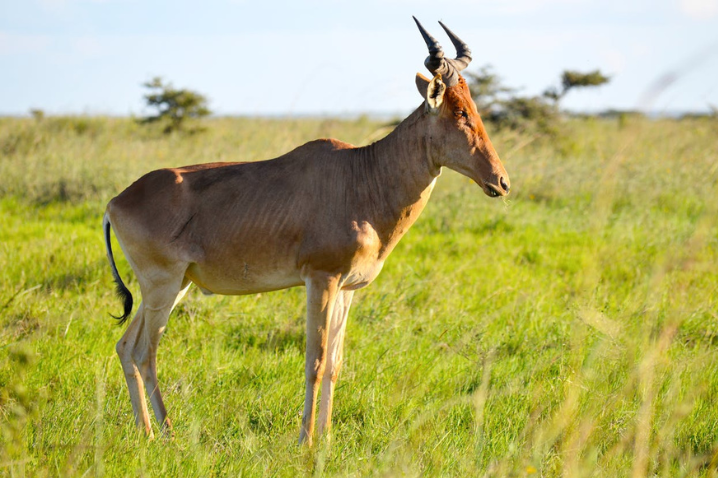
Jackson’s hartebeest have one of the most distinctive profiles among African antelope, and once understood, it is difficult to confuse with other species.
The most obvious feature is the elongated, narrow face, which gives the animal a noticeably stretched appearance compared to other plains game. This is combined with a sloping back, where the shoulders sit higher than the hindquarters, creating a slightly angular, forward-heavy posture. The coat is typically reddish-brown, sometimes deepening around the shoulders, and both sexes carry horns. These horns are central to identification and trophy evaluation. They emerge from thick bases, sweep outward, and then curve inward in a characteristic lyre shape.
In mixed environments, this combination of a long facial structure and distinctive horn curvature is usually enough to confirm identification even at distance.
In Uganda’s savanna ecosystems, hartebeest are often encountered alongside species such as Uganda kob, topi, and tsessebe. Misidentification is not uncommon, particularly for those unfamiliar with subtle differences. The Uganda kob presents a lighter, more compact appearance, with a clearly visible white underside. Topi are darker and more muscular in build, often showing blue-black patches on the upper legs and shoulders. Tsessebe, while related, appear heavier and less elongated overall.
By contrast, Jackson’s hartebeest is taller, more angular, and immediately recognisable by its extended facial profile. This single feature is often the most reliable field indicator.
Jackson’s hartebeest is one of the most visually alert antelope in Uganda’s savanna systems, relying almost entirely on early detection rather than concealment or dense cover. This makes it a fundamentally different hunting challenge compared to species that depend on habitat for protection.
Herds are typically structured around small to medium group sizes, with dominant bulls maintaining loose territorial control over productive grazing areas. These territories are not rigidly defended at all times, but they influence movement patterns and herd positioning throughout the day.
One of the most defining behavioural traits of hartebeest is their tendency to pause and assess danger before reacting. In practice, this moment is often where the opportunity is won or lost. It’s not uncommon to have a hartebeest standing and looking directly in your direction at 150–200 yards—waiting for movement. Any hesitation or unnecessary adjustment at that point is usually enough to end the stalk. When disturbed, animals will often stand still, facing the perceived threat, attempting to confirm risk through visual cues. This brief window can present an opportunity—but only if the hunter is already in a favourable position.
Once committed to flight, however, hartebeest become extremely difficult to recover. They are capable of sustained speed over long distances and will not settle quickly after being spooked, often moving well beyond immediate range. Hunting success will depend on a disciplined, terrain-driven stalk. Open ground means that traditional concealment is limited, so hunters must rely on subtle landscape features such as shallow depressions, low rises, and indirect approach lines that keep them below the animal’s line of sight. Even minor exposure on a skyline is usually enough to trigger detection.
Patience is critical. Rushed approaches are rarely successful, and effective hunts often involve repositioning multiple times to maintain wind advantage and visual cover across open terrain.
Jackson’s hartebeest is a strict grazer, feeding almost exclusively on short, nutrient-rich grasses. Its distribution is therefore closely tied to rainfall patterns, grazing pressure, and the availability of fresh regrowth. Rather than remaining fixed in one area, hartebeest move in response to changing conditions, often concentrating in zones where grass has recently been burned, grazed down, or renewed by early rains. These feeding preferences create predictable movement patterns that experienced hunters can use to their advantage.
During the dry season, when grass becomes shorter and more limited, animals tend to gather in more defined feeding areas. This improves visibility and increases the likelihood of consistent encounters, making it the most effective period for hunting. In contrast, the wet season disperses animals across wider areas, reducing predictability and requiring more extensive searching.
Shot opportunities are typically encountered when animals are feeding in open ground or moving between grazing patches. Because of their alert nature, approaches must be carefully timed to coincide with feeding behaviour, when attention is directed downward and movement is more relaxed.
Understanding this relationship between grazing patterns and seasonal movement is often the difference between a passive sighting and a successful, well-planned stalk.
Jackson’s hartebeest isn’t judged on horn length alone. What matters more is how everything comes together—shape, balance, and overall character.
A good bull will usually show strong bases and a clean, even curve through both horns. That classic lyre shape is what most hunters look for, and when it’s well-formed and symmetrical, it stands out straight away. Irregular or uneven horns tend to take away from the overall quality, even if length is there. Judging them properly takes a bit of time in the field. It’s easy to underestimate an animal at first glance, especially at distance. What looks average can change completely once you get a better angle or see how the horns carry their mass.
Older bulls tend to show it in more ways than just horn development. Heavier bases, a slightly rougher look to the coat, and a more settled presence in the herd are often good indicators that you’re looking at a mature animal worth taking. In Uganda, there’s an added layer to it. Because of the variation in this region, you’re not just looking for a good set of horns—you’re also looking for an animal that represents the typical Jackson’s hartebeest form for that area.
In the end, it’s that combination—good structure, maturity, and a true representation of the animal in its environment—that makes a hartebeest worth taking.
In Uganda, Jackson’s hartebeest is rarely pursued as a standalone hunting objective. Instead, it is typically included as part of a broader plains game safari, where multiple species are hunted within the same concession and time frame.
This reflects both the way hunting is structured in Uganda and the natural distribution of game. Hartebeest share the same open savanna habitat as several other desirable plains game species, making it practical and efficient to include them as part of a combined hunt.
Hunters targeting Jackson’s hartebeest will often pursue it alongside species such as Uganda kob, waterbuck, bushbuck, and other regional antelope. This approach allows for a more complete and rewarding safari experience, while also increasing overall opportunity in areas where game movements are influenced by seasonal conditions. For this reason, Jackson’s hartebeest is best viewed not as a primary standalone species, but as a valuable addition to a well-structured plains game hunt in Uganda.
For a full breakdown of available species and safari options, see our plains game hunts in Uganda guide.
For international hunters traveling to Uganda, particularly those investing in a broader East African safari—the timing of a Jackson’s hartebeest hunt plays a direct role in both trophy quality and overall success.
The dry season consistently offers the most reliable conditions. As grass levels recede, visibility improves across the savanna, allowing hunters to locate animals at distance and plan more controlled stalks. At the same time, hartebeest begin to concentrate in predictable feeding areas where grazing remains viable, reducing the uncertainty that often comes with wetter conditions. This period thus aligns well with the expectations of most visiting hunters. Travel logistics, trophy preparation, and overall hunting efficiency tend to be more consistent during the dry months, making it the preferred window for those coming from the United States or other international destinations.
Daily movement patterns also become more defined under these conditions. Early mornings and late afternoons provide the best opportunities, as animals move between grazing areas and feed more actively in cooler temperatures. These periods not only increase encounter rates but also offer more stable conditions for careful shot placement in open terrain.
Midday activity is typically reduced, particularly in warmer weather, and is better used for repositioning, glassing new areas, or evaluating previously located animals. For serious hunters and collectors, the key advantage of proper timing is not simply increased sightings, but greater control over the hunt itself—from identifying mature bulls to executing deliberate, well-planned stalks under favorable conditions.
Jackson’s hartebeest in Uganda exists within a conservation framework that is closely tied to protected areas and the surrounding managed hunting concessions. While the species as a whole is not currently classified as threatened, its long-term stability in Uganda depends heavily on how these ecosystems are maintained and utilized.
Most viable populations are concentrated within or adjacent to established conservation landscapes, where wildlife management, anti-poaching efforts, and habitat protection are actively enforced. Outside of these areas, pressures such as agricultural expansion, livestock grazing, and human settlement have historically reduced both range and population density.
This is where regulated hunting plays a measurable role. In Uganda, licensed hunting operations are structured to operate within controlled quotas and designated areas, ensuring that offtake remains sustainable and aligned with population dynamics. These programs are not simply extractive—they are part of a broader conservation model that assigns economic value to wildlife and incentivizes its protection.
Revenue generated from hunting contributes directly to anti-poaching initiatives, habitat management and monitoring, and local community participation and benefit-sharing
This last point is particularly important. In regions where wildlife competes with livestock and agriculture, the presence of a functioning hunting economy can shift wildlife from being seen as a liability to a valuable resource worth preserving. For Jackson’s hartebeest, which depends on open savanna systems that are increasingly under pressure, this model helps maintain the very landscapes that support its populations. Without active management and economic justification, these habitats are far more vulnerable to conversion and degradation.
For international hunters, this adds an additional dimension to the experience. Pursuing Jackson’s hartebeest in Uganda is not only about the hunt itself, but also about participating in a system that supports the continued existence of the species within its natural range.
When conducted through reputable operators and properly managed concessions, hunting contributes directly to the long-term conservation and sustainability of hartebeest populations in Uganda.
Jackson’s hartebeest occupies a unique position among African plains game. Its taxonomic ambiguity, combined with its regional specificity, gives it a level of distinction not always found in more widely distributed species.
For hunters and collectors who value authenticity and depth of experience, it represents more than just another antelope. It reflects the landscape it comes from and requires a more considered approach in the field.
Jackson’s hartebeest has a way of catching people off guard. It doesn’t look like a difficult hunt at first, but that changes quickly once you’re in the field. Most encounters happen in open ground, with very little to work with. The animals see well, hold their ground just long enough to make things uncomfortable, and then disappear if anything feels off. Getting into position takes time, and more often than not, it takes more than one attempt.
It’s not a hunt you rush. You end up adjusting, backing out, and trying again until things line up properly. When it does come together, it’s usually because everything was done right, not because you got lucky. That’s what makes it stick. Not the size of the animal, but the way the hunt plays out.
For hunters looking for something beyond the usual plains game routine, Jackson’s hartebeest offers that difference. It’s tied closely to the country and the terrain, and it asks a bit more from you to get it done.
Search from our range of Hunts across various popular destinations in Africa.

Book Your Hunt