Designed by Hunters, for Hunters

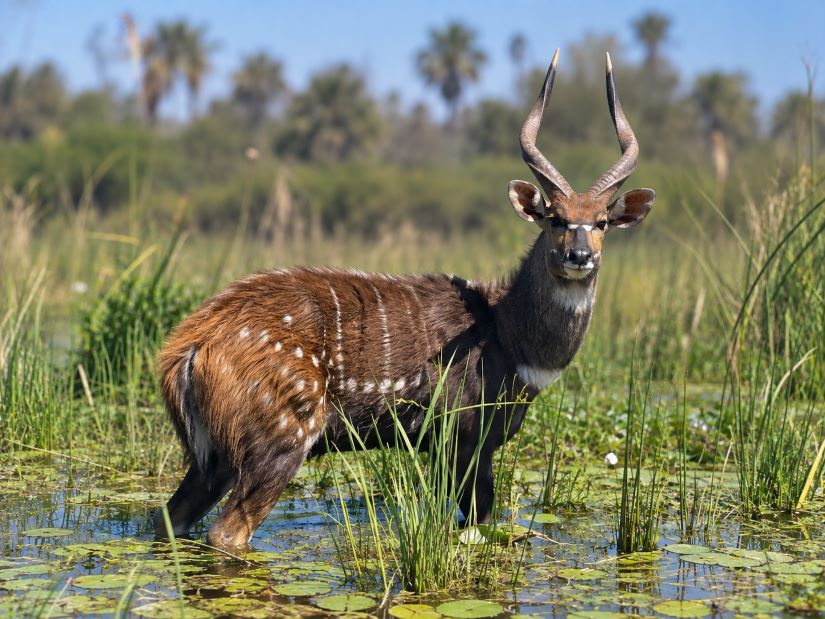
The sitatunga (Tragelaphus spekii), also referred to as the marshbuck, is a medium-sized amphibious antelope native to Central and East Africa. Renowned for inhabiting swamps, marshes, and flooded wetlands, this elusive spiral-horned antelope provides one of Africa's most specialized hunting experiences. Hunters interested in learning more about available Sitatunga hunts can explore opportunities across several African destinations where different subspecies occur.
There are three recognized subspecies of the Sitatunga antelope:
The Nile sitatunga, also known as the East African sitatunga, occurs in southern Sudan along the White Nile and its tributaries, northern regions of the Democratic Republic of Congo, and parts of Uganda. Today, many hunters seeking this elusive wetland antelope focus on hunting in Uganda, where extensive papyrus swamps, marshes, and river systems provide ideal sitatunga habitat and some of Africa's most specialized antelope hunting opportunities.
It is listed by the International Union for the Conversation of Nature (IUCN) with a status of “least concern.”
These semi-aquatic antelopes have large hooves that are widely splayed, allowing them to walk on terrain without sinking. It also assists them in escaping from predators, such as wild dogs and leopards, by fleeing into deeper waters. They are greatly accomplished swimmers and if chased, they will enter deeper water and submerge themselves until only their nostrils are visible.
Breeding occurs throughout the year, with females giving birth to one offspring. The sitatunga is nocturnal and diurnal, although they are more active at dusk and dawn, preferring to rest in the shade of the reeds during the day.
Name:
Tragelaphus spekii spekii
Male Weight:
150-280 pounds
Male Shoulder Height:
35-49 inches
Range:
Southern Sudan and northern Democratic Republic of Congo
Life span:
11 years
The Nile sitatunga is highly adapted to its wetland habitat, with a water-resistant coat that helps it stay dry
Only the male sitatunga has spiral-shaped horns that grow between 18-36 inches in length. The medium-sized antelope rams sport a gray-brown coat with a faint white striping while the females of the species have a chestnut-colored coat. Coats are long-haired and rather shaggy. Their coats have an oily, waterproof type secretion that keeps them dry. Males and females have two white marks between their eyes as well as white spots on their cheeks. Their tails are dark above, with light coloring below. Their hind legs are longer than the front ones, with feet and hooves specifically adapted to walk and swim in water. Their hooves, as mentioned, are uniquely formed and widely splayed, to allow them to easily move in semi-aquatic areas such as mud and on aquatic vegetation. Males weigh 150-280 pounds, standing approximately 35-49 inches at the shoulder, while females are smaller and weigh 110-125 pounds, standing 30-35 inches at the shoulder.
The best way to target them is from the water or targeting the antelope from a blind. Hunters use canoes to slowly and silently make their way across rivers and marshlands. The real challenge comes when it’s time to take that perfect shot from a moving canoe!
Three words to sum up this hunting safari: wet, muddy, and memorable! Sitatunga hunting is exciting but requires the hunter to bring his A-game as it is challenging safari hunting in a wet muddy, marshy environment, allowing for an exceptional hunting adventure!
Consider a fast-shooting rifle equipped with an excellent quality tactical scope as shooting ranges can vary from 100-400 yards. Calibers can vary from a .270 right up to a 300 win-mag. A 7mm is another option for the hunter to consider.
Search from our range of Hunts across various popular destinations in Africa.

Book Your Hunt