
13-Day Dwarf Buffalo, Sitatunga & Forest Game Safari in Gabon
Booking Season: 2026
Hunt Difficulty: Difficult

The “Fanged Deer” of the African Rainforest
The water chevrotain is one of the least understood mammals in Africa—and one of the most unusual species a hunter may encounter in the rainforest. Often referred to as the “fanged deer,” it is not a true deer at all, but a primitive, forest-adapted antelope that has changed little over time. Small, nocturnal, and almost entirely dependent on dense cover, it lives in the same low-visibility environments that define hunting in Gabon. For hunters, it is not a primary objective. That is precisely what makes encounters with the species so memorable for hunters spending extended time inside Central African rainforest systems.
But for those spending time in the forest, it represents something different—a rare and unpredictable encounter in one of Africa’s most intact ecosystems.
Available Dwarf Crocodile Hunts
13-Day Dwarf Buffalo, Sitatunga & Forest Game Safari in Gabon
Booking Season: 2026
Hunt Difficulty: Difficult
10-Day Gabon Duiker and Forest Game Safari
Booking Season: 2026
Hunt Difficulty: Difficult
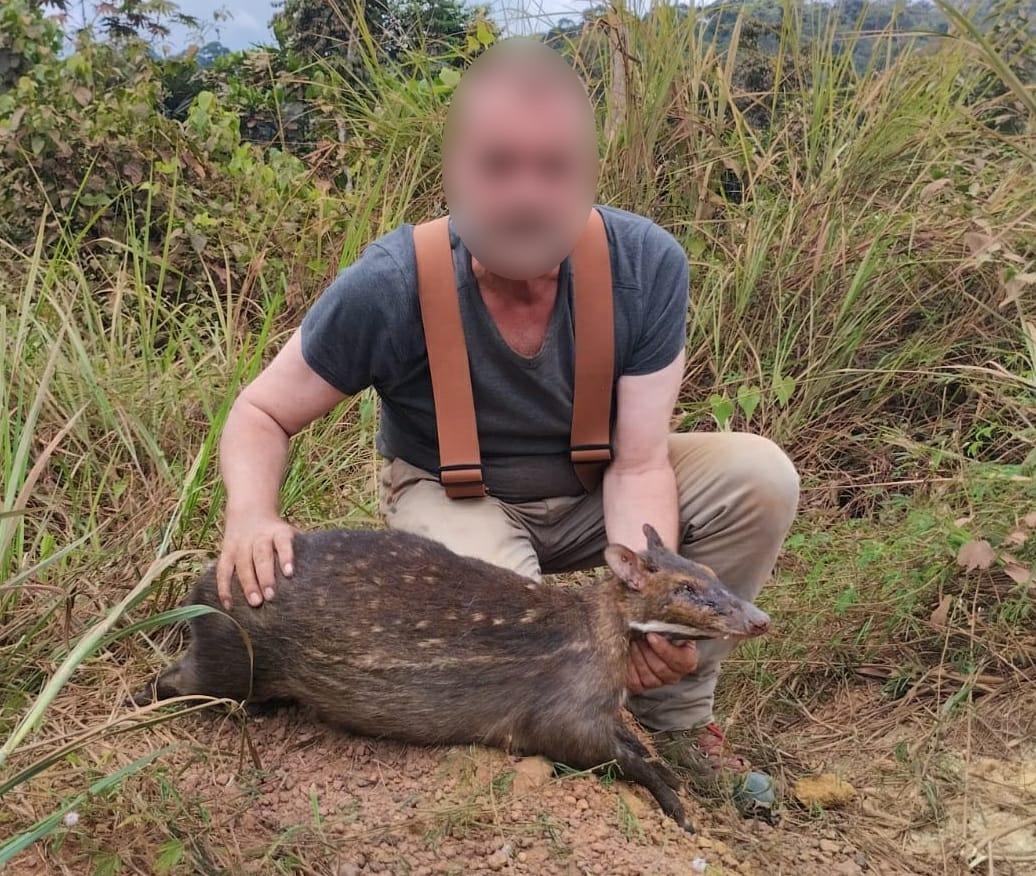
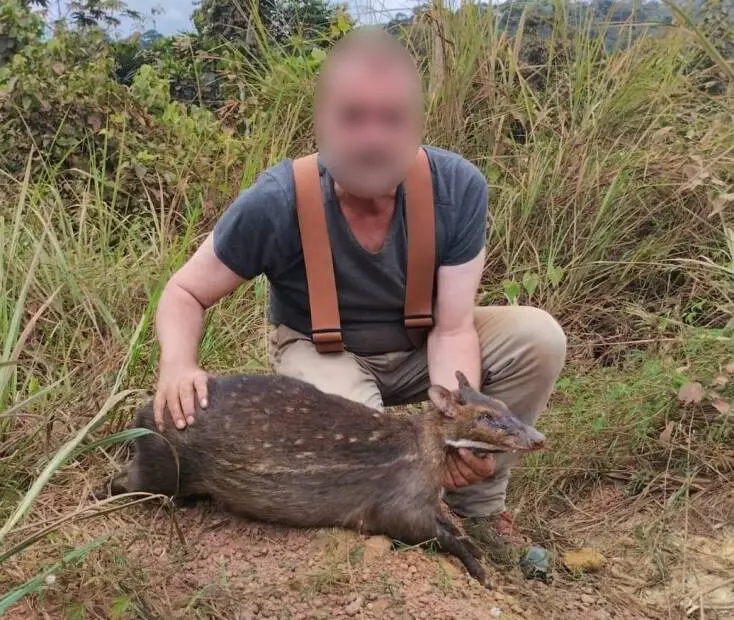
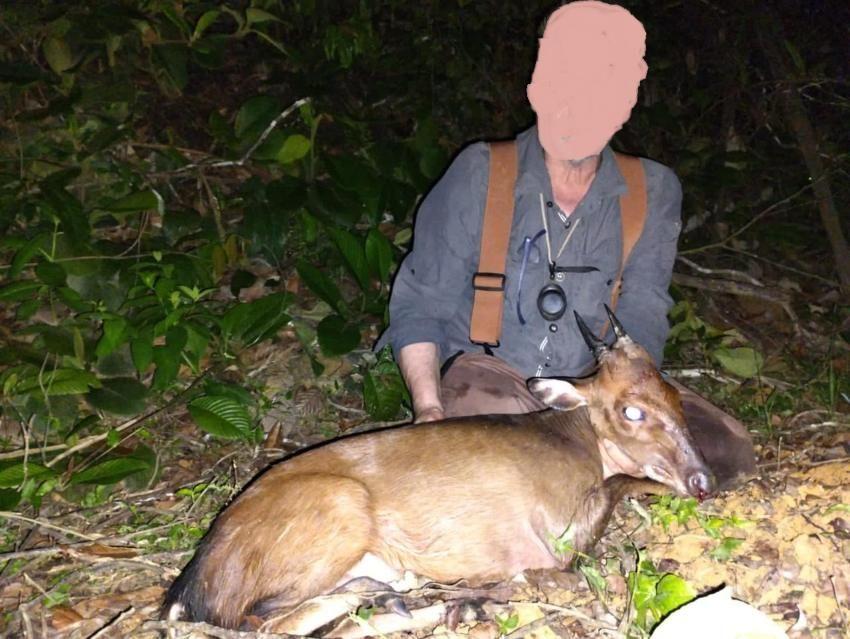
The water chevrotain (Hyemoschus aquaticus) is the largest of the chevrotain species, found across Central and West Africa, and considered one of the more unusual mammals within African rainforest ecosystems. Despite often being referred to as a “fanged deer,” it is not a true deer, but a primitive, forest-adapted antelope that has retained characteristics rarely seen in modern species.
Its most distinctive feature is the presence of elongated upper canines, which protrude slightly and resemble small tusks. It is a small antelope, typically standing less than 35 cm at the shoulder, which contributes to how easily it remains concealed in dense vegetation. Combined with its compact body and low stance, this gives the animal an appearance that is immediately unusual—and one of the main reasons it draws attention well beyond typical hunting circles.
In terms of habitat, the species is closely tied to dense, water-rich environments. It favors riverine vegetation, flooded forest systems, and shaded corridors where light penetration is limited and cover remains constant. These are not transitional zones—they are core rainforest areas where movement is restricted and visibility is naturally reduced. Behaviorally, the water chevrotain is almost entirely nocturnal and largely solitary. Its diet consists primarily of fallen fruit, vegetation, and organic matter found along the forest floor, while predators include larger carnivores such as leopards and pythons- factors that have shaped its cautious and evasive behavior. .
It moves carefully, relying on cover rather than speed, and reacts quickly to disturbance. What further separates it from other small antelope is its ability to evade danger by diving and remaining submerged underwater—sometimes for extended periods. This trait alone places it among the more unusual mammals found in African forests. For most people encountering the species for the first time, the interest begins with its appearance and evolutionary background.
For a smaller group—particularly experienced hunters and collectors—it represents something else entirely. Not a primary target in the conventional sense, but a rare, seldom-seen species that exists within some of the most intact and least accessible hunting environments in Africa.
In Gabon, water chevrotain occupy the same environments that define rainforest hunting as a whole—areas where terrain, vegetation, and water systems combine to limit both movement and visibility. They are most often associated with narrow jungle waterways, swamp margins, and dense forest edges where the ground is soft, the canopy is thick, and sightlines are short. These are not areas where wildlife can be observed from distance or approached in a controlled way. Instead, they are environments where animals remain concealed until close proximity, and where movement through the landscape is dictated as much by footing as by direction.
This has a direct impact on how the species is encountered. Because the water chevrotain spends much of its time within heavy cover and is active primarily at night, sightings are infrequent and often brief. Even in areas where they are present, they can move undetected, slipping between vegetation and water with little indication of their presence.
This is why they are rarely targeted directly. Not because they lack interest, but because the conditions in which they live make deliberate pursuit impractical. Instead, they are encountered as part of the broader rainforest environment—appearing unexpectedly, and often disappearing just as quickly.
For those who understand the terrain, that unpredictability is part of the appeal.
Water chevrotain are not typically pursued as a primary hunting species in Gabon. While they do exist within the country’s rainforest systems, they are best understood as an incidental or opportunistic species—encountered in the course of hunting other forest game rather than targeted directly.
This reflects how safaris in Gabon are structured in practice. Hunts are built around time spent moving through dense forest environments, where multiple species may be encountered, but outcomes are rarely tied to a single objective. The terrain, visibility, and behavior of the wildlife all contribute to a system where encounters develop naturally rather than being engineered in advance.
For U.S. hunters accustomed to more structured, single-species safaris—where a specific animal is identified, tracked, and pursued with clear intent—this represents a different approach. For hunters traveling from the United States, this often represents a shift away from expectation-driven safaris and toward a more environment-led experience. In Gabon, the emphasis shifts away from targeting and toward operating effectively within a complex environment where opportunity is dictated by conditions, not planning.
Within that framework, the water chevrotain holds a particular kind of appeal. Not because it is commonly hunted, but because it is rarely seen—and when encountered, it reflects a deeper level of time spent in the forest.
Encounters with water chevrotain bear little resemblance to traditional plains game hunting. There is no glassing from distance, no predictable movement patterns, and no opportunity to plan long approaches. Everything unfolds at close range, often within a matter of seconds.
In Gabon’s rainforest environment, visibility is limited by design. Light is filtered through dense canopy, vegetation restricts lines of sight, and movement through the terrain is slow and deliberate. In these conditions, animals are rarely seen before they are close—and often not until they are already moving away.
Detection tends to come from subtle cues rather than clear visual confirmation. A slight shift in cover, the sound of movement through wet ground, or a brief outline crossing a narrow opening may be the only indication that an animal is present. Even along trails or water edges, where movement is more likely, exposure is short and inconsistent.
When a water chevrotain is seen, the window to react is typically brief. There is little time to assess, reposition, or wait for a better angle. More often than not, the animal disappears back into cover before a clear opportunity develops. This is not a species that presents itself in predictable ways. Its value lies in the fact that it does not—and in the reality that even in areas where it is present, it can pass entirely unnoticed.
Due to the close-range nature of rainforest hunting and the limited visibility inside dense cover, hunters are strongly encouraged to familiarize themselves with proper shot placement for hunting game in Africa before undertaking a Gabon safari.
What sets the water chevrotain apart is not just its rarity, but the combination of traits that define how it survives in the rainforest. The presence of elongated, fang-like canines is unusual for an antelope, giving it an appearance more often associated with older, more primitive species. This alone draws attention, but it is only part of the picture.
Its behavior further separates it from more familiar game. Being almost entirely nocturnal, it limits visibility by default, moving under the cover of darkness in environments where light is already restricted. Its ability to evade predators by diving and submerging itself underwater adds another layer of adaptation rarely seen in terrestrial mammals.
Above all, it is a species built around cover. Even in undisturbed habitat, it remains concealed, relying on dense vegetation and minimal movement to avoid detection. This combination of traits places it firmly within the category of rainforest-adapted animals that are inherently difficult to observe, and even more difficult to encounter with any consistency.
Within the broader context of hunting in Gabon, the water chevrotain occupies a very different position compared to more established forest species.
Animals such as forest buffalo and bongo tend to define the structure of a hunt. They influence how time is spent in the field, how tracking is approached, and how a safari is ultimately measured. By contrast, the water chevrotain exists outside of that framework.
It is not typically a focal point, nor does it drive the direction of the hunt. Instead, it sits on the margins—present within the same environment, but rarely central to the outcome. That distinction is important. It shapes expectations and reinforces the idea that not every species in the rainforest is pursued with the same intent. For those who understand this, the value of the water chevrotain is not diminished by its position—it is defined by it.
A typical Gabon safari is built around time spent in dense rainforest concessions, where movement is slow, visibility is limited, and encounters are earned rather than expected. Certain species naturally take priority, particularly those that fall into the category of dangerous game hunts or represent primary objectives of the hunt.
Water chevrotain do not fall into that category. They exist within the same ecosystem, often in the same areas being worked for other species, but they are not what drives the safari itself. Instead, they form part of the broader experience—one of many species that contribute to the depth and unpredictability of hunting in this environment. For hunters focused on species like forest buffalo, where tracking, positioning, and sustained effort define the hunt, the presence of smaller, rarely seen animals such as the water chevrotain adds another dimension. It reinforces the reality of the rainforest as a complete system, not a single-species pursuit.
That is ultimately where the water chevrotain fits. Not as the objective, but as part of the environment that makes Gabon one of the most complex and authentic hunting destinations in Africa.
Most searches related to the water chevrotain are informational rather than hunting-focused. That reflects how the species is generally understood. It is rarely discussed in a hunting context, is not widely marketed, and does not form part of any high-volume or structured safari offering.
This creates a clear gap between expectation and reality. From the outside, the species attracts attention because of its unusual appearance and behavior. But in the field, it exists within a much broader and more complex system of rainforest hunting, where outcomes are not defined by a single objective.
In these environments, species diversity matters more than individual targets. Conditions—terrain, visibility, and movement—shape what is possible on any given day. Encounters are not planned in the traditional sense, but develop as a result of time spent in the field.
Within that context, the water chevrotain is part of the landscape rather than the focus of the hunt. Understanding that distinction is key to understanding how hunting in Central and West Africa actually works.
Is a water chevrotain a deer?
No. Although it is often referred to as a “fanged deer,” it is not a true deer. It is a primitive, forest-adapted antelope with characteristics that differ significantly from more familiar species.
Why does it have fangs?
The elongated upper canines are used primarily for display and territorial interactions. They are not used for feeding or predation, but are a retained trait that distinguishes the species from other small antelope.
Can you hunt water chevrotain in Africa?
Yes, but it is not typically pursued as a primary hunting species. Encounters are rare and usually occur incidentally while hunting other rainforest game.
Where are water chevrotain found?
They are distributed across Central and West Africa, including countries such as Gabon, where intact rainforest habitat still supports stable populations.
Why are they so rarely seen?
Their nocturnal behavior, combined with a strong reliance on dense cover and their ability to evade predators by submerging underwater, makes them extremely difficult to observe—even in areas where they are present.
Search from our range of Hunts across various popular destinations in Africa.

Book Your Hunt