
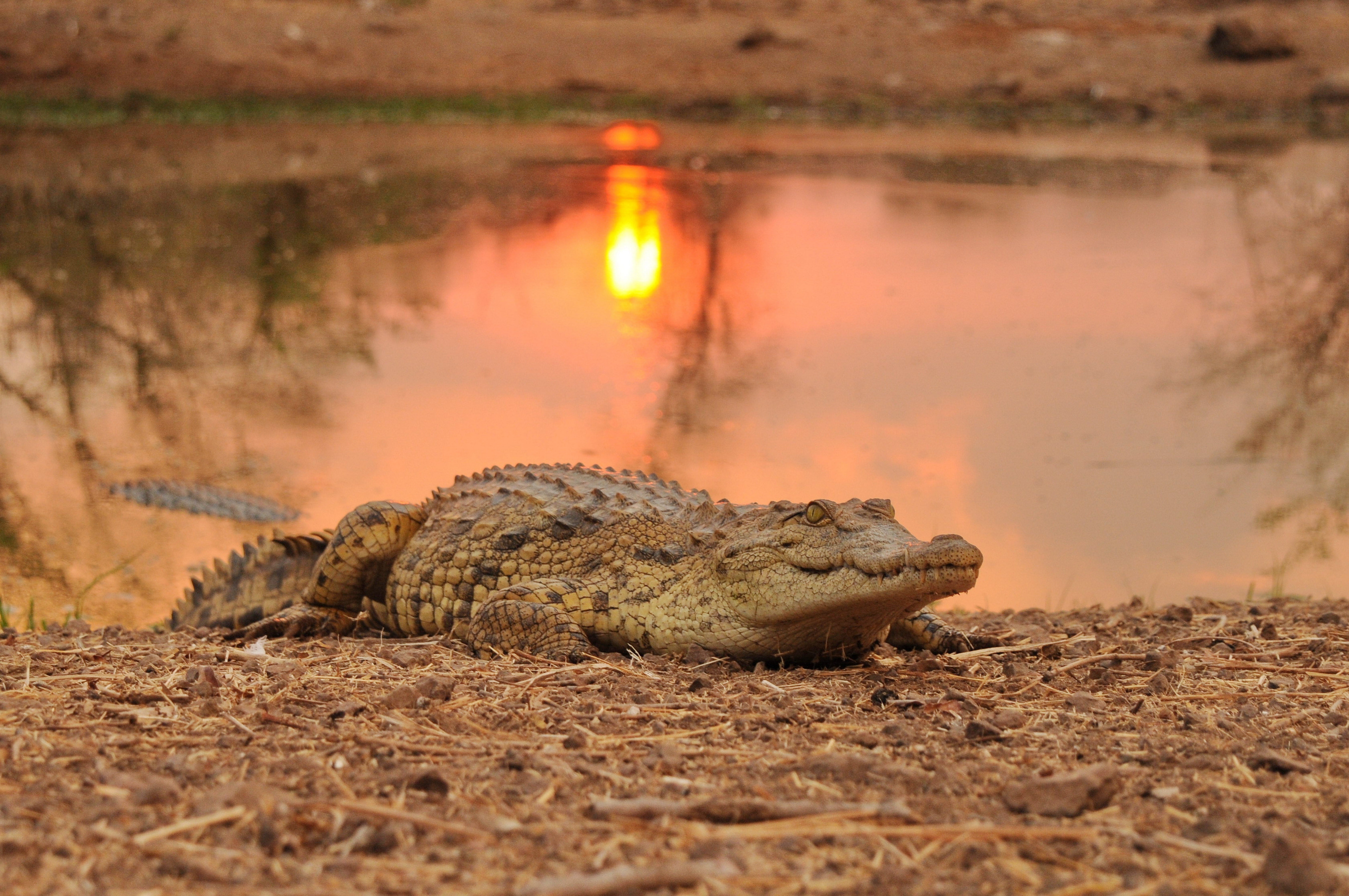
Crocodile hunting is often misunderstood, even by experienced African hunters seeing it for the first time. On paper, it actually looks simple. In reality, it has a way of exposing overconfidence very quickly. This is not an African hunt defined by pursuit or action. Rather, it is a hunt defined by patience, judgment, restraint, and consequences. One poor decision can end even the best-planned Crocodile Hunts, while the difficulty and risks of recovery can outweigh the moment of the shot itself.
For hunters traveling from North America, this dangerous game hunting safari demands careful preparation, patience and a clear understanding of responsibility long before their boots touch African soil.
Understanding crocodile hunting properly means understanding why seasoned dangerous game hunters approach it with caution, not excitement.
[DYNAMIC-BLOGTABLEOFCONTENT]
Why Crocodile Hunting Is Different
Crocodiles are not pursued. They are waited for.
There is no tracking, no pressure applied through movement, and no opportunity to “make something happen.” Everything depends on patience, observation, and the ability to decline marginal opportunities.
There is no way to force a crocodile hunt. You wait, sometimes for days, and the crocodile decides if today is the day. And if that is an issue for you, this hunt may well not be for you.
Crocodiles are often grouped alongside Africa’s most dangerous and unpredictable animals, requiring a very different mindset compared to typical plains game species. To better understand how crocodile fits into a broader safari context, explore our guide to dangerous game hunts in Africa, where we break down the challenges, risks, and expectations of hunting Africa’s most formidable species.
The Longest Five Seconds of the Hunt
Most crocodile hunts involve hours of waiting interrupted by only a few seconds of opportunity.
A mature crocodile may spend most of the day partially submerged, exposing little more than its eyes and nostrils above the water. Then, without warning, it climbs onto a sandbank, turns broadside, and presents the shot hunters have been waiting for.
The challenge is that everything now happens very quickly. The professional hunter is studying the animal. The hunter is trying to settle the crosshairs. The crocodile may move its head at any moment. Wind, distance, angle, and water all suddenly matter.
Many hunters describe these few seconds as the most intense part of the entire safari. Not because of danger, but because they understand there may not be another opportunity like it.

Why Recovery is Planned Before The Shot
Most hunters focus on the shot. Experienced professional hunters often focus on what happens immediately afterwards.
A mature Nile crocodile may weigh well over a thousand pounds and spend most of its life in or around water. That reality influences every decision made during the hunt. Before the hunter settles behind the rifle, the professional hunter is already considering water depth, current, vegetation, bank access, visibility, and how a recovery would be conducted if the crocodile reaches the water.
This is one reason crocodile hunting demands such patience. A crocodile may appear broadside and offer what looks like a perfect opportunity, yet the professional hunter may still advise waiting. The reason is often not the shot itself, but what may happen after the trigger is pulled.
Even a perfectly placed shot can create anxious moments. Large crocodiles are incredibly powerful animals, and their reflexes can continue after death. Violent tail movement, rolling, splashing, and sudden movement towards the water are not uncommon. A crocodile that reaches deep water can create a far more complicated recovery situation than one that expires on a sandbank or shoreline.
Experienced hunters quickly learn that successful crocodile hunting is not simply about hitting the target. It is about recovering the animal responsibly and ensuring that every reasonable step has been taken before the shot is ever fired.
That level of planning is one of the reasons Nile crocodile hunts are regarded as some of the most technical and disciplined pursuits in African dangerous game hunting. Success is measured not only by the quality of the trophy, but by the judgment exercised throughout the entire process.
Where Experience Makes the Difference
One of the biggest misconceptions about crocodile hunting is that success depends primarily on the hunter's ability to shoot accurately.
Accuracy certainly matters, but experienced professional hunters know that many of the most important decisions are made long before the rifle is ever raised.
Judging trophy quality, evaluating recovery conditions, reading crocodile behavior, understanding river systems, and knowing when not to take a shot all come from experience rather than marksmanship.
A mature crocodile may appear to offer a perfect opportunity, yet an experienced professional hunter may immediately identify a problem that is not obvious to the hunter. The angle may be wrong. The animal may not be as large as it appears. Water conditions may create recovery concerns. Or the crocodile may simply not be positioned correctly.
These decisions are often invisible to the client, yet they can determine the outcome of the entire safari.
This is one reason experienced hunters place so much value on reputable outfitters and professional hunters when booking a crocodile hunt. In a pursuit where opportunities can be limited and mistakes difficult to correct, experience often becomes one of the most valuable assets in camp.
Why Crocodile Hunts Fail More Often Than Expected
Most unsuccessful crocodile hunts fail for reasons unrelated to a hunter’s shooting ability.
Common failure points include:
- Rushed shots during brief exposure
- Misjudged angles over water
- Incorrect assessment of posture
- Overconfidence in textbook shot diagrams
- Recovery limitations not considered before the shot
Unlike buffalo or lion, crocodiles rarely allow follow-up shots, and they are famously unimpressed by good intentions. They disappear into the murky depths, never to be seen again.
Experienced professional hunters consistently emphasize that decision-making matters more than marksmanship on crocodile hunts.
Shot Placement: Diagrams vs Reality
In a nutshell, shot placement charts for a crocodile hunt simplify a complex reality.
In real crocodile hunts:
- The brain is small and deeply set
- Posture changes anatomy significantly
- Water distorts distance and angle
- Head movement is subtle but critical
Most missed or lost crocodiles weren’t missed because the hunter didn’t know where to shoot, but because reality refused to line up with the diagram, resulting in an unfavorable outcome.
Because crocodiles present such a small and precise target area, shot placement becomes one of the most critical aspects of the entire hunt. Even slight errors can result in a lost animal, which is why understanding crocodile shot placement and anatomy is essential before attempting a crocodile hunt.

The Mental Side of Crocodile Hunting
Something not often discussed, is that crocodile hunting tests mental discipline more than physical endurance. The waiting game…
Long hours of stillness, intense visual focus, and the knowledge that one decision defines the outcome create a unique psychological challenge. Many experienced dangerous game hunters describe crocodile hunts as mentally exhausting, not because anything dramatic is happening, but because nothing is, and that’s exactly the problem.
This aspect is often underestimated by many hunters interested in pursuing this member of the Dangerous 7.
Why River Systems Matter More Than Countries
Successful crocodile hunts are shaped more by river dynamics than national borders or international borders.
Key considerations to consider include:
- Water depth and clarity
- Current strength
- Bank structure
- Vegetation density
- Safe recovery access
A river that looks perfect in photographs can become very uncooperative once a crocodile decides to sink in the wrong place. Ethical operators prioritize recoverability and safety, it’s not just crocodile density.
Not All Crocodile Waters Are Created Equal
Experienced crocodile hunters often talk about river systems long before they talk about countries.
The Zambezi River, Lake Kariba, Cahora Bassa, and the Luangwa River have all developed reputations for producing exceptional Nile crocodiles, but each offers a very different hunting experience.
Hunters interested in crocodile hunting in Zambia are often drawn to the Luangwa Valley and its remote river systems, where patience and observation remain central to success. Others prefer the vast waters of Lake Kariba or the Zambezi Valley, both of which have produced outstanding crocodile trophies for decades.
Meanwhile, hunters considering crocodile hunting in Mozambique are frequently attracted to the wild river systems surrounding Cahora Bassa and the Zambezi Delta. These areas combine exceptional crocodile habitat with the sense of wilderness that many hunters travel to Africa to experience.
Understanding the differences between these hunting areas is often more valuable than simply comparing countries. The river itself frequently determines the character of the hunt.
Who Should — and Should Not — Hunt Crocodile
Crocodile hunting is not an entry-level dangerous game experience by any means. This man-eating, blood-thirsty apex predator is a challenge for the most experienced hunter.
Best suited for:
- Hunters with prior dangerous game experience
- Those comfortable waiting long periods
- Hunters capable of declining poor angles
- Individuals who understand recovery risk
Not ideal for:
- First-time African hunters
- Those seeking high-action hunts
- Hunters unwilling to walk away from marginal shots
Knowing when, and when not to shoot is central to ethical crocodile hunting, and it’s often the hardest part of the entire hunt.
Walking away from a crocodile is harder than it sounds. Many experienced hunters remember the shots they didn’t take more clearly than the ones they did — especially when restraint was the right decision.
What Happens After the Shot
For many, this is the most misunderstood part of a crocodile hunting safari.
After the shot:
- Crocodiles often sink immediately
- Recovery becomes time-sensitive
- Water conditions dictate danger
- Wounded animals increase risk
Professional hunters plan recovery before a shot is even taken. This is also the point where most stories about “easy crocodile hunts” quietly fade, like mist before the hot African sun.
Recovery decisions are never made in isolation. Professional hunters consider not only the animal and the river, but the people standing nearby — as well as the families that hunters return to after a long journey. That responsibility shapes every ethical decision on a crocodile hunt.

The Legal, Ethical, and Practical Reality
Legal permission does not always equal ethical execution.
Responsible crocodile hunting balances:
- Government permits
- Conservation objectives
- Recovery feasibility
- Human safety
Something can be legal and still unethical. Experienced operators avoid shots that jeopardize recovery, even when legally permissible.
Crocodile hunting rewards restraint. Hunters who arrive seeking excitement often leave feeling frustrated. Those who arrive with patience usually leave with respect, whether or not a shot is taken and the crocodile is in the salt or not.
Crocodile Hunting vs Cape Buffalo Hunting
At first glance, crocodile hunting and Cape buffalo hunting appear to have very little in common. One takes place along rivers and lakes, while the other often unfolds in thick bush, following fresh spoor through some of Africa's most challenging terrain.
Yet both hunts have earned a reputation for exposing weaknesses in hunters.
A Cape buffalo hunt rewards persistence, physical endurance, and the ability to remain calm when things become unpredictable. Hunters may walk many miles following tracks before finally closing the distance on a mature bull.
Crocodile hunting is almost the opposite.
There may be very little walking. Hours can be spent sitting behind binoculars, studying a single animal that appears unwilling to cooperate. The challenge is not physical exertion but patience, discipline, and judgment.
Buffalo hunting often presents multiple opportunities throughout a safari. A tracked bull may be lost and found again. Another herd may be located the following day. There are often opportunities to adapt. Crocodile hunting offers far less forgiveness.
A mature crocodile may only expose itself properly once. The angle may only be right for a few seconds. A mistake measured in inches can end the hunt immediately.
This is why many experienced hunters describe Cape buffalo as a test of determination, while crocodile hunting becomes a test of restraint. Both demand skill, but they challenge very different parts of a hunter's character.
The surprising reality is that many hunters who have successfully hunted buffalo, lion, leopard, and other dangerous game species still describe crocodile hunting as one of the most mentally demanding safaris they have ever experienced.
What Defines a Quality Crocodile Trophy
If you think that the quality of crocodile trophy is defined by length alone, you are sadly mistaken.
Other professional evaluation considerations:
- Skull proportions
- Age indicators
- Condition
- Ethical recovery
Large size without ethical execution is not considered success by experienced professionals.
Why Crocodile Hunts Stay With People
Crocodile hunts tend to linger in a hunter’s memory longer than most. Not because of adrenaline, but because of the quiet moments surrounding the experience, the waiting, the restraint, and the knowledge that a single decision carries lasting consequences.
Many hunters describe crocodile hunts as less exciting in the moment, but more reflective afterward. There is time to think. Time to doubt. Time to walk away from shots that look acceptable but don’t feel right. Time to make the right decision.
It is one of the few hunts where discipline matters more than desire, and that leaves a lasting impression.
For many North American hunters, the quiet moments on a riverbank in Africa become part of the story they carry home long after the travel bags are unpacked, the sand from their shoes has disappeared and their African tan has faded. It becomes part of a story that is never forgotten. Hunters considering how a crocodile might fit alongside other species can compare current African Hunting Trips before deciding which destination and safari structure best suit their plans.
Frequently Asked Questions
Is crocodile hunting dangerous?
Yes. Most risk occurs during recovery, not during the shot itself. The recovery of the crocodile from the water poses an array of danger, including other crocodiles and hippos, that share the same habitat.
Are crocodiles legally hunted in Africa?
Yes, under regulated quota systems in specific countries.
Is crocodile hunting suitable for first-time African hunters?
Generally no. Prior dangerous game experience is strongly recommended before targeting this apex predator.
What caliber is best for crocodile hunting?
Precision and reliability matter more than caliber size
Why do crocodile hunts fail?
Poor angles, rushed decisions, and recovery limitations — not lack of enthusiasm.
How long does a crocodile hunt take?
Often several days, depending on conditions and opportunity.
Can crocodile hunts be combined with other dangerous game?
Yes. In many African destinations, crocodile hunts are successfully combined with Cape buffalo, hippo, leopard, and other dangerous game species. Some hunters specifically choose crocodile safaris as part of a broader big game hunting in Africa experience, allowing them to pursue multiple species during a single trip.
Are crocodile hunts predictable?
No. Even in high-density areas, success depends on behavior, weather, and river conditions.
Do crocodile hunts change with seasons?
Yes. Water levels and visibility shift significantly, affecting opportunity and risk.
About the Author
Written by Tamlyn van Wyk
Tamlyn van Wyk is a co-founder of Game Hunting Safaris and an experienced African hunter with direct involvement in dangerous game hunts across Southern Africa. Her approach emphasizes ethical decision-making, real-world field judgment, and respect for the realities of high-risk hunting environments.
Tamlyn’s crocodile hunting experience includes a 15.1-foot Nile crocodile, reflecting the level of patience, discipline, and precision required for ethical crocodile hunting in Africa.
The insights shared on this page are based on firsthand field experience, collaboration with professional hunters, and practical exposure to crocodile behavior, recovery challenges, and ethical standards, not marketing copy or theory.
