
Published: March 2026
Author: Game Hunting Safaris Team
One of Africa's most iconic species, a kudu hunt remains a bucket list hunt for many American and international hunters. For hunters planning kudu hunts in Africa, particularly in South Africa, understanding how big kudu actually get can help set realistic expectations and improve trophy selection.
[DYNAMIC-BLOGTABLEOFCONTENT]
The Question Every Hunter Eventually Asks
It happens on almost every kudu hunting safari.
You’ve been walking quietly through the bush for hours...the wind is right. The ground is dry beneath your boots. Somewhere in the distance a francolin calls.
Out of the blue, the professional hunter raises his hand.
Everyone comes to a sudden, complete stop.
He lifts his binoculars and studies a hillside covered in thorn trees.
For several seconds, he says nothing.
Then he lowers the binoculars slightly and whispers.
“There’s a bull.” You look and see nothing.
A kudu’s nickname of “Africa’s Gray Ghost” seems very fitting at this point in time. You step forward slowly until you can finally see him.
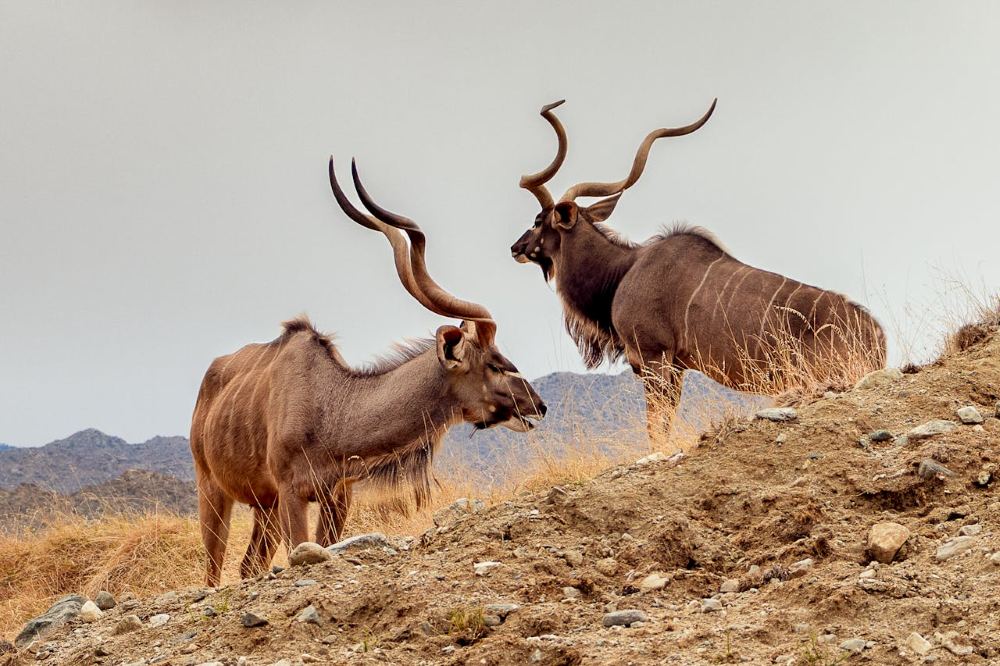
At first the animal is almost invisible. Kudu blend perfectly into their surroundings, and the grey coat with its thin white stripes disappears against the bushveld.
Then the bull turns his head. And the horns catch the light.
Long spirals rise above his ears, twisting upward in elegant curves that instantly capture a hunter’s attention. For a moment nobody moves.
Then the hunter turns to the professional hunter and asks the question that has been asked on countless African safaris:
“Is he big enough… or should we keep looking?”
Judging kudu horn size is one of the most difficult and misunderstood parts of hunting Africa’s famous gray ghost.
For hunters planning kudu hunts in Africa, understanding how big kudu actually get—and how experienced professional hunters judge bulls—can make a huge difference when that moment finally arrives.
Greater kudu are one of the most sought-after plains game animals in Africa and are widely considered the most iconic antelope hunters pursue on African safaris. Hunters often call them Africa’s Gray Ghost, because even very large bulls can disappear into thick bush almost instantly without a trace, never to be seen again.
Kudu hunting is rarely done in isolation. In most cases, it forms part of a broader plains game safari where hunters pursue multiple species across the same terrain. This not only increases opportunity in the field but also creates a more complete and rewarding African hunting experience. To better understand how kudu fits into a wider safari strategy, explore our guide to plains game hunts in Africa, where we break down species combinations, destinations, and what to expect from a multi-species hunt.

How Big Do Kudu Actually Get?
Greater kudu are among the largest antelopes in Africa. Mature bulls can grow spectacular spiral horns making them one of the most recognizable trophies on an African plains game safari.
Hunters often ask a simple question: How big do kudu actually get?
The answer depends on several factors, including age, genetics, and habitat. However, experienced hunters generally use a rough guideline when discussing trophy size.
Quick Kudu Trophy Size Guide
Horn Length Trophy Description
40-45 inches Young Bull
45-50 inches Mature Bull
50-54 inches Excellent Trophy
55 inches + Exceptional Bull
60 inches + Extremely Rare
Many first-time hunters are surprised by how impressive a 50-inch kudu actually looks in the bush.
In thick African vegetation, a mature bull with heavy horns and a large body can appear quite enormous. When a bull like that steps out of the brush, it is a moment that most hunters remember for the rest of their lives.
Bulls exceeding 55 inches are already exceptional animals.
True 60-inch bulls are extremely rare anywhere in Africa and are considered world-class trophies.
Why Some Kudu Look Smaller Than Others
Hunters who travel to different parts of southern Africa sometimes notice something interesting.
Kudu taken in one region may appear noticeably larger than animals taken in another. For example, a mature bull taken in the Eastern Cape of South Africa may appear smaller than bulls hunted in areas such as Limpopo, Namibia, or Zimbabwe.
This sometimes leads hunters to believe they are dealing with a different species.
In reality, they are not as both trophies are, in fact, Greater Kudu.
Environmental factors play an important role in how large animals grow. Rainfall, soil nutrients, and vegetation all influence body size and horn development.
The Eastern Cape is dominated by dense thicket vegetation and rugged terrain. Kudu living in this habitat are extremely well adapted to the environment, but they often grow slightly smaller bodies than animals living in more open regions.
In contrast, areas such as Limpopo and Namibia often produce larger-bodied kudu with heavier horns.
But they are all still classic greater kudu.
Greater Kudu vs Lesser Kudu
Another point that occasionally confuses hunters is the name “Lesser kudu.”
The lesser kudu is not simply a smaller version of the greater kudu.
It is a completely different species.
Lesser kudu are found mainly in East Africa, including countries such as Kenya, Ethiopia, as well as parts of Tanzania.
This species has tighter spiral horns, more pronounced white body stripes, and a smaller overall body size.
Because they live in remote regions and are much more difficult to hunt, lesser kudu safaris are typically far more expensive than greater kudu hunts in southern Africa.
For most hunters traveling to South Africa or Namibia, the animal they pursue is the greater kudu, the iconic grey ghost of the African bush.

Why Kudu Horns Are So Difficult to Judge
Judging kudu horns in the field is surprisingly difficult.
The primary reason is the spiral shape of the horns.
Unlike straight horns, kudu horns twist upward in long spirals. That spiral shape can create powerful visual illusions.
A bull with wide open spirals may appear longer than he actually measures.
Another bull with tighter spirals may look shorter, even though his horns measure longer along the curve.
The angle from which the hunter sees the animal also plays a major role. If a bull is standing broadside, the entire horn may be visible. But if he turns his head slightly, part of the spiral may disappear behind his ears or into the brush.
Distance makes the problem even harder.
Many kudu are first spotted at 150 to 250 yards, sometimes even farther. At that distance, small differences in horn shape can be difficult to judge accurately.
Then there is the bush itself.
Branches may hide the tips of the horns. Shadows may conceal the lower spirals. A bull may step behind a tree just as the hunter tries to study him.
It is no surprise that kudu have earned the nickname Gray Ghost of Africa.
Even experienced hunters sometimes struggle to judge them correctly. It is a learning process that humbles even the most seasoned hunters.
Why Kudu Horns Spiral
The spiral shape of kudu horns is not only beautiful but also practical.
Only male kudu grow horns.
During the breeding season, bulls compete with each other for access to cows. When two bulls fight, their horns lock together.
The spiral design allows them to push against each other without breaking their horns.
Over time those horns grow longer and more dramatic, forming the elegant twisting spirals that make kudu one of the most admired and iconic animals in Africa.
What Professional Hunters Look For
Professional hunters (PHs) rarely judge a kudu bull based on horn length alone.
Instead, they study the entire animal.
A mature bull often looks different from younger animals. His shoulders appear heavier and his neck thicker than a younger male. The chest is deeper, and the bull often carries himself with a certain confidence that experienced hunters recognize immediately.
The bases of the horns are another important clue. Mature bulls often have heavier bases than younger animals.
One of the small details PHs watch carefully is the horn tips. Younger bulls usually have sharp, pointed tips. Older bulls often show worn or slightly blunted tips from years of fighting and moving through thick bush.
Behavior also tells an important story.
Young bulls frequently travel together in bachelor groups, while older bulls are often solitary animals that move quietly through thick vegetation, their confidence evident.
These subtle clues help professional hunters determine whether a bull is truly mature.
How PHs Learn to Judge Trophy Animals
Judging trophy animals takes time and experience and is certainly not something that is learnt overnight. It takes time, practice, and experience to correctly judge trophy species.
In South Africa, many professional hunters spend months learning to judge animals during their training. This skill is something that takes time to hone.
For example, in schools such as the Vanderkloof Professional Hunter Training Academy, students spend long hours studying horns and skulls, with rows of kudu horns placed on tables. Students must estimate the horn length before measuring them with a tape.
They repeat this process again and again, training themselves and getting their eye in.
The goal is to train the eye to recognize the difference between a 48-inch bull, a 52-inch bull, and a 56-inch bull.
But judging horns in a classroom and judging them in the bush are two very different things. Firstly, on the table, there is no stress of Africa’s Gray Ghost doing what it does best and disappearing into the veld in what is a very possible scenario in the wild.
Secondly, on a table, the horns are clearly visible.
In the field, the animal may be partly hidden by brush, standing in shadow, or moving slowly through thick vegetation.
That is why even experienced hunters sometimes hesitate before making the final call.

The Pressure on Young Professional Hunters
Many visiting hunters do not realize how much pressure can fall on the professional hunter in those moments.
In some areas of South Africa, kudu may be priced according to horn length. A difference of only a few inches can significantly change the trophy fee.
International hunters often spend a considerable amount of money traveling to Africa, and expectations can be high, very high in fact.
When a PH recommends a bull, the hunter trusts that judgment. It’s a given that a PH’s knowledge and experience set him apart as being able to accurately judge horn length.
But judging a bull standing in thick bush at two hundred yards is never an exact science.
Young PHs in particular can feel enormous pressure in those situations. Some even prefer recommending slightly smaller bulls rather than risking a mistake that could create problems later.
Trophy Expectations and Hunter Responsibility
Traveling to Africa for a safari often represents a once-in-a-lifetime experience for many hunters. You know….the bucket list experience that everyone talks about.
Flights, permits, and safari costs make the trip a major investment.
Because of this, many hunters arrive with clear expectations about the size of the trophy they hope to take.
And expect to take.
For many international hunters, kudu quickly become addictive animals to pursue.
Much like elk, moose, or whitetail deer in North America, hunters often find themselves wanting a bigger animal each time they return.
A hunter might take a solid 48-inch bull on his first safari. On the next trip, he hopes for a 52-inch bull to better his previous hunt. A few years later he may begin dreaming about something even larger.
It’s true. The pursuit of trophy kudu can become quite addictive – the challenge of hunting an even bigger trophy each time becomes a measurement of the success of the safari.
That desire to improve on a previous trophy is part of hunting everywhere in the world.
But not every hunter has the luxury of returning to Africa again and again. Many international hunters save for years to make a single safari possible.
Because of that, expectations can become very high, and the pressure placed on professional hunters to judge bulls correctly in difficult conditions can increase significantly.
At the end of the day, both the hunter and PH are trying to make the best decision possible for the best possible outcome, in a moment that may last only a few seconds. The intensity of that moment is quite unlike anything that hunters may have experienced before.
At the end of the day, both the hunter and PH are trying to make the best decision possible for the best possible outcome, in a moment that may last only a few seconds. The intensity of that moment is quite unlike anything that hunters may have experienced before, which is why understanding large antelope shot placement is such an important part of preparing for a successful kudu hunt.
Modern Breeding Programs and Giant Kudu Bulls
South Africa also has a large wildlife breeding industry.
Some breeders focus on selectively breeding animals with exceptional genetics, including longer horns and heavier bodies. Over several generations, these programs can occasionally produce animals with unusually large horn measurements.
Because of this, hunters sometimes see photographs online of enormous kudu bulls that are far outside the averages found in wild populations.
In truly free-range regions across Africa, however, a 50 to 55-inch bull is already considered an outstanding trophy.
Understanding this difference helps hunters set realistic expectations before planning a safari.
The First-Bull Mistake Many Hunters Make
Something interesting often happens during the first few days of a kudu safari.
A good bull appears.
The PH studies the animal and quietly says, “That’s a good bull.”
But the hunter hesitates.
It is the first kudu he has seen on the safari, and he begins to wonder if something bigger might appear tomorrow.
So the opportunity passes.
The bull disappears into the bush.
Days later, the hunter begins to realize that the first bull might actually have been the best animal of the entire safari. Too late to cry over spilt milk.
It is a lesson many hunters eventually learn.
The Advice Many Professional Hunters Give
After years of guiding hunters, many professional hunters develop a simple philosophy.
When the hunter asks, “Is he big enough?” the PH often replies, “If you like him… shoot him.”
Because opportunities in the African bush can disappear quickly.
A mature kudu bull may appear for only a few seconds before melting back into the vegetation.
And once that moment is gone, there is no guarantee another chance will come.

Conclusion
A great kudu is not measured only in inches.
It is measured in the experience of the hunt itself.
The long stalk through the bush.
The quiet whisper from the professional hunter as he spots the bull in the dense undergrowth.
The moment the bull finally appears…
The memory that stays with the hunter long after the safari ends.
And sometimes the best advice is the simplest: If you like him… shoot him...
Frequently Asked Questions
What is considered a big kudu?
A kudu bull measuring around 50 inches or more is generally considered an excellent trophy in most parts of southern Africa.
How long are kudu horns?
Mature bulls typically carry horns between 45 and 55 inches, measured along the spiral.
Are 60-inch kudu common?
No. Bulls exceeding 60 inches are extremely rare and represent exceptional trophies.
What country produces the biggest kudu?
Large kudu bulls are often found in Namibia, Limpopo in South Africa, and parts of Zimbabwe, where habitat and genetics support larger animals.
Why are kudu called Africa’s Gray Ghost?
Kudu are called the Gray Ghost because of their grey coloring and their remarkable ability to disappear quickly into thick African bush.
Explore Hunting Destinations
Author
Game Hunting Safaris Team
Pierre, Tamlyn, and their family have hunted kudu across many regions of South Africa over the years. Through their experience guiding international hunters—especially visitors from the United States—they have seen firsthand how challenging it can be to judge kudu bulls in the field. A kudu hunt is not simply another African safari; it’s the opportunity to challenge yourself against one of Africa’s most iconic and recognised antelopes.
Their goal is to help hunters manage their expectations and fully understand the realities of African hunting safaris, in order for them to make informed decisions and fully appreciate one of Africa’s most iconic hunts.