
Published: 25 March 2026
Author: Pierre van Wyk
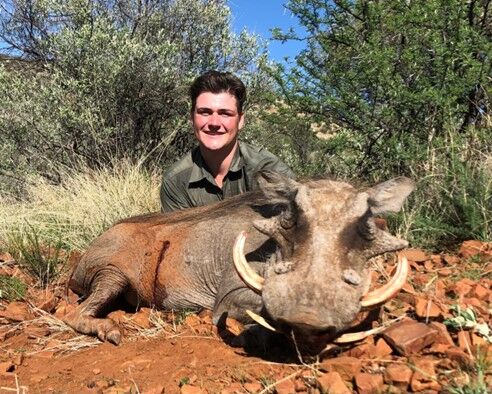
Warthog hunting in Africa is one of the most exciting hunting safaris you can enjoy.
[DYNAMIC-BLOGTABLEOFCONTENT]
Planning Warthog Hunts in Africa
Hunters interested in pursuing this species can explore available warthog hunts in Africa across several well-known hunting destinations.
Few hunters travel to Africa specifically to hunt warthog. Most arrive dreaming about kudu, gemsbok, buffalo, or another iconic African species they have seen in magazines or hunting shows.
But after a few days in the bush something usually changes.
Because warthogs have a habit of creating some of the most exciting moments of the entire safari. Unexpected, but so memorable.
The grass moves. A dark shape bursts out. A tail shoots straight up into the air like a flag. And suddenly everyone is scrambling for the sticks.
That moment happens so quickly that most hunters remember it long after the hunt is over.
While many hunters initially focus on a single species, warthog hunts are often just one part of a broader safari experience. Across Africa, these animals are commonly pursued alongside iconic plains game such as kudu, impala, zebra, and wildebeest, all of which share similar habitats and hunting conditions. Combining species not only maximizes time in the field but also creates a far more dynamic and rewarding safari. To explore how warthog fits into a wider safari strategy, visit our plains game hunts in Africa guide, where you’ll find a complete overview of species, destinations, and what to expect from a multi-species hunt.
Warthog Hunting at a Glance
Warthogs are one of the most widespread and entertaining plains game animals hunters encounter in Africa. They are fast, unpredictable, surprisingly tough, and often appear when least expected during a hunt.
Understanding how warthogs behave, where they live, and how their anatomy differs slightly from antelope can greatly improve hunting success. This guide explains how warthogs move through their environment, how they are typically hunted, where shot placement is most effective, and why these animals have earned a reputation for creating some of the most memorable moments on an African safari.
Why Hunters Are Fascinated by Warthogs
Most hunters arrive in Africa with a plan. There is usually a specific animal they hope to pursue. The focus might be kudu, buffalo, or maybe sable.
But once the hunting begins, warthogs have a way of stealing the spotlight.
They appear suddenly, run like lightning, and disappear into thick bush before a hunter has much time to think. When a mature boar presents itself, very few hunters ever say no.
Professional hunters see it all the time. A client may have travelled halfway across the world to hunt one particular animal. Yet when a big pig suddenly crosses the clearing, priorities change quickly. Very quickly.
Warthogs have that effect on people…

Understanding Warthog Behavior
The common warthog occurs across much of southern and eastern Africa and is one of the most adaptable animals on the continent.
Despite their unusual appearance, they thrive in many different environments. They are commonly found in bushveld, open savannah, farmland edges, and grasslands where they can dig for food and still have access to burrows for protection.
Warthogs are most active during the cooler parts of the day, usually early morning and again late in the afternoon. During the heat of midday they often retreat into burrows where temperatures are cooler and predators are less of a threat.
Much of their time is spent feeding. They dig constantly for roots, bulbs, and other underground food sources, using their snouts and tusks to break open the soil.
Where Warthogs Are Found
Warthogs are widely distributed throughout several popular hunting destinations in Africa. Hunters frequently encounter them in South Africa, Namibia, Zimbabwe, Zambia, and Botswana.
They prefer areas that offer a mix of open feeding ground and some form of shelter. Bushveld terrain with sandy soils tends to hold good numbers, although they can also thrive in agricultural areas where food is plentiful.
Because they adapt so easily to different environments, warthogs are often encountered during hunts for other plains game animals.
Hunting Methods
There are several ways warthogs are typically hunted during an African safari.
The most traditional method is spot and stalk hunting. Hunters locate animals feeding in open areas and carefully stalk within shooting distance using available cover. Because warthogs often feed with their heads down while digging, it can sometimes allow a hunter to close the distance more easily than expected.
Another effective method is hunting near waterholes, particularly during dry conditions. When water becomes scarce, many animals concentrate around reliable water sources, including warthogs.
However, many warthogs are taken opportunistically. Hunters stalking for kudu, impala, or wildebeest often encounter a boar suddenly crossing an opening or feeding along the edge of the bush.
In Africa, hunts rarely unfold exactly as planned. And that’s exactly what makes it so exciting.

Shot Placement
Although warthogs are not large animals, they are tougher than many hunters expect.
The best shot is usually a broadside heart-lung shot placed just above the front leg about one-third of the way up the body. This position reaches the vital organs and typically produces a quick and ethical harvest.
One challenge hunters quickly discover is that warthogs rarely stand still for long. Quite often the opportunity presents itself when the animal is already running or about to disappear into thick bush.
Because of this, good shot placement becomes even more important.
Warthogs can also be remarkably resilient when hit poorly. On one occasion I shot a running boar and struck the back leg instead of the vitals. What followed turned into a very long tracking day. That pig covered more than five miles before we eventually caught up with it and managed to deliver the coup de grâce.
That experience reinforced something many hunters learn sooner or later in Africa: even smaller plains game animals deserve respect and careful shot placement.
Why Warthog Shot Placement Can Be Misleading
Warthogs can also be deceptive when it comes to where their vital organs sit.
Because of their large head, thick neck, and heavy shoulders, many hunters assume the vital area lies farther forward than it actually does. In reality the heart and lungs sit slightly farther back in the body than most people expect.
Shots placed too far forward may strike heavy muscle or shoulder bone without reaching the vital organs.
Professional hunters often remind clients to aim just behind the front leg rather than too close to the shoulder. Understanding this small anatomical difference can make the difference between a quick recovery and a long tracking job.
Suitable Calibers
Most standard plains game calibers are perfectly suitable for warthog hunting. Rifles such as the .243 Winchester, .270 Winchester, .308 Winchester, and .30-06 Springfield are commonly used and more than capable of handling the job.
In practice, accuracy and shot placement matter far more than the size of the caliber.
Why Warthogs Run With Their Tail Up
One of the most recognizable sights in Africa is a warthog running away with its tail sticking straight up in the air.
This behavior serves a simple purpose. The raised tail helps other members of the group follow one another through tall grass while escaping danger.
For hunters, that upright tail is often the last thing visible before the animal disappears into thick bush.
Warthogs and Their Burrows
Unlike many plains game animals, warthogs depend heavily on burrows.
Most of these burrows were originally dug by aardvarks and later adopted by warthogs as shelter. These underground refuges provide protection from predators as well as relief from extreme temperatures.
Interestingly, warthogs usually enter their burrows backwards. This allows their tusks to face outward toward the entrance, giving them a defensive advantage if something attempts to enter.
Why Warthogs Often Stop and Look Back
Many hunters eventually notice a curious behavior in warthogs.
After running from danger, a warthog will often stop after forty or fifty yards and look back. The animal is trying to reassess the threat and determine whether it is still being pursued.
For hunters this brief pause can create a second opportunity. A warthog that seemed to vanish moments earlier may suddenly stop and present a shot before disappearing again.
PH Tip: Stay Ready
Professional hunters often remind their clients to stay on the sticks for a few seconds after a warthog begins running.
Because they frequently stop and look back, the opportunity may not be over yet. Sometimes the second shot presents itself only moments later.
When a Warthog Steals the Moment
A professional hunter once told a story about a Spanish client who had travelled to Africa three times searching for a sixty-inch kudu.
On the third safari they finally got the opportunity. The hunter fired and the kudu ran off into the bush.
As the PH turned to discuss the follow-up, he noticed the hunter loading his rifle again.
“What are you doing?” he asked.
The hunter replied without hesitation.
“There was a big pig. I could not say no.”
Most professional hunters smile when they hear that story, because they have seen the exact same thing happen many times.

Warthog Meat and Processing
Many hunters are surprised by how good warthog meat can be.
It is lean, flavorful, and very versatile. In many hunting camps the meat is used for steaks, roasts, sausages, or biltong.
Often the meat from a freshly harvested warthog ends up around the fire the same evening.
Crop Damage and Population Management
Warthogs can also create challenges for farmers.
Their digging behavior damages crops, irrigation systems, and pastures. In agricultural areas they can become a nuisance species if populations grow too large.
Responsible hunting helps manage these populations while also providing meat and income for local communities.
How Fast Warthogs Reproduce
Warthogs reproduce relatively quickly compared to many other animals.
Sows typically give birth to litters of two to four piglets, although larger litters can occur. Because of this reproductive rate, populations can grow rapidly in areas where food and habitat are plentiful.
Warthogs Can Be Dangerous
Despite their somewhat comical appearance, warthogs should never be underestimated.
A wounded boar may turn and charge if cornered. Their sharp tusks can slash upward and cause serious injuries.
Professional hunters treat them with respect, especially when tracking a wounded animal in thick bush.
Warthogs Are Not Pets
Some people believe warthogs can be tamed.
That assumption has caused problems before.
One professional hunter named Peter once dealt with a supposedly tame warthog at an outfitter’s property. Peter weighed around 280 pounds, but when the pig charged it dragged him nearly fifty yards and broke his arm cleanly in half.
He required surgery with metal plates inserted and missed the entire hunting season.
Wild animals remain wild animals.
Why Tusks Differ by Region
Warthog tusks can vary depending on the terrain where the animals live.
In areas with sandy soil, tusks often grow longer because they experience less wear while the animal digs for food. In rocky terrain, tusks are constantly rubbed against hard soil and stones, which gradually wears them down.
As a result, two boars of the same age may show very different tusk lengths depending on the environment they inhabit.
Taxidermy and Trophy Options
Warthogs offer several interesting trophy possibilities.
Some hunters choose shoulder mounts to capture the distinctive face and tusks of the animal. Others prefer European skull mounts that emphasize the shape and size of the tusks.
In some cases tusks are also used for knife handles or walking sticks, creating practical keepsakes from the hunt.
One of the Most Underrated Animals on Safari
At first glance warthogs may not appear as impressive as Africa’s larger antelope.
But hunters quickly discover they create some of the most memorable moments of a safari.
In fact, most campfire stories are not about the perfectly planned plains game hunt. They are about the unexpected chaos caused by a warthog.
A pig bursting from the grass at the wrong moment. A missed opportunity. A sudden charge. Or the hunter who simply could not resist pulling the trigger.
As long as the animal is a mature boar, very few hunters ever say no.
Author Bio
Pierre van Wyk works in the African safari industry and has spent many years hunting plains game across Africa.
Pierre, together with Tamlyn and their children, has taken numerous warthogs throughout southern and eastern Africa. One rule has generally applied in camp: if the animal is a mature boar, they have almost never said no to the opportunity.
Much of the knowledge shared in this article comes directly from years spent hunting and guiding in the African bush.