
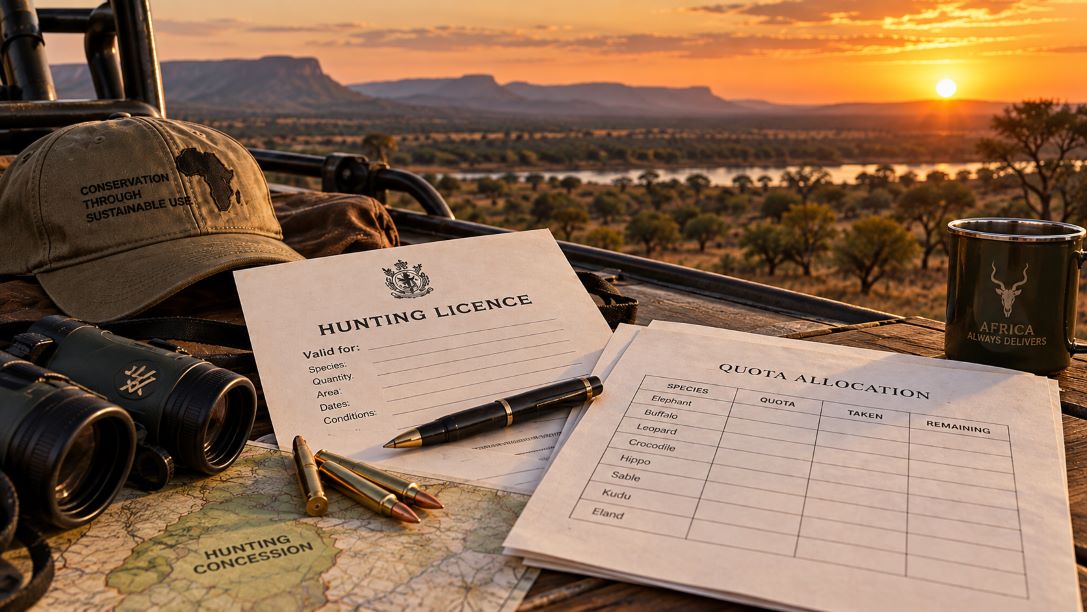
A long species list can make an African hunt look exceptional on paper. Buffalo, kudu, sable, elephant and a dozen other species may all appear on a licence, quota sheet or package, and at first glance it can look as though the hunter has everything in front of him.
The problem is that a species appearing on paper does not automatically mean it is a realistic option in the exact area being booked. It may be legal in the country, it may exist somewhere on quota, and it may even be advertised as available. That still does not mean the hunter has a sensible chance of hunting it on that safari.
When comparing African hunting trips, one of the most important things to understand is the difference between what is available on paper and what is available in the field. Country availability is not concession availability, and quota availability is not the same as a realistic hunting opportunity.
Before paying a deposit, a hunter should know what is legally available, what is allocated to the exact hunting area, and what is present there in huntable numbers during his dates. Those are three different questions, and confusing them can turn an expensive safari into a very disappointing one.
What Quota Actually Tells You, and What It Does Not
Quota is important because it sets the legal limit on what may be taken from a hunting area during a season. Hunters often give the word more weight than it deserves when they are comparing safaris.
A quota can show that a species has been allocated to an area. It can show how many animals may be hunted. It does not automatically show whether that quota is still unsold, whether the species is currently present in useful numbers, or whether the hunter has a realistic chance of finding the right animal during his dates.
There can also be a difference between quota that exists on paper and quota that is available to the client. An outfitter may have had several animals allocated at the start of the season, but some of that quota may already have been sold or hunted before the next client arrives. The same applies to the animals themselves. A species may occur in the wider region and still be scarce in the exact concession being hunted. It may move seasonally, concentrate around particular habitat, or spend part of the year in a completely different area.
An elephant can be on quota and present in the concession during one part of the season, then become far less realistic during the month a hunter has booked because the herds may have moved elsewhere.
Rainfall, water availability, food, breeding behaviour and pressure from people or other hunting activity can all affect where animals are found. Timing matters just as much as the quota itself. A species that is a realistic objective in June may be a weaker prospect in October, even in the same concession.
The useful question is not only, “Is this species on quota?”
The better question is: “Is there still quota available to me, and is there a realistic hunting opportunity for that species in this exact area during my safari?”
Those two questions can produce very different answers.
Country Availability Is Not Concession Availability
A country can hold an impressive range of huntable species. That does not mean every hunting area within that country offers the same opportunity. Africa is too large, too varied and too dependent on habitat for that to be true.
The exact concession matters because species distribution can change across a country. Soil, rainfall, altitude, water, vegetation and historical range all influence where animals occur. Two hunting areas in the same country can therefore offer different species lists in practice, even though both operate under the same national hunting system.
Hunters can get caught by broad marketing language. Seeing that a species is “available in Tanzania,” “available in Zimbabwe,” or “available in Zambia” tells you little until you know where in that country the animal is found and whether the hunting area you are booking falls within that range.
A good booking conversation should therefore move quickly from the country to the exact concession. The useful question is not simply, “Can I hunt this species in Tanzania?” It is, “Can I realistically hunt this species in the exact block I am booking?”
That distinction is especially important when a hunter is trying to build a safari around several priority animals. The broader the wish list, the more likely it is that one hunting area will not cover everything.
Tanzania: The Licence List Is Not the Hunting Area
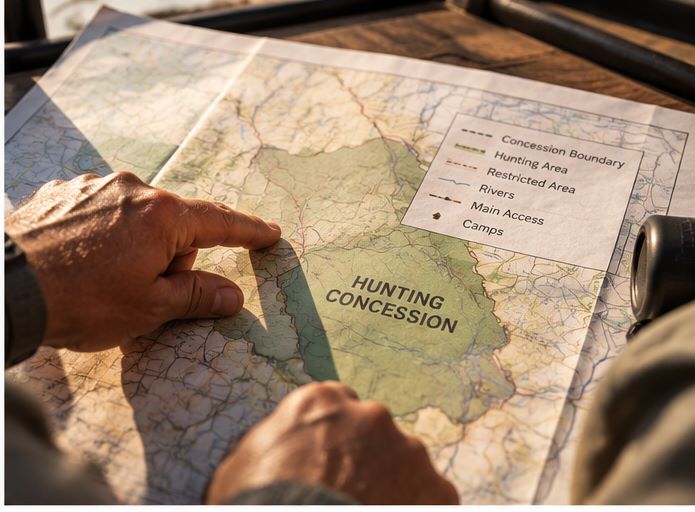
Tanzania is a clear example of why a long species list can be misunderstood. A hunter may be shown a 21-day licence or package with a wide range of animals and assume that all of them are options on the same safari. In practice, this depends heavily on the exact hunting area.
A concession in the Selous can offer excellent opportunities for certain species, while animals such as gerenuk, fringe-eared oryx, Grant’s gazelle and Thomson’s gazelle may be stronger in Masailand or another part of the country. The problem is not always that those animals are hundreds of miles away. A hunting block can cover hundreds of square miles and still be the wrong ground for one of the species near the top of the hunter’s list.
Planning matters. If a hunter wants a very broad Tanzania species list, he must discuss those priorities with the outfitter before the safari and ask which animals are realistic in the main concession and which may require access to another area. In some cases, arrangements can be made with another operator or concession holder, but that needs to be planned and agreed in advance.
We have seen hunters travel to the right region for a very specific species list, take several of their priority animals, and still go home frustrated because access to a neighboring concession had not been arranged for the remaining species. The animals were not necessarily far away. The opportunity simply sat on the other side of a boundary the hunter could not cross.
If one or two priority species are stronger in an adjoining area, that access should be discussed and agreed before the safari starts. Waiting until the hunter is already in camp may be too late.
The hunter also needs to allow for the time involved. A second hunting area may look close on a map and require hours of travel over bush roads. That can mean leaving camp before daylight, returning late at night, or spending a night away in a fly camp. If several priority species require different areas, extra travel days may need to be built into the safari.
Cost must be confirmed as well. Trophy fees are not always the same from one concession to another. A second concession holder may charge a different amount for the same species, particularly where he has stronger numbers or limited quota.
If another area may be needed, the hunter should know the trophy fee, access costs and any other charges before the hunt moves there.
Zimbabwe: Available in the Country Does Not Mean Available in Your Area
Zimbabwe is another good example of why country-level availability can be misleading. A hunter may see tuskless elephant, buffalo, leopard or another species advertised as available in Zimbabwe and assume that means it is a realistic option in any hunting block he books.
It does not.
A species can be huntable in the country and still be a weak prospect in the exact concession where the safari is taking place. Tuskless elephant are a good example. One area may have a meaningful number of suitable animals moving through it, while another area hundreds of miles away may offer little opportunity during the same period.
The same principle applies even when the distances are smaller. Wildlife distribution does not follow booking brochures or national boundaries neatly. Animals concentrate where habitat, water, food and movement patterns suit them, and those conditions change from one hunting block to the next.
That means the hunter should ask more than, “Can I hunt tuskless elephant in Zimbabwe?”
The useful question is, “How often are tuskless elephant actually hunted successfully in this exact area, and what is the current opportunity like for my dates?”
Recent area history matters here. If the last few hunters have struggled to find suitable animals, or if most of the current activity is taking place in another part of the country, that should form part of the booking conversation before the safari is confirmed.
A hunter should never expect a guaranteed animal. He is, however, entitled to understand whether the opportunity being sold is based on recent reality in the exact hunting area, or simply on the fact that the species appears somewhere on Zimbabwe’s wider hunting list.
When One Safari Needs More Than One Hunting Area
A broad species list does not always mean a hunter needs to abandon the original plan. The better solution may simply be to build the safari around more than one hunting concession from the start.
If that is likely, the important thing is to know it before booking. The hunter must understand which species belong in the main area, which may require access elsewhere, and whether the extra travel still leaves enough hunting time for the priorities that matter most.
There is nothing wrong with a hunter wanting a long species list. Some hunters travel to Africa with a very specific collection in mind and, if time and budget allow, may want to pursue almost everything available. In that case, the itinerary may need to include several hunting areas rather than trying to force every species into one concession.
A better approach is to decide which species matter most and build the safari around those priorities first. Other animals can then be added where the area, quota and timing make sense. Hunting is not always a shopping list, but if the hunter does have a long one, the logistics need to match it.
Recent Area History and Available Quota Both Matter
A hunting concession can have a strong reputation and still be a poor choice for a particular species at the time you are booking. What an area produced five or ten years ago is useful background, but it is not the same as knowing what hunters are seeing and hunting there now.
Recent history matters because game numbers, movement patterns, water, hunting pressure and neighboring land use can all change. A concession that was once known for a certain species may have weaker numbers today, while another area may be producing better opportunities during the same season. Hunters must therefore ask for recent information from the exact area being booked. When was the species last hunted successfully there? How often are suitable animals being seen? Have the last few hunters had realistic opportunities, or are most of the stories coming from older seasons?
If possible, ask for the contact details of one or two recent hunters who hunted that exact area. Ask what they saw, how often they encountered the species you are interested in, what the hunting pressure was like, and whether the opportunity matched what they had been told before the safari.
Professional hunters and trackers usually have a good feel for this because they are working the ground regularly. Fresh tracks, sightings, trail-camera photographs and recent hunts can all help build a more accurate picture of what is happening in the area now. But current animal numbers are only half the picture. The hunter also needs to know whether the quota is actually available for his safari. A species may be on quota in the concession, but part of that allocation may already have been sold, reserved for another client or used earlier in the season.
If a priority species is one of the main reasons for booking the hunt, ask whether that quota is being held for your dates or whether it remains subject to availability. The quotation, hunt agreement or booking confirmation should make clear what has actually been reserved and what has not.
None of this guarantees success. Hunting remains hunting. But there is a difference between booking an area because it has a famous name and booking it because the animals are there now and the quota is genuinely available to you.
What to Confirm Before Paying a Deposit
By the time a hunter reaches the deposit stage, the important questions should already have moved beyond the basic safari price. Understanding the wider structure of African hunting safari prices matters, but the hunter needs to know exactly what the quotation covers and what assumptions are being made about the species he wants to hunt.
If one or two animals are the main reason for booking the safari, confirm whether quota has actually been reserved for those species, whether they are expected to be hunted in the main concession, and whether access to another area may be required. If another concession could be involved, ask whether trophy fees, daily rates, transport or access charges will change.
The hunter must also understand what remains subject to availability. There is a big difference between a species being listed on a general price sheet and that species being specifically available for the dates and area being booked. If the safari depends on a particular animal, that distinction should not be left vague.
This is also the right time to ask what the outfitter is basing the opportunity on. Recent successful hunts, current sightings, tracks, trail-camera photographs, local movement and the PH's own time in the area can all help explain why a species is considered realistic.
A good outfitter should be comfortable answering those questions. He cannot guarantee an animal, and an experienced hunter should be suspicious of anyone who does. What he should be able to do is explain why the opportunity is realistic, what the limitations are, what may change before the hunt, and what the backup plan is if the original area does not produce as expected.
The hunter is not asking for a promise. He is asking for a clear picture of what he is paying for.
Frequently Asked Questions
Does hunting quota guarantee I will have a realistic opportunity for that species?
No. Quota only confirms that a species may legally be hunted within the relevant allocation. A realistic opportunity also depends on whether the quota is still available, whether the animal is genuinely present in the hunting area, the time of year, recent movement and current conditions in the concession.
Can a species be available in the country but not in the hunting area I book?
Yes. Species distribution can vary sharply between regions and concessions. A country may legally offer a
species, but the exact hunting block you book may have weak numbers or no realistic opportunity at all. That is why the exact concession matters more than a broad country species list.
Why are species such as sitatunga and lechwe in Zambia so area-specific?
Species such as sitatunga and the different lechwe populations are tied closely to particular wetlands, floodplains and habitats. Booking a safari in Zambia does not automatically mean those species are realistic options in every hunting area. The hunter needs to confirm where the animals occur and whether the concession being booked gives a genuine opportunity.
Can trophy fees change if I hunt a species in another concession?
Yes. Trophy fees, access charges, daily rates and transport costs can differ between concession holders. If another hunting area may be needed for one of your priority species, confirm the additional costs before the safari starts and again before the hunt moves into that area.
About the Author
Pierre van Wyk is the co-founder of Game Hunting Safaris and has spent years working with professional hunters, outfitters and international clients across Africa. He has seen first-hand how quota, concession access, species distribution and timing can affect a safari, and writes from practical experience helping hunters avoid costly booking mistakes.