
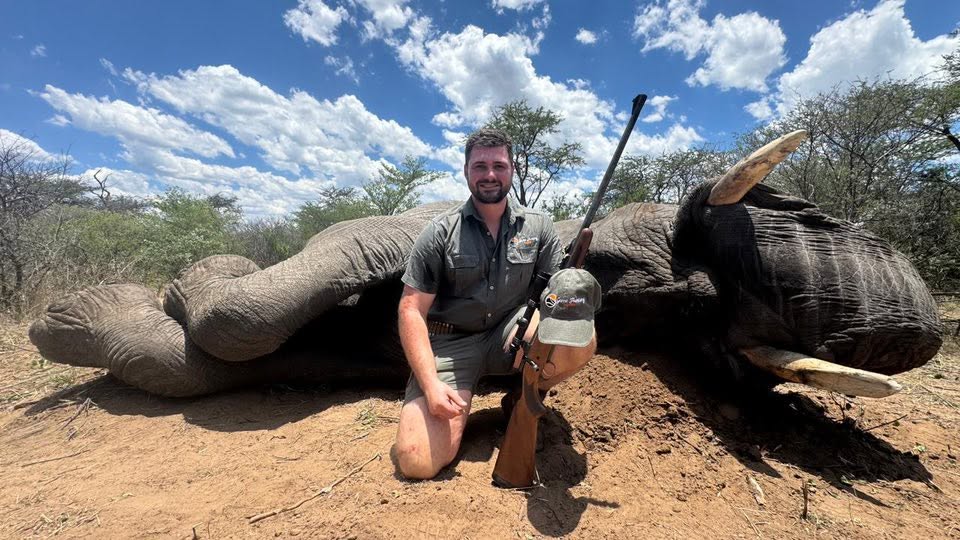
When Intelligence, habitat pressure, and the weight of the decision
Published: June 2026
Last Updated: June 2026
By Pierre van Wyk
Co-Founder, Game Hunting Safaris
A Note Before You Read
Most discussions about elephant hunting focus on tusk weight, record books, and photographs taken beside animals few people will ever stand next to.
Public debate, on the other hand, often centers on politics and outrage.
Very little space is given to what the experience actually feels like.
Tracking elephant for hours in dry heat.
Reading wind constantly.
Closing the distance deliberately and quietly.
Standing twenty yards from a mature bull.
Knowing there is no rehearsal for that moment.
Knowing there are consequences either way.
This article is not written to glorify or defend.
It is written to honestly describe what elephant hunting in Africa truly involves: wildlife management, habitat pressure, drought cycles, community realities, emotional weight, and responsibility.
If you are looking for a simple trophy story, this will not read that way. If you are trying to decide whether this hunt is right for you, this may help.
Why Elephant Is Different
Many seasoned veterans who have completed Cape Buffalo Hunts, Lion Hunts, and Leopard Hunts still pause when elephant enters the conversation.
That hesitation is rarely about fear. It comes from understanding that elephant are different.
Buffalo are respected for their aggression, lions for their status as apex predators, and leopards for their intelligence and unpredictability. Elephants command respect for another reason entirely. Their intelligence is impossible to ignore, and their social structure is visible even to a casual observer.
A breeding herd moves as a coordinated unit. A matriarch leads with quiet authority. Calves are protected instinctively. Communication flows constantly through posture, sound, and subtle vibration.
When you stalk an elephant, you are not simply pursuing an animal. You are stepping into a social system built on memory, experience, and cohesion. That reality changes the emotional tone of the hunt.
Even hunters who strongly support conservation and regulated elephant hunting often admit that elephant are the one species that force deeper reflection long before the trigger is ever pulled.
That reflection is not weakness.
It is respect.

Intelligence and Social Structure
Breeding herds operate with unmistakable cohesion. When one cow senses disturbance, the entire herd adjusts. Calves are repositioned instinctively. Heads lift. Ears spread. The matriarch evaluates the situation before movement occurs.
Lone bulls present a different dynamic. Older bulls often separate from breeding herds and move independently. They can appear calm, even relaxed, but their awareness is sharp. They read wind direction and terrain quickly. They notice subtle changes.
Standing within thirty yards of an African elephant creates a moment of mutual awareness. You understand that the animal knows you are there.
That exchange, silent and heavy, unsettles even experienced hunters. It should.
Habitat Pressure and Ecological Reality
Across parts of Southern Africa, elephant populations have grown substantially over the past several decades while available habitat has remained finite.
In Botswana, particularly along the Chobe River, elephant density is among the highest on the continent. Botswana is frequently cited as holding well over 100,000 African elephant in recent surveys.
That figure reflects conservation success. But conservation success introduces complexity.
When large herds concentrate around permanent water sources year after year, ecological pressure becomes visible in ways that are impossible to ignore. Mature trees are pushed over to reach high foliage. Bark is stripped from trunks. Mopane woodland thins gradually. Riverine forests open. Shade diminishes. Smaller browsing species shift patterns or are pushed out of heavily used corridors.
Elephants are often described as ecosystem engineers. At balanced densities across broad landscapes, they shape habitat in dynamic ways. At high localized densities, their impact accelerates change dramatically.
Watching that transformation over years creates a deeper understanding of why wildlife management decisions are rarely simple or emotionally neutral.
Drought, Quotas, and Management Decisions
Drought magnifies these pressures.
In parts of Namibia, where Elephant Hunting in Namibia takes place under tightly regulated quota systems, severe dry cycles have intensified habitat stress and human-wildlife conflict. When rainfall fails for multiple seasons, water shrinks to a few permanent sources. Vegetation weakens. Crop damage increases as elephants move closer to farmland.
In those conditions, wildlife authorities sometimes adjust quotas. These adjustments are not celebratory. They are management responses intended to reduce ecological strain and mitigate escalating conflict between wildlife and rural communities.
The African elephant is listed under CITES, with listing classifications differing by country. International export and import regulations are tightly controlled and subject to change based on conservation data and policy decisions.
Elephant hunting in Africa operates within these regulatory frameworks. It does not exist outside them.
Understanding this broader context does not remove the emotional weight of the hunt. It places it within reality.
Tracking Elephant on Foot
Elephant hunts begin long before the final approach.
At first light, trackers locate fresh spoor near water or feeding areas. The width and depth of tracks help estimate size and weight. Moisture in dung indicates how recently a herd passed. Grass disturbance reveals direction of travel.
Wind discipline becomes constant. A single swirl can undo hours of patient tracking.
Tracking elephant on foot requires restraint. The professional hunter evaluates terrain continuously, considering herd position, escape routes, and potential shooting angles before allowing the stalk to tighten.
There is no rushing the final approach. By the time a hunter stands within twenty yards of a mature bull, the physical work has already been done.
What remains is composure.

The Psychological Pressure at Close Range
Most elephant shots are taken inside thirty yards.
At twenty yards, scale alters perception. You hear breathing clearly. You notice small details that would be invisible at distance. The ground feels different beneath your boots.
Your heart pounds.
Most African countries require a minimum caliber for dangerous game, commonly starting at .375 H&H. Many professional hunters prefer larger calibers such as .416 or .500 Nitro Express for elephant due to penetration requirements and close-range follow-up reliability.
The brain shot window is precise. A small miscalculation in angle or timing can result in a marginal hit. Thick bush can quickly absorb a fleeing bull, complicating recovery.
Understanding precise angles and anatomy is critical, which we explain in detail in our elephant shot placement guide. Even experienced hunters have missed under that pressure.
And when that happens, the consequences extend beyond the moment.
The Reality Every Experienced Hunter Understands
Seasoned hunters know something that is rarely spoken openly, especially in marketing brochures or trophy photographs: even when preparation is thorough and decisions are sound, animals can be lost.
It is not common. It is never acceptable to be careless. But dangerous game hunting in thick country, at close range, under real pressure, carries risk.
At twenty or thirty yards, adrenaline is real. The margin for error narrows to inches. A brain shot missed by a small angle can mean a bull disappears into heavy cover in seconds. Thick bush swallows movement quickly. Dust settles. Sound fades. And what felt controlled a moment earlier becomes uncertain.
Following up a wounded elephant is physically demanding and potentially dangerous. Professional hunters and trackers will commit fully to the recovery. They will track as long as there is sign. They will push into thick cover. They will take calculated risks. That responsibility is taken seriously.
But Africa does not always give back what disappears into dense bush.
For a hunter who has saved for years, who has worked, planned, trained, and invested emotionally in the experience, losing a bull can be devastating. It is not only the financial loss, though that can be significant. It is the collapse of something that may have been a lifelong goal.
The weight is deeper than money. Knowing that a wounded elephant may still be out there carries a psychological burden that stays with you.
Ethical hunters feel that heavily. The thought of an animal suffering is not something brushed aside casually. It sits in the back of your mind. It affects sleep. It lingers long after the hunt has ended.
Anyone who claims that every dangerous game hunt ends perfectly has either not hunted long enough or chooses not to speak about the harder realities.
Acknowledging this possibility does not weaken elephant hunting. It reinforces the seriousness of it. It reminds every hunter that this pursuit demands preparation, composure, humility, and accountability.
When you understand that success is never guaranteed and responsibility is absolute, the moment at twenty yards carries even more weight. You are not simply taking a shot. You are accepting the consequences of whatever follows.
A Personal Reflection
On my own elephant hunt, we closed to roughly twenty yards on a mature bull. My heart was pounding so hard I could feel it in my hands. The air felt heavier. Sound narrowed.
When I fired, both barrels of my .500 Nitro Express discharged. For a split second, I am not entirely sure who got the bigger fright: me or the elephant. The recoil nearly put me on my back. I recovered, reloaded, and fired again.
Then there was stillness.
When the bull went down, I did not feel celebration. I felt weight. Tears came unexpectedly, not from regret and not from triumph, but from gravity. I had taken the life of something immense and intelligent.
In that moment, the scale of the animal was undeniable. The quiet afterward was different than any other hunt I had experienced.
At the same time, I had missed my son’s first elephant hunt in Namibia. He later told me nothing compares to the emotion that follows such an experience. He was right. There is joy. There is accomplishment. But there is also reflection, and sometimes sadness, because you understand what has taken place.
Both emotions can exist together. If you can take an elephant and feel nothing at all, it may be worth reconsidering why you hunt.

After the Shot
After the shot, the experience shifts from intensity to reflection.
There is often silence first. Dust settles. The scale of the animal becomes undeniable when you stand beside it. The texture of the skin, the size of the feet, the sheer mass of the animal…it leaves an imprint that photographs cannot capture.
Then the practical work begins. Documentation is completed. Measurements are recorded. Community members gather. Meat distribution is organized carefully. Nothing is wasted. In many areas, the protein provided from one elephant feeds families for an extended period.
But even amid the activity, reflection lingers. For many hunters, the emotional weight does not arrive at the exact moment of the shot. It arrives afterward, when adrenaline fades and clarity sets in. The realization settles slowly.
An elephant is not just another species on a list. For many, it becomes one of the most defining experiences of their hunting lives.
Who Elephant Hunting Is Not For
Elephant hunting is not for everyone, and that is not a criticism.
It is not for the hunter who feels deeply unsettled by the intelligence and social structure of the species. If standing within twenty yards of a visibly aware animal creates hesitation that cannot be reconciled, that feeling deserves respect.
It is not for someone pursuing adrenaline alone. Elephant hunting is intense, but it is not entertainment. It carries weight before the shot, during the shot, and long after the hunt is over.
It is not for the hunter who expects a simple or uncomplicated emotional experience. Elephant hunts often involve reflection and complexity. They demand composure at close range and emotional maturity afterward.
It is also not for someone unwilling to accept the broader realities of wildlife management. Habitat pressure, drought cycles, herd dynamics, and human-wildlife conflict are part of the context in which these hunts occur.
Even experienced hunters sometimes decide that elephant is not right for them. That decision deserves respect.
Weighing the Decision Carefully
If you are considering elephant hunting in Africa, take time to understand the ecological realities, regulatory structure, and psychological demands involved. This is not a hunt entered into casually. It requires clarity of purpose and an honest assessment of your own readiness.
There is no shame in deciding it is not for you. But if you choose to pursue it, do so with full awareness of what the hunt involves — not only physically, but emotionally and ethically.
Approach it with preparation. Approach it with humility. And approach it with respect for the animal, the land, and the responsibility that comes with the trigger.
Frequently Asked Questions
Is elephant hunting legal in Africa?
Yes. Elephant hunting is legal in specific African countries under government-regulated quota systems administered by wildlife authorities. These quotas are based on population data, habitat capacity, and human-wildlife conflict considerations. Regulations vary by country and can change depending on conservation assessments and international policy decisions.
Why do elephant quotas sometimes increase during drought?
During prolonged drought, habitat stress and human-wildlife conflict intensify. Water becomes scarce, crop damage rises, and elephants concentrate near limited resources. Wildlife authorities may adjust quotas temporarily as part of broader management strategies aimed at reducing ecological and community pressure.
Are tuskless elephant cow hunts common?
Tuskless cow hunts occur in certain management areas where herd reduction is necessary to maintain ecological balance. They are not trophy-driven hunts and are often more technically and emotionally demanding than bull hunts due to herd cohesion and defensive behavior.
How close are most elephant shots taken?
Most elephant shots are taken inside thirty yards. Close-range shooting requires precise shot placement, steady composure, and a clear understanding of elephant anatomy. Preparation and mental discipline are critical.
Is it common to lose an elephant after a shot?
It is not common when preparation and shot placement are correct, but it is a recognized risk in dangerous game hunting. Thick bush, close range, and the power of the animal can complicate recovery. Honest professionals acknowledge this possibility rather than pretending it never occurs.
About the Author
Pierre van Wyk is the co-founder of Game Hunting Safaris and a lifelong African hunter with decades of experience guiding international clients across Southern Africa. He has personally hunted elephant, buffalo, and other dangerous game species across multiple African countries and works closely with professional hunters, trackers, and wildlife authorities throughout the region.
His approach is simple: tell the truth from first-hand experience so hunters can make informed decisions based on reality, not marketing.