
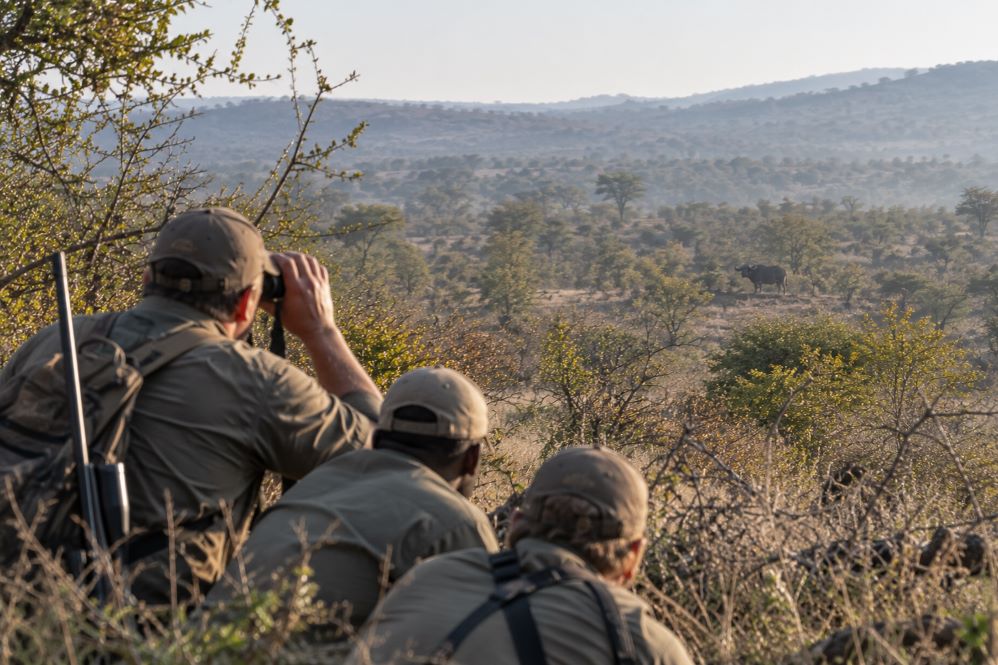
African hunting rarely moves at one speed.
A day may begin by covering ground quickly while tracks are still fresh, then slow to a crawl once the hunting team starts closing the distance. You may spend an hour gaining a few hundred yards, stop completely because the wind has changed, then have only seconds to decide whether the opportunity in front of you is the right one.
That change of pace is one of the things that catches visiting hunters out when hunting in Africa.
Distance can be deceptive too. An animal may be visible from a long way off, but that does not mean the hunt will be decided at long range. The real work may be in closing the distance, using the ground properly, waiting for the right angle and knowing when not to move.
When everything finally comes together, the decision window is often shorter than the hunt that created it.
That is where pace, distance and judgement come together.
The Hunt Rarely Moves at One Speed
One of the first things visiting hunters notice in Africa is how quickly the pace of a hunt can change.
There are times when the hunting team needs to cover ground. Tracks may be fresh, animals may be moving, or the country ahead may offer a better place to cut them off or ambush them. At that stage, there is no point in creeping along as if the animal is standing behind the next bush.
Then everything changes. Fresh spoor tightens up. A tracker slows down. Voices disappear. Boots start finding the quietest patches of ground. The PH checks the wind more often, and what looked like a straightforward walk suddenly becomes a careful stalk.
Sometimes the right move is no movement at all. A herd may be feeding just out of sight. Another animal may be standing where nobody wants it. The wind may be swirling. The hunting team may simply need to wait and let the situation develop instead of forcing it.
Some visiting hunters can become impatient. After walking hard for several hours, stopping for twenty minutes can feel like nothing is happening. That pause may be the most important part of the stalk.
Good African hunting is not about moving slowly all day. It is about knowing when to cover ground, when to slow down, and when to stop.
Seeing Distance Is Not Hunting Distance
A hunter can spot an animal from a long way off in Africa and still be nowhere near a shot.
That is true in open country, where a kudu, gemsbok or buffalo may be visible across a valley, riverbed or stretch of broken bush. The animal has been found, but the hunt may only be starting.
For hunters coming from the United States, that can take some adjustment. On a whitetail hunt, the shot may often be decided by a known stand, trail or opening. On a western elk or pronghorn hunt, you may glass across big country and still have to spend hours using ridges, folds and cover to get into position.
Africa can combine both ideas in the same stalk. You may see the animal from a long way off, but the ground between you and it decides what happens next.
The number on the rangefinder is only part of the story.
What matters is the ground between the hunting team and the animal. There may be a dry riverbed that gives cover, a ridge that hides movement, open terrain that cannot be crossed unseen, or thick bush that makes the final approach much shorter than expected.
Tamlyn van Wyk, co-founder of Game Hunting Safaris and a qualified Professional Hunter, says visiting hunters often focus on the animal they can see rather than the ground that still has to be hunted. From a PH’s point of view, the real question is what lies between you and the animal: wind, cover, open ground, other game and whether there is a practical route to close the distance without ruining the opportunity.
Sometimes several hundred yards can disappear quickly because the country allows it. On another stalk, gaining fifty yards may take half an hour. Seeing an animal and being able to hunt it are two different things.
The final shot may be relatively close, but the work required to create that shot could have started a long way away.
The Last Few Hundred Yards Change Everything
Closing the final few hundred yards is often where a straightforward stalk can become complicated.
At longer range, the hunting team may still have room to adjust. A ridge can be used differently, the wind can be tested again, or a new approach can be chosen. Closer in, those options start disappearing.
Noise and movement matter more.
A loose stone under a boot, a branch brushed at the wrong moment or a swirl in the wind can undo hours of work. Other animals may also become part of the problem. A zebra, impala or warthog that was never part of the hunt can suddenly be the animal most likely to give everything away.
The closer the team gets, the less margin for error there is.
The same principle applies whether the animal ahead is plains game or dangerous game. The consequences may be different, but the final approach still depends on reading the ground, the wind and the animals before taking the next few yards.
Hunters may sometimes feel pressure to keep moving simply because they are close. Getting closer is not always the answer. There are times when the best position has already been reached, and another fifty yards offers more risk than advantage. That same judgement can matter even more on dangerous game, where walking away from an elephant bull can be the right decision.
The final approach is less about covering distance and more about protecting the opportunity already created.
The Last 100 Yards Can Take Longer Than the First Five Miles
By the time a hunting team reaches the final hundred yards, distance is no longer the main problem.
The animal may already be close enough. What is missing is the right moment. That could mean waiting for a bull to step clear of the herd, for an animal to turn, for a shooting lane to open or for the PH to get a proper look before anything happens. Ten yards of progress may depend on something the hunters cannot control.
The last hundred yards can take far longer than they have any right to. A team may cover many miles in the morning, yet spend half an hour in one place because moving now would gain little. Sometimes the hunt advances because the animal moves, not because the hunters do. To somebody watching from the outside, it can look as though the stalk has stopped. It has not. The final hundred yards are often less about getting closer and more about waiting for the situation to give you something worth using.
And once it does, the pace can quickly change.
The Decision Window Is Much Shorter Than the Hunt
A stalk can take hours to build and only a few seconds to finish. When the opportunity finally comes, hunters may already have walked miles, crawled through cover, waited on the wind and watched the animal move in and out of view. None of that work guarantees a shot.
The animal still has to be right, the angle must be right, and there cannot be another animal standing where it should not be. The hunter also has to be settled enough to make the shot count. These pieces can come together slowly. Other times they line up all at once and the whole hunt changes pace in seconds.
A PH may have been studying the animal for minutes while the hunter has only had a clear look for a fraction of that time. When the animal turns, steps into an opening or clears the herd, what was a long period of waiting becomes a short decision window. Discipline matters. The fact that a hunter has worked hard to get into position does not make the shot automatically right. If the opportunity is poor, the work that came before it does not change that.
One rushed decision can also turn into hours, or even days, of tracking a wounded animal. A short decision window should never be confused with a licence to hurry.
African hunting often comes down to this contrast: the hunt may take all day to create the opportunity, but the final decision can arrive in seconds.
What the PH Is Watching While the Hunter Is Waiting
From the hunter’s position, the last few minutes of a stalk can feel strangely quiet. The animal may be in sight, nobody is moving, and it can seem as though the hunt has simply paused.
The PH is usually still working through the situation.
He may be checking whether the animal is properly identified, watching what other animals are doing, judging the angle, looking for anything behind the target and deciding whether the position is likely to improve or fall apart. At the same time, he is watching the hunter: whether the rifle is settled, whether the sticks are stable and whether the shot being offered is one the hunter can make confidently.
Tamlyn says this is often the point where a hunter sees an opportunity while the PH is still seeing a situation that is developing. A few extra seconds can produce a better angle, move another animal clear or confirm that the shot should not be taken at all.
Not every opportunity needs prolonged discussion. Sometimes everything is right immediately. The important part is that the final call is being made on more than distance alone.
By the time the PH says to take the shot, much of the decision-making may already have happened quietly in the background.
Frequently Asked Questions
How Far Are Most Shots on an African Hunting Safari?
There is no useful single average because Africa varies too much by country, species and terrain. A plains game shot in open country can be different from a buffalo hunt in thick bush or an elephant hunt where the final approach may be close. What matters more than the number itself is whether the hunter is steady, the animal is presenting the right shot, and the shot is within the hunter’s ability.
Should You Always Try to Get Closer Before Taking a Shot?
Not necessarily. Getting closer can improve the shot, but another fifty yards can also mean crossing open ground, changing the wind or disturbing other animals. There are times when the best shooting position has already been reached and moving closer adds more risk than benefit.
Do I Need to Practise Shooting From Sticks Before Hunting in Africa?
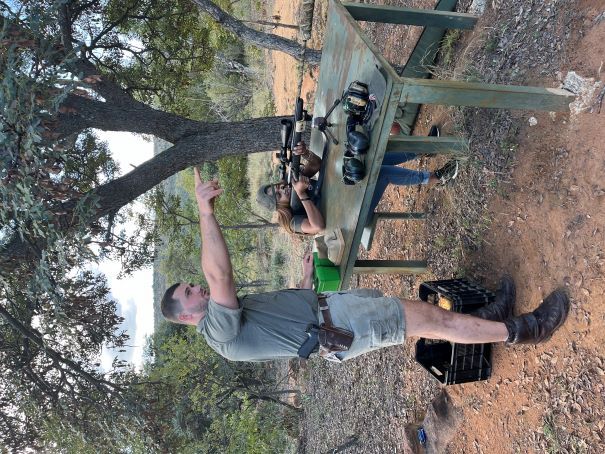
Yes. Hunters preparing for African hunting trips should spend time practising from the type of field positions they are likely to use rather than relying entirely on bench shooting. The important part is becoming comfortable getting the rifle onto the sticks, settling quickly and making a controlled shot without feeling rushed.
Hunters should also be familiar with shot placement on African game, because knowing where to aim is just as important as getting steady on the sticks.
Why Does a PH Sometimes Make You Wait When the Animal Is Already in Range?
Being in range does not automatically mean the shot is ready. The PH may still be confirming the animal, waiting for another animal to move clear, checking the angle or watching whether the situation is improving. A few extra seconds can make the difference between a clean opportunity and one that should be left alone.
How Long Can an African Stalk Take?
Anything from a few minutes to several hours. The amount of ground covered does not always tell you how difficult the stalk has been. A hunting team may walk several miles quickly and then spend thirty minutes trying to gain the final few yards.
What Should a Hunter Do When a Shot Opportunity Appears Quickly?
Be ready, listen carefully and avoid confusing speed with hurry. Some opportunities only last a few seconds, but that does not remove the need for a steady position, a clear target and a shot the hunter is confident making. A rushed decision can turn a short opportunity into hours of follow-up.
What Hunting Africa Actually Teaches You
Hunting Africa has a way of changing how you think about time and distance. You may cover miles quickly, spend an hour gaining the last few hundred yards, then have only seconds to decide whether the opportunity is right.
The lesson is not simply to hunt slower or faster. It is knowing when to move, when to wait, when distance is working in your favour and when an available shot is still not the right one.
Author
Pierre van Wyk is the co-founder of Game Hunting Safaris and has spent years around African hunting, working with hunters, Professional Hunters and outfitters across Africa. His focus is on the practical side of safari hunting, the decisions, conditions and small details that often change the hunt more than the original plan.