10 Day African Plains Game Hunt 7 Species in South Africa
Booking Season: 2026
Hunt Difficulty: Moderate, Difficult

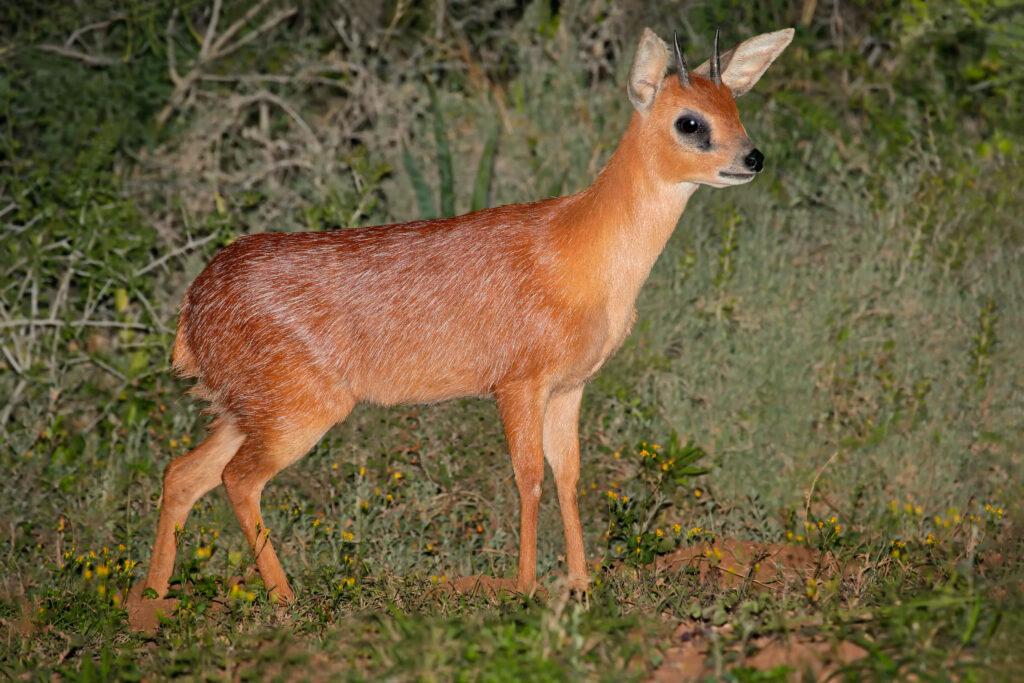
The Cape grysbok is one of South Africa's true endemic antelope, found only in the unique landscapes of the Cape. Perfectly adapted to fynbos, renosterveld and dense coastal thickets, this elusive little antelope relies on camouflage and stillness rather than speed, often disappearing into the vegetation before a hunter even realises it was there.
South Africa offers the only opportunity to hunt Cape grysbok, with the Western Cape and parts of the Eastern Cape providing the specialised habitat the species requires.
Hunters planning a safari Hunting in South Africa will quickly discover that few antelope are as closely associated with a single region as the Cape grysbok. Unlike many animals pursued on a broader Plains Game Hunt, Cape grysbok favour dense natural cover where every slow step and careful scan of the surrounding vegetation could reveal a mature ram standing almost invisible against the landscape.
Although small in stature, Cape grysbok have earned a respected place among hunters pursuing Africa's Tiny 10. Their limited distribution, secretive behaviour and remarkable camouflage make them a rewarding trophy for hunters who appreciate careful observation, patient hunting and the distinctive landscapes that make the Cape one of Africa's most distinctive hunting destinations.
Available Cape Grysbok Hunts
10 Day African Plains Game Hunt 7 Species in South Africa
Booking Season: 2026
Hunt Difficulty: Moderate, Difficult
Cape grysbok are masters of remaining unseen. Unlike many antelope that rely on speed to escape danger, their first instinct is often to freeze and remain motionless. Their grey-brown coat blends perfectly with the fynbos, renosterveld and dense coastal scrub, making a mature ram surprisingly difficult to pick out even when standing only a short distance away.
Their secretive nature adds another layer of difficulty. Cape grysbok are predominantly nocturnal, spending most of the day concealed in dense vegetation before becoming active around dusk and throughout the night. In hunting areas where night hunting is lawful and the necessary permits have been obtained, this can be the most effective time to pursue a mature ram. Where hunting is restricted to daylight hours, the best opportunities usually come during the first and last light of the day as the animals move between cover and feeding areas.
Unlike species that occur across large parts of southern Africa, Cape grysbok have a relatively limited natural distribution. Success depends not only on patience in the field but also on hunting the right areas with an experienced Professional Hunter who understands where these elusive antelope are most likely to be found.
The challenge is rarely getting within shooting distance. It is recognising a Cape grysbok before it quietly melts back into the surrounding vegetation. Success comes from moving slowly, constantly studying the cover ahead and recognising the subtle outline of an animal that seems to disappear into the Cape landscape
Cape grysbok are found only in South Africa, with their natural range extending across much of the Western Cape and into parts of the Eastern Cape. Their distribution is closely tied to the Cape Floral Kingdom, where dense fynbos, renosterveld, coastal scrub and patches of indigenous thicket provide the cover they depend on for survival.
Unlike many plains game species that can be found across a wide variety of habitats, Cape grysbok are highly selective. Hunters looking to pursue this elusive antelope should focus on hunting areas where extensive natural vegetation has been preserved. The quality of the habitat is often far more important than the overall size of the property.
One of the more interesting places to encounter Cape grysbok is along the edges of vineyards bordering natural vegetation. Throughout parts of the Western Cape, vineyards are often surrounded by untouched fynbos and thickets where grysbok spend much of the day concealed. During the cooler hours of the evening, throughout the night and again at first light, they may briefly emerge to feed before quietly slipping back into cover. It is a sight that has become familiar to many landowners and hunters across the Cape winelands.
Cape grysbok have a relatively limited natural distribution, making the choice of hunting area one of the most important factors in a successful hunt. An experienced Professional Hunter who understands the species' behaviour and knows where suitable habitat exists will often make the difference between simply walking through beautiful Cape scenery and finding a mature ram.
Cape grysbok are rarely hunted by covering large distances or making long stalks across open country. Success usually comes from moving slowly through suitable habitat, stopping frequently to study the vegetation ahead and looking for the subtle outline or slight movement that gives away a concealed animal.
Although Cape grysbok are active throughout the night, legal hunting methods vary between provinces and hunting areas. Where night hunting is permitted and the necessary permits have been obtained, hunters may pursue Cape grysbok after dark using methods that comply with local regulations. In areas where hunting is restricted to daylight hours, the most productive periods are generally the first and last light of the day, when the animals leave dense cover to feed before disappearing again.
The pace of the hunt is deliberately slow. A hunter may spend considerable time glassing the edges of fynbos, coastal scrub and indigenous thickets before moving only a short distance and repeating the process. Opportunities are often brief, requiring both patience and quick decision-making when a mature ram finally presents itself.
Accurate shot placement is particularly important on an animal of this size. Hunters should wait for a clear, unobstructed shot rather than attempting to force an opportunity through dense vegetation. Spending time beforehand reviewing our guide to Shot Placement on Small Antelope can help ensure a clean, ethical harvest when the opportunity finally comes.
Cape grysbok do not require large-caliber rifles or excessive power. Accuracy, light recoil and suitable bullet selection are far more important than muzzle energy. Calibers such as the .223 Remington (where legal), .22-250 Remington and .243 Winchester are all excellent choices when paired with appropriate ammunition.
Cape grysbok are often hunted as part of a broader plains game safari, where carrying a dedicated small-caliber rifle may not be practical. In these situations, a versatile plains game rifle can be an excellent option, particularly when larger antelope are also included on the hunt.
When using calibers such as the .270 Winchester, 7mm Remington Magnum, .308 Winchester or .30-06 Springfield, careful bullet selection becomes especially important. Premium monolithic or controlled-expansion bullets generally preserve the delicate skin and shoulders far better than rapidly expanding conventional soft-point bullets, helping to minimise trophy damage while still providing reliable penetration.
Regardless of the rifle you carry, confidence in your equipment and the ability to place an accurate shot are always more important than caliber alone.
Although small in stature, Cape grysbok deserve the same level of preparation as any African trophy. Success depends less on covering long distances and more on selecting the right hunting area, understanding the species' habits and working with an experienced Professional Hunter who knows where mature rams are most likely to be found.
Timing can also influence success. While Cape grysbok are active throughout the year, cooler conditions and the reduced vegetation of the drier months often make them easier to locate during legal hunting hours. Hunters planning to pursue Cape grysbok should also confirm the regulations that apply to their chosen province, particularly where night hunting may be permitted under specific conditions.
Whether your goal is to complete Africa's Tiny 10 or simply hunt one of South Africa's most distinctive endemic antelope, careful planning will greatly improve your chances of success. Choosing the right outfitter and planning your Hunting Trip well in advance will help ensure you hunt suitable habitat at the right time of year.
Yes. South Africa is the only country where Cape grysbok occur naturally. They are found primarily in suitable habitat across the Western Cape and parts of the Eastern Cape, where dense fynbos, renosterveld and coastal thickets provide the cover they depend on.
Yes. Cape grysbok are recognised as one of Africa's Tiny 10, a collection of small antelope species that present a very different hunting challenge from traditional plains game. Their elusive behaviour, limited distribution and remarkable camouflage have made them a sought-after trophy for hunters pursuing this unique collection.
Cape grysbok can be hunted throughout the legal hunting season, although cooler, drier conditions often improve visibility during daylight hours. As a predominantly nocturnal species, activity usually increases around dusk, throughout the night and again at first light. Where night hunting is lawful and the necessary permits have been obtained, these periods can provide excellent opportunities.
Cape grysbok occur naturally only in South Africa. Their range extends across much of the Western Cape and into parts of the Eastern Cape, where they inhabit fynbos, renosterveld, coastal scrub and dense indigenous thickets.
Yes. Cape grysbok are often included as part of a broader Plains Game Hunt in South Africa. Choosing an outfitter with access to suitable Cape habitat allows hunters to pursue this unique endemic antelope while enjoying a diverse safari.
Accurate, light-recoiling calibers such as the .223 Remington (where legal), .22-250 Remington and .243 Winchester are excellent choices. When using larger plains game calibers, careful bullet selection becomes especially important to minimise trophy damage while ensuring clean, ethical harvests.
Yes. Cape grysbok are regarded as one of South Africa's more challenging small antelope. Their tendency to remain motionless, exceptional camouflage, predominantly nocturnal behavior and preference for dense natural cover make mature rams surprisingly difficult to locate.
Search from our range of Hunts across various popular destinations in Africa.

Book Your Hunt