
[DYNAMIC-BLOGTABLEOFCONTENT]
Hunting an African lion had been on my bucket list for many years. Having grown up in Africa, I had always admired these apex predators and understood the respect they commanded among Professional Hunters and dangerous game hunters alike. As one of Africa's legendary Big Five Hunting species, the lion represents a challenge that many hunters spend a lifetime dreaming about. When the opportunity finally came to pursue a mature lion in the Kalahari Desert, it was a chance I simply could not pass up.
South Africa has long been one of the continent's leading destinations for ethical, conservation-based Lion Hunting in South Africa, offering hunters the opportunity to pursue this remarkable predator under well-regulated hunting programmes. In early 2021, Tamlyn and I booked our hunt. I would be hunting a mature male, while Tamlyn accepted the challenge of pursuing a lioness herself. Until then, her hunting had focused mainly on African plains game, so stepping into the world of dangerous game was something entirely different. As our departure date drew closer, the excitement, and more than a few sleepless nights began to build.
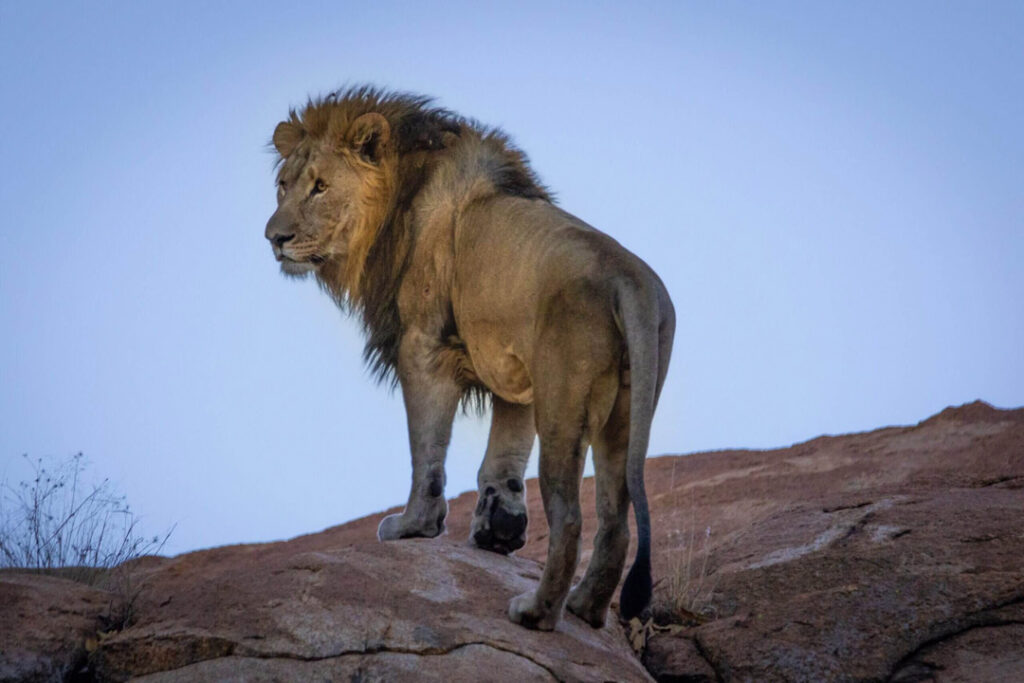
What’s so special about the African Lion?
- African lions have been admired throughout history as symbols of strength and courage.
- They are powerful, and second in size only to tigers.
When a lion roars, it can be heard five miles away.
Females are the main hunters. - Male lions can reach 400-500 pounds.
- The African lion can consume up to 25 percent of their body weight in a single feeding.
- While the lion is known as the king of the jungle, it does not live in jungles but inhabits savannas, grasslands, dense bush, semi-desert, and open woodlands where prey is abundant.
- A breeding pair of lions can generally mate every 20 to 30 minutes with up to 50 copulations in 24 hours, which we can all agree is most impressive.

What Every Lion Hunter Should Know
When it comes to big game hunting in Africa, the lion is probably the most famous and respected member of the Big 5. A lion is a sought-after trophy, and taking down a mature lion is a huge achievement for the hunter and the safari team, including trackers and skinners.
- A lion is extremely dangerous in the field, and their charges and attacks can be devastating.
- Lionesses are generally known to be far more cunning and aggressive than males, while both, when mature, show little fear for the man.
- A male lion can stand nearly four feet at the shoulder and measure muzzle to tail at an incredible 10 feet.
- The minimum caliber rifle in most African countries is a .375, and a one-shot kill shot cannot be guaranteed. Considering a larger caliber when hunting lions is certainly not a bad option, provided you can shoot accurately. For this lion hunting safari, I decided to go with a Hornady Interlock shooting 270 grain, which does not separate like two-piece divided cores. The interlock retains mass and energy for deep penetration that ensures a quick, clean, and humane kill.
- Shot placement is one of the most important aspects of any lion hunt, as the follow-up on a wounded lion can be extremely dangerous. A poorly placed shot may result in a lion seeking cover and waiting for those following its spoor. Before arriving in Africa, every hunter should understand the principles of lion shot placement to help ensure a quick, humane kill and reduce the likelihood of a dangerous follow-up. Even then, the guidance of an experienced Professional Hunter remains essential when the moment of truth arrives.
- Do not try to rush your hunt, and proceed with caution when on the trail of this alpha predator.
- Always listen carefully to your PH. Confirm that they have vast experience with big game hunting in Africa, specifically lion hunting safaris, as this is a specialized game hunting experience.
Why Your Professional Hunter Matters
One of the biggest lessons I have learned over the years is that dangerous game hunting is never just about the hunter. Success, and more importantly, safety, depends on the experience, judgement and calm leadership of the Professional Hunter standing beside you.
Unlike many other African species, lion hunting can change in a matter of seconds. A fresh track may disappear into thick cover, the wind can shift unexpectedly, or a wounded lion may decide to stand its ground instead of retreating. In those moments, every decision matters. An experienced PH is constantly reading the spoor, watching the wind, interpreting the behaviour of the trackers and deciding whether to push forward, wait patiently or change the plan altogether.
During any Dangerous Game Hunts, the Professional Hunter carries a responsibility that extends far beyond helping a client take a trophy. Their primary responsibility is the safety of everyone in the hunting party, while ensuring the hunt remains ethical, controlled and conducted with respect for the animal being pursued.
Looking back on my own lion hunt, I realised just how reassuring it was to have an experienced PH quietly making those decisions. His calm instructions, confidence and years of practical knowledge allowed me to focus on making the shot when the moment finally arrived. In a hunt where events can unfold in seconds, that experience is invaluable.
The Hunt Begins
Hunting in the Kalahari Desert is often referred to as “Estate Lion Hunting.” This means that the lion breeding happened in captivity under the guidelines of the South African Predator Association (SADA) and local nature conservation authorities.
The released animals live in concession areas of 20,000 – 50,000 hectares, surrounded by a 7,8-foot electric fence. The fence ensures the safety of neighboring African plains game and the farmers on surrounding ranches. By law, these lions are released 60 days before any hunting. They are required to hunt and are without support after the release.
The hunts are labeled by anti-hunters as being “canned.” This portrays the image that hunters approach a cage and shoot the lion. Make no mistake, this is by no means the case! Any camp stories relaying tales that these lions are tame or domesticated are absolute nonsense. This method of lion hunting is fair chase, a legal and ethical method of lion hunting. Walking, stalking, and being stalked, in my opinion, far outweighs the experience of baiting and hunting from a blind where the lion is generally oblivious to your existence. Getting close and personal is what it’s about.
We commenced our lion hunting safari with a six-hour drive from OR Tambo Airport in Johannesburg and headed to the Northern Cape province, where we arrived on a chilly winter’s morning. We were accompanied by a young PH, looking to gain more experience in big game hunting Africa’s dangerous seven. Our eyes opened a little wider when he requested that we stop outside the small town of Ventersburg, where his father practiced as a physician. He advised that he just “quickly” wanted to drop off the GPS pin location in case “the hunt went south,” as his father, in addition to being a doctor, was also a pilot. At this point, the realization hit that the hunt was on, and the lion hunting safari was in full swing!
After a lengthy drive through sand and the scrub, we finally arrived at the outfitter’s lodge, which was 5-star in every way! We walked through the entrance to be met by a gorgeous 60-plus inch shoulder mounted kudu bull and a collage of approximately 30 images taken frame-by-frame of a lion attacking the PH and trackers, only to be finished by his faithful 500 Jeffrey. This visual was inspiring, with the pictures telling a thousand-word story.

After meeting the senior Professional Hunter (PH) and being advised that he was a veteran of more than 1500 lion hunts, we knew we had made the right choice when choosing this South African outfitter. Following some fine dining and incredible cuisine fit for a king, we had a hot shower and tried to get some sleep. Quick-moving shadows and roaring lions filled our dreams as we settled in for an anxious night before the hunt.
Meeting someone who had successfully guided more than 1,500 lion hunts immediately reinforced what we had discussed before arriving. Dangerous game hunting is built on experience. Rifles, equipment and preparation all matter, but nothing replaces the judgement gained from decades of following lions through African bushveld. That quiet confidence spread through the entire hunting team and allowed us to focus on the hunt ahead, knowing we were in capable hands.
Daybreak saw the PH, Tamlyn, Keenan, and I heading out to see what fresh spoor we could find. Keenan was brandishing his .458 Remington loaded with 500 grain and me the .375. There is very little to compare to a sunrise in the Kalahari Desert passing African plains game such as kudu, gemsbok, springbok, waterbuck, and some of the members of the Tiny 10 crowding and competing for the morning sun’s warmth after the cold winter night.
We caught a brief glimpse of a few old “dagga boys,” otherwise known as Africa’s Black Death, lurking around, glaring at us and looking for an opportunity to cause some mayhem. They fondly reminded me of buffalo hunting in Mozambique a few years back. Not many people know that the term “dagga” refers to the term mud in one of the African languages, and these old “dagga boys” have generally been kicked out by the herd. After a few hours, we found some fresh lion spoor in the Kalahari sand. The paw print was huge and bigger than my hand!
My heart skipped a couple of beats when advised this belonged to a lioness, not the old male we were targeting. At this point, one of the trackers, Jabu, armed only with a stick, grinned up at us as he knew what was coming. These trackers are legendary and fearless! They have total trust in the PH, knowing that he will save their lives in the critical seconds of a lion’s charge.
Around 11:30 we decided to head back as the heat was intense. In the Kalahari, while the nights are extremely cold, the sun packs a punch, and temperatures are high. Hydration is critical. In the bush, the sun is your biggest enemy and risk. At 14:00 we headed out again and changed our direction towards the south. Again, we spotted some incredible African plains game and birdlife. The indigenous trees and plant life in the area is spectacular. Non-hunters think that all we want to do is go out and kill. Very few of them understand the importance of hunting in conservation and certainly do not realize how lucky we are to witness the African sunsets, the wildlife, and the miracles provided by Mother Nature.
Thirty minutes into the Lion Hunt, we picked up the fresh tracks of a male lion! Immediately, it was down to business! With the trackers out front, we began to follow the spoor. Everyone was on high alert, eyes going from one direction to the other, as we scouted the surrounding areas. Needless to say, we jumped a little when a warthog mother and a few offspring came darting out of the scrub across our paths a few meters ahead of us! A few hours and miles later, soaked with sweat, with my legs beginning to ache a little, we came across a kill site.
Judging by the spoor and activity, the lion had taken down an unlucky warthog. The kill was still fresh, and the sign told us the lion had dragged the pig out of his hole. The consensus was that we had spooked the lion while feeding. We continued following the spoor until the PH stopped and gestured for me to come over. Glancing down, we could see where the lion had circled back and had crossed over our spoor. Now, the hunters had become the hunted!
When the Lion Starts Hunting You
One of the biggest differences between lion hunting and pursuing most other African game is that there may come a point where the roles begin to reverse. Rather than continuing to move away, a mature lion may stop, circle back or quietly position himself where he can observe the hunters following his spoor. He knows the terrain far better than those pursuing him, and thick cover gives him every advantage.
Experienced Professional Hunters and trackers are constantly looking for the subtle signs that the hunt has changed. Fresh spoor crossing your own tracks, alarm calls from birds, sudden silence in the bush, or the uneasy feeling that the lion is no longer retreating can all indicate that he knows exactly where you are. From that moment onward, every step is taken with greater caution and every decision becomes more deliberate.
This is where experience counts. The Professional Hunter decides when to slow down, when to stop, when to change direction and, if necessary, when to back out altogether. A wounded or pressured lion is capable of covering surprisingly short distances before turning to face what it sees as a threat. There is no room for rushed decisions or unnecessary risks.
Looking back, the moment we realised the lion had crossed our spoor completely changed the atmosphere of the hunt. Until then, we had simply been following fresh tracks through the Kalahari. From that point onward, we knew the lion was fully aware of our presence, and the hunt demanded even greater patience, discipline and trust in the team around us.
We continued moving cautiously forward for another mile or two, but unfortunately, the light was beginning to fade, and we decided to call it a day.
Driving back to base camp in the faithful Toyota Land cruiser (the only vehicle for African conditions!) while clutching a cold well-deserved beer, Jabu called out and pointed into the distance. Starting into the sun I caught a glimpse of the lion darting into the thick shrub. He was a monster, and this moment will always be one of my favorite lion hunting safari memories.
We decided to head out early the next day, just having time to rush down a quick coffee and some traditional South African rusks, after which we headed out. The question was, did he return to finish his meal? Fresh spoor was all over, and it looked as if he had decided to return to the kill site and finish his warthog feast. Immediately, we fell into formation and began following the tracks. The sun was beating down, and everyone was silent and focused. A few lopsided grins by the hunting teams were the only show of the upcoming excitement we knew would soon unfold.
Walking down lion results in a continued focus on following, pushing, bumping, and stopping encounters. These African apex predators eventually get to the point where they have had enough and turn to face those who are annoying them. When their comfort zone is violated, you know that they will soon unleash their fury.
We pushed hard for a few more hours. A few times we could hear noise through the grasslands ahead of us. Not sure if this was the lion or if we were spooking up other animals, but we stuck to the basics and followed the spoor. We stopped under an enormous camel thorn tree, had a quick water break, and discussed our strategy. We agreed that the lion was ahead somewhere and that we must increase the pace and push ahead.
The final stand came quickly. The PH stopped and glanced into the distance. He gestured for me to move in next to him, and he edged slowly forward in the thick bushes. He pointed into the scrub ahead. As much as I tried, I could not see the lion through the long grass. We continued to push ahead a few more feet, and at that point, the lion started growling and chewing on branches and sticks, indicating his raw fury. The African lion is a master of camouflage. It was unbelievable that we were about 25 yards out, I could hear him throwing his toys, but I could still not get eyes on him. My heart was racing! I was trying to blink the sweat out of my eyes, and in the back of my mind all I could think was: “Whatever you do, do not pull the shot!”
The PH decided to edge a little more forward and asked again if I could see him. I could hear him making an awful racket but was still battling to make him out. After listening to a few words describing the setup, he suddenly came into view, and I could make him out in all his glory! Let me tell you, at this point, you realize how wild and dangerous this animal is and the importance of having a calm and experienced PH at your side! He calmly whispered a few pointers and had me on the sticks. Thank goodness I had put in the hours at the range on the sticks. Soon, I had him in my sights. I did not have a shot as he was in the thick brush, continuing with all his anger antics. In what felt like a millionth of a second, he stood and turned to face us, his open mouth showing a full display of incisors designed to rip flesh to pieces.

I felt a light tap on my shoulder and squeezed the trigger. I hit the lion full in the chest, and he went ballistic! He did a complete turn in the air and let out a roar that sounded like a lightning bolt had hit the ground next to us. He turned and ran back about 50 yards. The PH turned, smiled at me, and asked, “Was that close enough for you?”
It turned out when we measured that we were only 18 yards from him when taking that shot. I will never forget that moment of my lion hunting safari! The PH listened to the sounds the lion was making, and the two of us slowly walked about 20 yards from him and, for safety’s sake, gave the coup de grace.
Resting my hand on his shoulder, and taking a moment to express my gratitude and thanks, I realized how privileged I was to have enjoyed dangerous game hunting in Africa and taken down a majestic lion. My childhood dream had become a reality. The memory will last forever.

That night in camp was filled with the sounds of celebrations, memories made, and more friendships built on newly gained experiences. Tamlyn’s hunt for her lioness did not go quite as smoothly, but that is a tale for her to tell.
Keenan was fortunate enough to add to his Tiny 10 collection by harvesting a magnificent steenbok and gray duiker, a truly unique African antelope.

Interesting Facts About The African Lion
- I was unaware, until closely examining my lion, that at the end of the tail, hidden between the hair, is another hook, or claw.
- When receiving my trophy from the shipping agent, included was a bottle containing two bones. After chatting to experts, I learned that these bones are “floating bones,” and not connected to anything. In some African cultures, these bones are highly sought after, by witch doctors and traditional healers and made in African jewelry.
I have been very fortunate and privileged to have had this opportunity afforded me. I have a strong desire to ensure that lion hunting safaris are readily available to all those who support and understand the importance of hunting within the conservation framework. I enjoy hunting in South Africa, and the lion is a magnificent specimen to hunt. The game hunting safari left me with one of life’s most memorable experiences, which I would love to share with others.

A Hunt I WIll Never Forget
Standing just 18 yards from a mature African lion is a moment I will never forget. Long after the trophy has found its place in my trophy room, what remains strongest in my memory are the trackers reading fresh spoor, the quiet confidence of an experienced Professional Hunter, and the respect that a wild lion commands when encountered on its own terms.
Every dangerous game hunt leaves its mark, but lion hunting is different. It demands patience, discipline and absolute trust in the hunting team around you. For me, this hunt was the fulfilment of a childhood dream and a reminder of why ethical, conservation-based hunting continues to play an important role in protecting Africa's wildlife and wild places.
If you are planning your own African hunting adventure, explore our Hunting Trips to learn more about the destinations, species and safari options available across the continent.
Frequently Asked Questions
Is lion hunting legal in South Africa?
Yes. Lion hunting is legal in South Africa when conducted in accordance with national and provincial legislation. Hunters should always book through reputable outfitters who operate within the country's wildlife regulations and conservation framework.
What rifle calibre is recommended for lion hunting?
Most African countries require a minimum calibre of .375 for lion hunting. Many hunters choose larger calibres, but accurate shot placement remains far more important than rifle size. An experienced Professional Hunter will also advise on suitable ammunition for the specific hunt.
How close do hunters usually get to a lion?
Every hunt is different, but hunters pursuing lions on foot can sometimes find themselves surprisingly close. During my own hunt, the final shot was taken from just 18 yards, demonstrating both the importance of careful tracking and the need to remain calm under pressure.
Why is hunting an African lion considered one of the ultimate hunting achievements?
As one of Africa's iconic Big Five species, the lion has earned a reputation as one of the world's most respected dangerous game animals. Successfully hunting a mature lion requires patience, teamwork, careful shot placement and complete trust in an experienced Professional Hunter. For many hunters, it represents the fulfilment of a lifelong ambition.
Author
Pierre van Wyk is the Co-Founder of Game Hunting Safaris and has spent decades hunting and working alongside Professional Hunters throughout Africa. Drawing on firsthand experience pursuing both plains game and dangerous game, he writes to help hunters better understand African wildlife, ethical hunting practices and the realities of planning an authentic African hunting safari.