
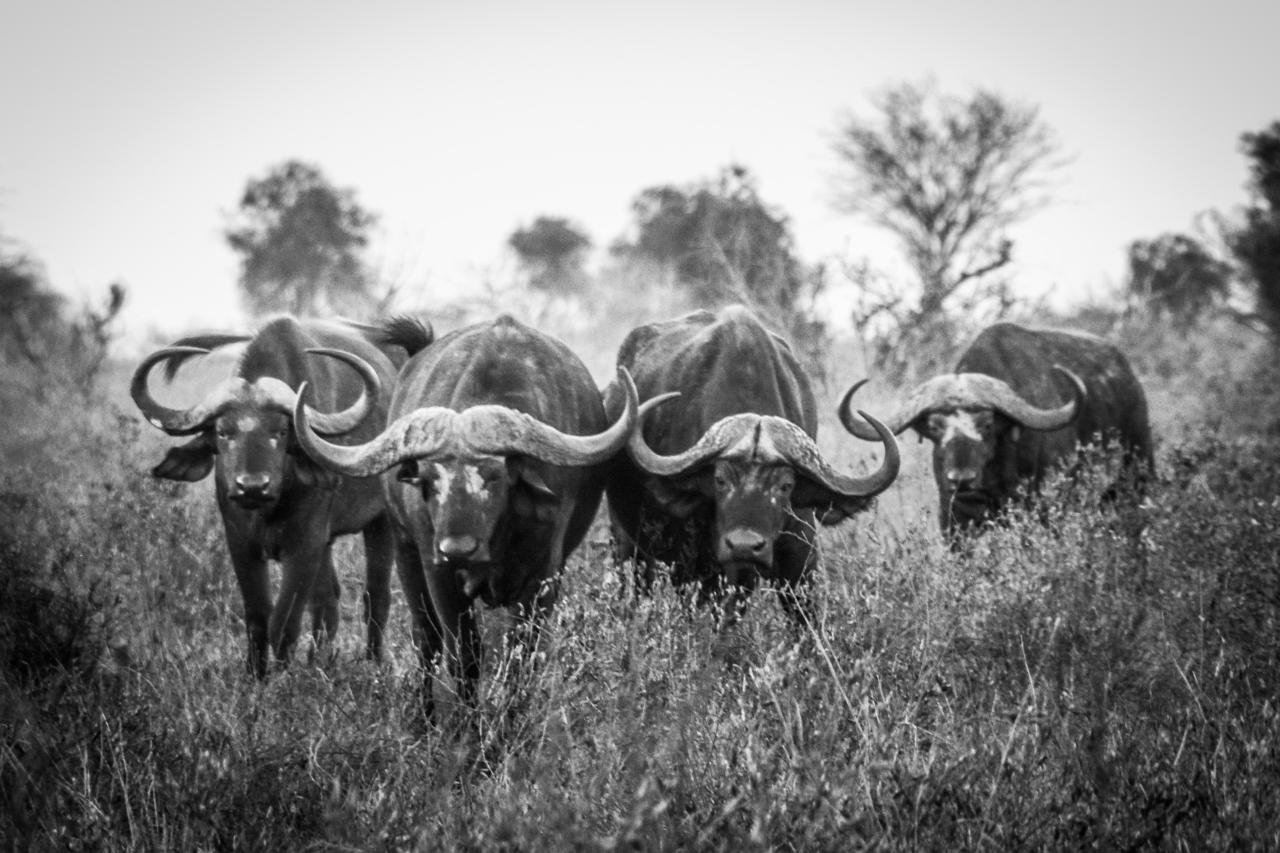
Cape buffalo hunting in Tanzania can change depending on where in the country the safari takes place. A hunter following buffalo through the miombo woodland and river systems of southern Tanzania may face a different hunt from someone looking for old bulls across the drier country of Masailand.
That difference matters. Tanzania is enormous, and buffalo are not distributed or hunted in the same way across every concession. Herd size, water, vegetation, seasonal movement, hunting pressure and the presence of livestock or local communities can all influence where buffalo are found and how much country must be covered to find them.
In some concessions, the hunt may begin by locating herds and then looking for old bulls travelling with them or hanging around their edges. Elsewhere, particularly in country where buffalo occur at lower densities, the better opportunity may come from finding the tracks of two or three old dagga boys moving quietly through thick cover.
That is part of what makes Cape Buffalo Hunting in Tanzania difficult to describe as a single type of safari. The country contains several different buffalo hunting environments, and choosing between them should involve more than asking which concession has buffalo on quota.
Southern Tanzania remains famous for its large wilderness areas and strong buffalo populations, while western Tanzania offers remote country where buffalo share the landscape with elephant, lion, leopard and other species that form part of Big Game Hunting in Tanzania.
Masailand presents another picture entirely. Buffalo may occur alongside pastoral areas where cattle and goats are part of the landscape, and huge herds should not necessarily be expected. Yet mature bulls can still be found tucked into riverine cover, thorn and other pockets of suitable habitat.
A buffalo hunter therefore needs to understand the country behind the hunt.
Where you hunt in Tanzania can change how you find buffalo, how you follow them and ultimately what kind of safari you have.
[DYNAMIC-BLOGTABLEOFCONTENT]
Southern Tanzania: Buffalo Country on a Different Scale
Southern Tanzania is probably closest to what hunters’ picture when they think about a classic Tanzanian Cape buffalo hunt. Huge hunting areas, miombo woodland, river systems and strong buffalo populations create country where a hunting team can spend days working through different herds before finding the bull they want.
The Selous ecosystem is the obvious example, but even here it would be a mistake to assume every concession hunts the same way. Some areas contain extensive miombo woodland, while others are broken by rivers, floodplains, sand rivers, heavier riverine cover and more open country. A buffalo hunt can change as the animals move between those different habitats.
Much of the searching begins from the hunting vehicle. Roads, river crossings, water and other likely movement areas are checked for spoor, particularly early in the morning. Once suitable tracks are found, the truck is left behind and the trackers take over.
Large herds can certainly be part of southern Tanzania buffalo hunting, but finding buffalo does not necessarily mean finding a bull worth hunting. A herd may need to be approached more than once before the PH can properly judge the bulls travelling with it. Wind or cover may end the first attempt, leaving the hunting team to back out and try again later.
Old dagga boys can present a different problem. Two or three bulls may leave little sign compared with a large herd and spend much of the day tucked into thick woodland or riverine cover. Following them can mean hours on tracks before there is even a glimpse of a buffalo.
Water becomes increasingly important as conditions dry out. Buffalo movement may become concentrated around permanent rivers, pools and other reliable water, but that does not necessarily make the hunt easy. Knowing where buffalo are likely to drink is different from knowing where they will be hours later.
This is where the sheer size of southern Tanzania starts working both for and against the hunter. There can be a tremendous amount of buffalo country available, but there can also be a tremendous amount of country to search.

Western and Central Tanzania: When Finding Buffalo Takes More Work
Move west and north from the great southern hunting areas and Tanzania begins to change. Rungwa, Kizigo, Ugalla and the wider western systems contain huge stretches of miombo woodland, seasonal rivers, wetlands and pockets of open country.
These regional differences extend well beyond buffalo, and our Hunting in Tanzania guide looks more broadly at the country's major hunting areas, species and safari conditions. Buffalo are there, but the country can make them difficult to find. Tanzania's own wildlife authority describes the Rungwa-Kizigo-Muhesi system as extensive miombo habitat supporting buffalo alongside elephant, lion and leopard.
One of the difficulties is visibility. A hunting team can cover a great deal of country without seeing buffalo, even when animals are relatively close. Thick woodland can hide an entire herd, while smaller groups of bulls may move through the bush without giving much away beyond tracks, dung or signs around water.
That puts more emphasis on searching intelligently. Roads are used to cover country, old tracks are checked against fresher ones, and water can become increasingly useful as the season dries. If good spoor is found, the decision still must be made whether it is fresh enough to justify leaving the truck and committing several hours to it.
The distances involved can also punish a bad decision. Following tracks for three hours only to discover that the buffalo are still moving is different when the vehicle is several miles behind you and the afternoon heat has arrived. Turning around and starting again is simply part of hunting big concessions.
Buffalo movement can change with water and forage. Research from the wider Ruaha-Rungwa ecosystem has shown that buffalo alter their habitat use seasonally, reinforcing something experienced hunting teams already understand: where buffalo were concentrated earlier in the season may not be where they are found later.
Western Tanzania can change again around systems such as Ugalla and Moyowosi-Kigosi, where rivers, wetlands and floodplain country break up the miombo. Moyowosi-Kigosi, for example, combines extensive wetlands with surrounding miombo and is exceptionally remote and difficult to access.
The result is not necessarily a harder or better buffalo hunt than southern Tanzania. It is simply a different problem to solve.
There may be plenty of buffalo country around you. The challenge is working out which part of it the buffalo are using today.
Masailand: Buffalo Without the Big Herds
Masailand can present a different buffalo hunt from the wilderness systems farther south and west. In some hunting areas, buffalo occur at lower densities and a hunter should not arrive expecting to find the large herds commonly associated with Tanzania's better-known buffalo country.
This is also a landscape used by people and livestock. Cattle and goats may be encountered while hunting, and pastoral activity can influence where buffalo spend their time. That can seem strange to someone expecting every Tanzania buffalo safari to take place hundreds of miles from the nearest community, but it is part of hunting this region.
The buffalo have learned to live in that country as well. Mature bulls and small groups of dagga boys can use thick thorn, riverine vegetation, drainage lines and isolated pockets of cover where they may remain remarkably difficult to see. A patch of bush that looks insignificant from a distance can hold buffalo that have been there for hours.
That changes how the hunt is approached. Rather than spending the day sorting through several large herds, effort may go into finding the tracks of only one or two bulls. Water, fresh spoor and the knowledge of trackers who understand how buffalo use individual pieces of cover become particularly important.

Community and livestock activity can complicate the picture further. Fresh cattle tracks can cross buffalo spoor, livestock may have used the same water, and animals can move away from areas that have seen increased human activity. Knowing what sign matters and what can be ignored becomes part of finding the buffalo.
There is also something interesting about hunting an old bull this way. He does not need hundreds of other buffalo around him to make the hunt worthwhile. Finding the tracks of a mature dagga boy, working out where he has gone and eventually discovering him buried in a piece of thorn can provide an entirely different challenge from approaching a herd in southern Tanzania.
Masailand is a good reminder that buffalo density and buffalo hunting quality are not necessarily the same thing. Fewer buffalo can mean spending more time looking for them, but the old bulls are still there.
How the Country Changes the Shot
The country being hunted can influence the final approach just as much as it affects how buffalo are found. Miombo, riverine vegetation and thorn can reduce visibility to a matter of yards, while open woodland and floodplain country may allow a bull to be judged and approached from considerably farther away.
That difference can influence rifle choice as well. A double rifle with open sights can be extremely effective when hunting buffalo at close range in heavy cover, while a scoped bolt-action may provide an advantage where the country opens and a longer shot becomes possible. Neither is automatically the better choice. The rifle needs to suit the conditions in which it will be carried and used.
What does not change is the need for a sufficiently powerful dangerous game rifle and heavy bullets capable of deep penetration. Cape buffalo are heavily built animals, and the first shot needs to reach the vital organs from the angle presented. Understanding Cape Buffalo Shot Placement before the safari is important as the opportunity that eventually appears may look quite different from the broadside buffalo pictured on a target.
Terrain can also determine how much time the hunter has. An old bull stepping into an opening across relatively open country may allow several moments to settle the rifle and confirm the shot. The same bull appearing through thick bush at close range may offer only a brief opportunity before disappearing again.
The buffalo has not changed. The country around him has, and the hunter needs to be prepared for both.
Which Tanzania Buffalo Hunt Is Right for You?
Choosing where to hunt buffalo in Tanzania should start with the type of safari you want rather than the reputation of a particular region. Two concessions can both offer Cape buffalo, yet provide different hunts once you arrive.
If seeing more buffalo and working through different herds appeals to you, parts of southern Tanzania may make the most sense. A hunter who enjoys remote country, long tracking days and the uncertainty of searching enormous areas may be drawn toward the central and western hunting regions. Masailand can suit someone comfortable with a different setting, where buffalo may be less numerous but finding an old bull tucked into isolated cover becomes the challenge.
The actual concession matters just as much as the region. Ask about recent buffalo numbers, the size of the herds being seen, how frequently mature bulls are encountered, where the animals are concentrating and how much hunting pressure the area has received. If your goal is specifically an old dagga bull, tell the outfitter that before the safari is planned.
It is also worth asking how buffalo are usually hunted in that area. The amount of time spent tracking, typical shooting distances, vegetation, access to water and the distances covered each day can tell you considerably more about the hunt than simply knowing buffalo are on quota.
There is no single Tanzania buffalo hunt that will suit every hunter.
The better question is whether the buffalo, country and hunting style of a particular area match the safari you have in mind.
Planning a Cape Buffalo Hunt in Tanzania
Tanzania gives a buffalo hunter choices that go well beyond simply selecting a concession with buffalo on quota. The country you hunt, the number and movement of buffalo, the terrain and the style of hunting can all shape the safari.
That is why the conversation should begin with the kind of buffalo hunt you want. Tell us whether you would rather work through herds in vast wilderness country, spend days tracking old bulls through remote miombo or hunt lower-density areas where finding a mature dagga boy may be the biggest part of the challenge.
Hunters ready to start comparing areas, available safaris and other species can explore our African Hunting Trips or speak to us about building a Tanzania buffalo hunt around the kind of hunting you want to do.

Frequently Asked Questions About Cape Buffalo Hunting in Tanzania
Where is the best Cape buffalo hunting in Tanzania?
There is no single best region for every buffalo hunter. Southern Tanzania is known for extensive wilderness areas and strong buffalo populations, while central and western Tanzania can involve searching enormous areas of miombo and seasonal river country. Masailand offers a different hunt again, with lower buffalo densities in some areas and mature bulls often using smaller pockets of thick cover. The best choice depends on the type of hunt you want.
Is Masailand good for Cape buffalo hunting?
Yes, but a Masailand buffalo hunt should not necessarily be judged by the number of buffalo seen. Some areas have lower densities than Tanzania's major southern buffalo systems, and large herds may be less common. The attraction can instead be finding and tracking mature bulls or small groups of dagga boys using thorn, riverine cover and other suitable habitat.
Are Cape buffalo in Tanzania hunted from herds or as dagga boys?
Both. Mature bulls may be found travelling with or around larger herds, while older bulls can also occur alone or in small bachelor groups commonly referred to as dagga boys. Which situation a hunter encounters depends on the area, season and current buffalo movement.
Does the time of year change buffalo hunting in Tanzania?
Yes. Water and forage influence buffalo movement throughout the hunting season. As conditions become drier, buffalo may concentrate more heavily around permanent water and reliable feeding areas. Conditions differ between regions, however, so the same month can produce different hunting situations in southern Tanzania, western Tanzania and Masailand.
How do I choose a buffalo hunting area in Tanzania?
Start with the hunt rather than the name of the concession. Ask about current buffalo numbers, herd sizes, mature bull sightings, hunting pressure, water, vegetation, typical tracking distances and how buffalo have been using the area recently. If an old dagga bull is your priority, make that clear before choosing the safari.