
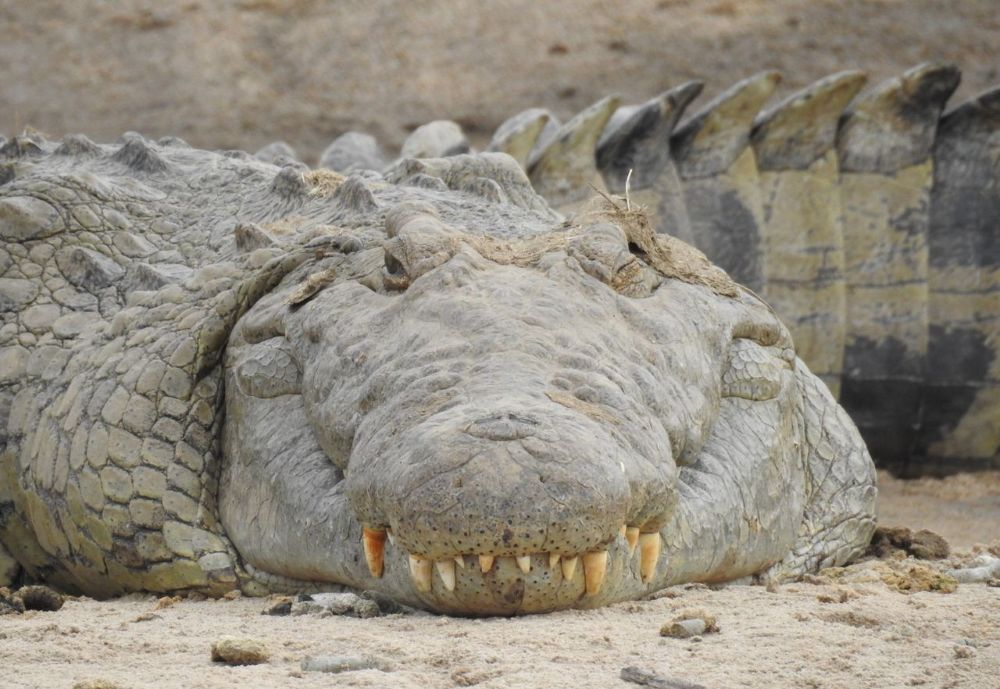
A crocodile is lying on a sandbank across the river. Through the binoculars he looks enormous. Heavy head, long body and a tail that seems to keep going.
You are already wondering whether this is the one. The Professional Hunter keeps looking.
He's not big enough.”

That can be difficult to understand on a first crocodile hunt. A large Nile crocodile is an impressive animal, and without another crocodile nearby for comparison, even an animal well below the size you are looking for can appear much bigger than he really is.
Judging crocodiles becomes even more difficult when you cannot see the entire animal. Part of the tail may disappear into the water. Grass can hide the belly. The crocodile may be lying at an angle that makes him look longer than he is, or only the head and upper body may be clearly visible.
A tail disappearing into the water can be particularly misleading. You cannot assume how much crocodile is hidden below the surface, and an old animal may even be missing part of its tail from an earlier injury.
This is particularly relevant when Crocodile Hunting in Mozambique, where large rivers, lakes and remote waterways can provide excellent crocodile habitat but rarely guarantee the hunter a perfect view of every animal encountered.
An experienced PH is therefore looking at considerably more than estimated length. The head, width across the eyes, depth through the belly, body proportions and overall maturity all help build a picture of the crocodile in front of him. Sometimes another crocodile nearby provides the comparison that makes the decision considerably easier.
Sometimes you simply need to keep watching.
The crocodile may change position and reveal more of his body. He may open his mouth, move farther onto the bank or give the PH a better angle from which to judge him. Or he may slide quietly into the water and disappear before anyone reaches a decision.
That is part of Crocodile Hunts. Seeing a big crocodile and deciding that he is the crocodile you want are two different things.
The difficult part is not finding a crocodile that looks big. It is deciding whether he is big enough before the opportunity disappears.
[DYNAMIC-BLOGTABLEOFCONTENT]
A Long Crocodile Is Not Always the Crocodile You Want
Length gets most of the attention when hunters talk about trophy crocodiles. Everyone wants to know whether the animal is fourteen, fifteen or sixteen feet long. The problem is that estimating those extra inches through binoculars can be difficult.
A long crocodile is certainly worth looking at, but the PH is judging more than the distance from nose to tail. The size and shape of the head, width across the eyes, depth through the belly and proportions of the body can all help indicate the maturity of the animal.
Body condition can complicate things further. Mature male crocodiles can lose condition during the breeding season, leaving an old animal looking noticeably leaner than he may at another time of year. The thickest crocodile on the bank is therefore not automatically the oldest or the one the PH will choose.
The tail can create another problem. If the last section disappears into the water, estimating total length involves some guesswork. An old crocodile may also be missing part of his tail from fighting or an earlier injury, making length alone an even less reliable way of judging the animal.
This is why the PH keeps studying the crocodile rather than immediately reaching for a number. He is trying to put several clues together and decide what sort of animal is lying on the bank.
Sometimes another crocodile nearby helps enormously. A bull that looked huge on his own may suddenly appear less impressive when an older, heavier animal crawls onto the same sandbank.
And sometimes the opposite happens.
The crocodile you almost dismissed as too lean suddenly looks different once you get a proper view of his head and body proportions.
Length matters, but the tape measure comes later. Before the shot, the PH must judge the crocodile he can see.
The Head Can Tell the PH a Lot
For a first-time crocodile hunter, the natural tendency is to look at the entire animal and try to judge how long it is. An experienced PH will often spend considerably more time studying the head.
On a mature crocodile, the head can look heavy and broad rather than long and narrow. Width across the eyes, the proportions of the skull and the way the head sits in relation to the neck and body can all help the PH judge whether he is looking at a younger crocodile with plenty of length or an older, more mature animal.

This becomes useful when much of the crocodile is hidden. A tail may disappear into the water and grass may cover part of the body, but the head can remain clearly visible through the binoculars.
The mouth can provide another clue. When a crocodile opens its jaws, an older animal may show worn, broken or missing teeth, leaving noticeable gaps. It is not something the PH will use on its own to judge age, but combined with a heavy head, body proportions and the overall appearance of the animal, it can add another piece to the picture.
Even then, one look is rarely enough.
Angle can change everything. A crocodile facing directly toward the hunter can appear extremely broad, while the same animal viewed from the side may give a very different impression. Distance, light and the position of the animal on the bank can make judging those proportions harder still.
This is where experience counts. The PH may have looked at hundreds of crocodiles in the same river system and already knows what an ordinary ten- or twelve-foot animal looks like through binoculars. When a genuinely old, heavy-headed crocodile appears, those differences become easier for him to recognize.
For the hunter, they may not be obvious at all. You may simply be looking at a very big crocodile.
The PH is trying to decide what kind of big crocodile it is.
Another Crocodile Can Be the Best Measuring Stick
Judging a crocodile on its own can be difficult as there is often little around it that provides a reliable sense of scale. A sandbank, patch of reeds or stretch of mud does not tell you whether the animal lying there is twelve feet long or bigger.
Put another crocodile beside him and things can change quickly.
Two animals lying on the same bank give the PH something real to compare. One head may be noticeably broader. One body may carry considerably more depth through the belly. The difference in overall length can suddenly become easier to see, particularly when both crocodiles are lying at roughly the same angle.
This can work against the crocodile you were originally watching.
An animal that looked enormous by himself may suddenly look ordinary when a large crocodile appears beside him. What seemed like a heavy head no longer looks particularly heavy, and the difference in body mass can become obvious.
The reverse may also happen. A crocodile that did not initially attract much attention may begin to stand out once several smaller animals gather nearby.
The comparison needs to be treated carefully. One crocodile may be farther from the hunter, lying at a different angle or partly hidden in the water. The PH is not using the other animal as a twelve-foot ruler.
He is simply getting another piece of information. Sometimes the easiest way to understand how big one crocodile really is, is to see a younger crocodile lying beside him.
The Crocodile May Not Give You Another Look
There is another problem with judging a trophy crocodile: the animal does not necessarily stay there while you make up your mind.
Crocodiles do not reach fifteen or sixteen feet by being stupid. Large, old animals have survived for years by reacting quickly when something does not feel right. A movement on the bank, an unfamiliar sound or something they simply do not like can be enough to make them leave.
A crocodile may lie motionless on a bank for a long time, giving the impression that there is no hurry. Then something changes. He lifts his head, becomes uneasy and slides into the water. Within seconds, the animal you have been studying through binoculars is gone.
That creates an interesting balance for the PH. There is no reason to rush the decision, but there is also no guarantee that waiting another ten minutes will produce a better look.
Sometimes it does.
The crocodile may move farther onto the bank, exposing the entire tail and belly. He may turn his head, open his mouth or change position enough for the PH to confirm what he has been thinking. Other times, waiting ends the opportunity.
Once a large crocodile enters the water, there is no certainty that he will climb back onto the same bank. He may surface farther away, move to another part of the river or simply disappear.
This is where patience and experience must work together. The PH needs enough time to be comfortable with the animal, but he also needs to recognize when he has seen enough.
For the hunter, that can feel slow right up until it isn't. You may spend twenty minutes doing nothing more than watching a crocodile through binoculars. Then the PH quietly says:
“That's a good crocodile. Get ready.”
And suddenly twenty minutes of waiting becomes a few seconds to get onto the rifle.
A Good Crocodile Is Not Always a Good Opportunity
The PH may be completely satisfied with the crocodile and still decide not to take the shot.
Where the animal is lying matters. A big crocodile resting on a clean sandbank with plenty of ground between him and deep water presents a different opportunity from the same animal lying with half his body already in the river.
The closer a crocodile is to deep water, the more important the first shot becomes. If the hunter is not confident that the shot will anchor the animal where he lies, waiting for a better opportunity may be the sensible decision.
Understanding Crocodile Shot Placement becomes important when only a few yards separate the animal from deep water. A crocodile only needs to cover a short distance to reach the water.
Even a well-hit crocodile can move after the shot. The violent twisting and rolling that may follow can carry an animal off the bank or into deeper water. Once a crocodile disappears into deep or murky water, recovery can become difficult and in some situations the animal may be lost.
The shooting position matters too. The hunter may have a clear view of the crocodile but no solid place to get comfortable behind the rifle. Grass may obscure part of the animal, the angle may be poor or the crocodile may be lying in a position that does not offer the shot the PH wants.
After spending hours or even days looking for a trophy crocodile, walking away from a good animal can be difficult. But judging the crocodile and judging the opportunity are two separate decisions.
The first asks whether this is the animal you came to hunt. The second asks whether you can take him cleanly and recover him.
Both answers need to be right.
A fifteen-foot crocodile in the wrong position is still a crocodile you may have to let slide back into the water.
When the PH Finally Says He's Good
By the time the PH decides that a crocodile is worth hunting, he may have watched the animal for considerably longer than the hunter expected.
He has looked at the length, head, body proportions and condition. He may have seen the crocodile beside other animals, watched him change position and waited for enough of the tail to become visible to remove some of the guesswork.
Eventually, there comes a point when there is enough information.
The crocodile is good.
From there, the focus changes. The question is no longer whether the animal might be fourteen feet or fifteen feet long. It is whether he is lying in a position that gives the hunter a clean opportunity and a good chance of recovering him.
This is one of the things that makes crocodile hunting such an unusual form of Big Game Hunting. A large part of the hunt can be spent doing little more than looking through binoculars, yet important decisions are being made the entire time.
For a first-time crocodile hunter, trusting that judgement matters. The PH has probably passed crocodiles that looked enormous to you and spent far longer studying others than you thought necessary.
Then eventually he puts down the binoculars.
“That's the one.”
At that point, stop worrying about the tape measure. You will find out how long he is when he is lying on the bank.
Frequently Asked Questions About Judging Trophy Crocodiles
How do Professional Hunters judge the size of a crocodile?
A PH will look at more than estimated length. The size and shape of the head, width across the eyes, body depth, overall proportions and condition can all help when judging a crocodile. Seeing the animal completely out of the water or alongside other crocodiles can make the assessment considerably easier.
How can you tell if a crocodile is old?
There is no single feature that confirms the age of a crocodile in the field. A heavy, broad head, mature body proportions and general appearance can provide clues. Older crocodiles may also have scars, injuries and worn, broken or missing teeth, although none of these should be used alone to determine age.
Is a longer crocodile always a better trophy?
Not necessarily. Length is important, but an older, heavy-headed crocodile may be a more desirable animal than a slightly longer crocodile that appears younger. The PH will normally judge the complete animal rather than making the decision from estimated length alone.
How big is a trophy Nile crocodile?
What qualifies as a good trophy depends on the hunting area and the animals available. A crocodile approaching or exceeding 14 feet is a very large animal, while genuine 15- and 16-foot crocodiles are exceptional and should never be assumed to be available on every hunt.
Why are crocodiles difficult to measure before the shot?
Crocodiles are long, low animals and are rarely positioned beside anything of known size. Part of the tail may be underwater, grass can hide sections of the body and viewing angle can distort apparent length. A crocodile missing part of its tail can make estimating total length even more difficult.
Why might a PH pass a large crocodile?
The animal may not be old or large enough, but size is only one reason. The PH may also dislike the shooting angle, the crocodile may be too close to deep water or the available shooting position may not give the hunter a sufficiently good opportunity. A trophy crocodile still needs to be taken under circumstances that allow a clean shot and realistic recovery.
About the Authors
Pierre and Tamlyn van Wyk are the founders of Game Hunting Safaris and have both hunted Nile crocodile in Mozambique. Pierre's crocodile measured 14.9 feet, while Tamlyn's measured 15.1 feet — a fact she is unlikely to let him forget.
