
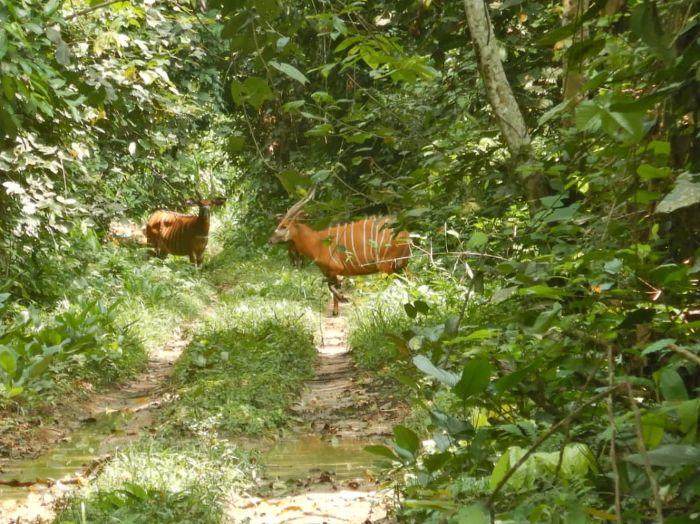
A hunter used to open African country learns to look far ahead.
He will glass ridges, check distant movement and study animals before deciding whether to move closer.
In the Congo rainforest, much of that disappears. You can bring the binoculars, but the forest may make you wonder why you packed them.
Visibility can shrink to a few yards. An animal may be close enough to hear before there is any chance of seeing it. Fresh tracks, disturbed leaves, broken vegetation and a sound somewhere ahead may tell the hunting team far more than another ten minutes behind the glass.
That changes the way the hunter must think.
In open country, a hunter may see the animal first, study it and then decide how to approach. In the Congo rainforest, that order can be reversed. You may spend hours, or even days, following sign from an animal somewhere ahead before getting your first proper look at it.
When hunting in the Republic of Congo, success often starts with learning to read what the forest is showing you before the animal itself ever appears.
The challenge is not simply getting closer. It is learning how to hunt terrain where seeing the animal may be the final step rather than the first.
The Forest Takes Away Your Long View
Open-country hunting gives the hunter information.
You may see animals hundreds of yards away, watch how they move, compare one bull with another and decide whether the wind and terrain will let you get closer.
The Congo rainforest takes that away.
There may be no distant ridge to glass and no open valley where animals can be watched for twenty minutes. The next useful view may be through a narrow gap between trees, across an old logging road or into a small opening in the forest. Sometimes the hunting team knows an animal is ahead because of the sign on the ground. Sometimes it is a noise in the vegetation. Sometimes there is movement and the hunter catches only part of the animal before it disappears again.
That can be frustrating for someone accustomed to seeing the country around him.
The temptation is to keep looking harder, but there is often nothing more to see. The hunter must become comfortable moving through country without knowing exactly what is fifty yards ahead, let alone five hundred. Instead of constantly searching the distance, attention starts shifting to what is close: the track underfoot, a branch that has been disturbed, vegetation that has been pushed aside, or a sound that does not belong to the wind.
The Congo does not necessarily give the hunter less information. It gives him different information, and he must learn how to use it.
You Learn to Hunt What You Cannot Yet See
This is where Congo hunting starts to feel different. The hunter may know there is an animal ahead without having seen so much as an ear.
A fresh track crosses an old road. Leaves have been turned. A branch is broken where it should not be. The tracker stops, looks again and suddenly the pace changes. That is part of the adjustment.
In open country, the hunter often sees the animal and then starts solving the problem. In the forest, he may spend hours solving the problem before the animal ever enters the picture.
That means paying attention to more than the end of the rifle. Watch when the trackers slow down. Notice when the PH stops talking. Listen when everyone suddenly stands still. Those changes usually have a reason, even when the hunter cannot yet see it. Bongo are a good example. During bongo hunting in Congo, a hunting team may pick up fresh sign and follow it through country where the animal itself remains completely hidden. The hunter knows the hunt is getting closer because the sign is getting fresher, not because he can see the bull. That requires patience.
It also requires trust.
You may be following an animal you have never seen, through country you cannot read, behind trackers who are picking up details that mean almost nothing to you. That is where respect for local experience matters.
These men have often spent years learning how animals move through this forest, what fresh sign looks like and when a track is worth following. The hunter may not understand every decision being made, but he needs confidence in the team to stay with the hunt when his own eyes are giving him little reassurance. In open country, the hunter can often see why the PH wants to move left, wait, or close the distance. In the Congo, there will be times when he simply must trust that the people in front of him are seeing a story in the forest that he cannot yet read.
It requires resisting the urge to push ahead simply because nothing appears to be happening. In the rainforest, plenty can be happening twenty yards in front of you while the forest shows you almost none of it.
The hunter’s job is not to become the tracker. It is to learn how to recognise when the people reading the forest are telling him that things have changed.
Sound Starts to Matter Almost as Much as Sight
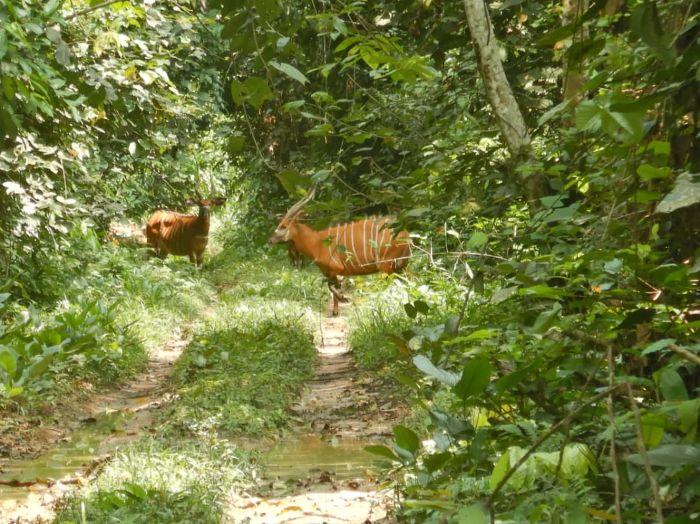
In open country, your eyes normally lead the hunt. In the Congo, your ears start doing a lot more work.
A branch snaps somewhere ahead. Leaves move, but nothing steps into view. There may be a heavy footfall in the vegetation, a low grunt, or the sudden sound of something moving away through cover. The frustrating part is that hearing an animal does not mean you are about to see it.
It may be twenty yards away and still completely hidden. That changes how the hunters react. There is less value in constantly shifting position, craning for a better angle or trying to force a view through vegetation that simply will not give you one. The better move may be to stop, stay quiet and let the hunting team work out what is happening ahead. Even small sounds start to matter.
The trackers may stop because they heard movement the hunter missed. The PH may suddenly raise a hand because something changed in front of the group. A few seconds later everyone may be standing completely still, listening into a wall of green. That silence is part of the hunt. It is also where an impatient hunter can make life difficult for himself.
A boot scraping against a root, a whispered question at the wrong moment or one unnecessary step forward can matter when the animal is close enough to hear you but still impossible to see.
There is another strange adjustment for the hunter. At times, it can feel as though you are simply following people into a wall of forest. The path may be narrow, visibility may be only a few yards and the hunter farther back in the line may have almost no idea what the tracker at the front can see. You keep moving, stop when he stops and start again when he decides there is something worth following.
For a hunter accustomed to looking across country and understanding where the hunt is going, that can feel almost like hunting with your eyes closed.
Once again, control shifts toward the trackers who know the forest. They are choosing the line, reading what is ahead and deciding when the group should move and when everyone needs to stand still. The hunter does not have to understand every turn through the forest. But he does have to trust the people who do.
The Congo teaches a simple lesson quickly:
If the forest will not let you see what is ahead, sometimes the smartest thing you can do is keep quiet and listen.
Roads, Trails and Clearings Become Part of the Hunt
In terrain this thick, any break in the forest matters.
An old logging road, a game trail, the edge of a swamp or a small clearing can give the hunter something the rainforest has been refusing to provide all day.
Space.
For a few moments, you may be able to look farther than the next wall of leaves. That can feel like a relief after hours of moving through tight cover, but these openings are useful for more than simply letting the hunter breathe. Old roads and trails are good places to pick up tracks. Animals crossing from one block of forest to another may leave sign where it is easier to read, and the hunting team can use those crossings to decide whether something fresh is worth following.
The road itself is not necessarily where the hunt happens. It may simply be where the next part of the hunt begins. A fresh track crosses the road. The trackers will study it, decide if it is worth following, and within minutes everyone may be back inside the forest again. Clearings and swamp edges can play a different role.
Depending on the species and area, they may offer one of the few places where the hunter gets a longer look at what is ahead. Even then, “open” in the Congo is relative. A small clearing that would barely get your attention in Namibia can feel enormous after hours under a closed forest canopy.
Those brief openings also help mentally.
Dense rainforest can feel claustrophobic, especially for a hunter who is used to being able to see the horizon. Stepping onto an old road or reaching the edge of a clearing gives you a chance to look around, get your bearings and, for a minute, feel as though the world has opened again.
Then somebody finds another track, and back into the green tunnel you go.
In the Congo, roads, trails and clearings are not empty spaces between hunts. They are often part of how the hunt is found, read and moved forward.
Rain Can Change the Forest Overnight
Rain is not an occasional inconvenience in the Congo rainforest. It is part of the hunting environment.
How often it falls depends on the month and the exact area, but a hunter should arrive expecting wet weather to play some part in the safari. Around northern Congo, rainfall occurs throughout the year, with heavier periods generally building again during the wetter months.
That does not necessarily make the hunting worse. Sometimes it can help. A hard rain can leave the forest floor quieter underfoot. New tracks laid after the rain are easier for the trackers to separate from older sign, and soft ground can hold details that were difficult to read before. The next morning can feel like someone has wiped part of the slate clean. Tracks crossing a road may mean more because the hunting team knows they were made after the storm.
Of course, rain also creates its own problems.
Trails become slippery. Mud gets deeper. Clothing stays damp. Vegetation holds water long after the rain has stopped, which means you can get soaked simply by pushing through it. For a hunter coming from a dry African safari, that takes some adjustment.
In the Congo, rain is not necessarily something that stops the hunt. Sometimes it changes the information the forest is giving you and gives the trackers a new trail to work with.
The Animal May Appear in Pieces
One of the strangest parts of hunting thick rainforest is that the first proper sight of the animal may not look anything like the picture in your head.
You may not get a full animal standing in the open. You may get a shoulder through leaves. A horn for a second, part of a body moving between two trees, or a flash of colour where everything else is green. Sometimes that glimpse must tell the PH far more than simply, there is the animal. Forest duikers are a good example of just how difficult this can become.
Several species may occur in the same broad forest country, and some are small enough to disappear behind surprisingly little vegetation. The PH may have only seconds to work out exactly what species he is looking at, whether it is the right sex where that matters, whether the animal is mature enough, and whether the hunter has a safe, clear opportunity.
There is another complication. The animal that finally appears may not even be the animal whose track the team has been following. In thick forest, other animals can cross the same ground, move through the same patch of cover or suddenly appear where the hunting team least expects them. The PH therefore cannot assume that the first duiker to show itself is automatically the right animal.
He still has to identify it properly.
Species. Sex. Maturity. And, where possible, whether this animal fits what the team has been following. Anything can happen in that forest. All while neither man may be seeing much more than pieces of the animal.
That is serious pressure. The hunter has his own problem at the same time. He needs to get into position quietly, understand where the animal is likely to appear and be ready without pushing the situation. There may be no opportunity to shuffle three feet to the left, reposition the rifle, whisper a long question and then start looking for the animal again.
By then it may be gone.
After hours of following tracks, listening and moving through cover, the temptation is to react the instant something finally appears. That is exactly when the hunter needs to slow his brain down. Seeing part of an animal is not the same as having enough information to shoot. The PH may need another second. Another angle. One more step from the animal. Sometimes the correct decision is simply to let the opportunity disappear because there was not enough information to make the shot responsibly.
That takes discipline after a long day in the forest. And when the PH finally says shoot, the hunter may have very little time to make it happen.
Rifle position matters. Knowing roughly where the animal is expected to appear matters. Keeping still and quiet matters. There may be only a small window through the vegetation and only a few seconds before it closes again.
That combination of identification, judgement, positioning and patience is one reason forest hunting can be far harder than the short shooting distance suggests.
The Mental Challenge Is Learning to Hunt Differently
A hunter used to open terrain often gets regular visual feedback. He sees animals, watches movement and has some idea whether the stalk is improving or falling apart.
The Congo may give him almost none of that for long stretches.
You can follow tracks for hours, hear movement ahead, stop repeatedly and still finish the day having seen very little. That can wear on a hunter, especially one who is used to measuring progress with his eyes. The difficult part is staying switched on when there is nothing in front of you to keep the adrenaline going. You still need to watch where you step, listen to the trackers, keep the rifle ready and react properly when the forest changes.
An open-country hunter has to let go of a few habits.
He cannot expect to understand the whole hunt from what he can see. He cannot force a view through vegetation that will not give him one. He cannot assume a short shooting distance means an easy opportunity, and he cannot treat a quiet hour as an hour where nothing is happening. Most of all, he must stop expecting the hunt to happen on his timetable.
A Congo forest hunt may involve long stretches of patience followed by a few seconds where everything suddenly matters. Similar lessons can apply elsewhere in Central Africa. Hunting Cameroon’s rainforest can create the same problem of extremely short visibility, while countries such as Gabon have their own challenges in dense forest. The terrain, species and hunting methods are not identical, but the hunter still has to adjust to country that gives him little visual information.
That is what makes this such a different kind of African hunting trip.
For some hunters, that is exactly the appeal. You are not simply hunting a different animal in the Congo.
You are learning to hunt in a different way.
Questions Hunters Ask About Hunting the Congo Rainforest
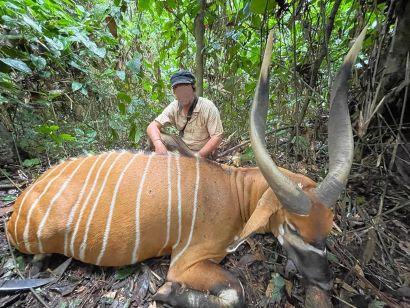
What species can you hunt in the Republic of Congo rainforest?
The Republic of Congo is best known for bongo, forest buffalo and specialist forest antelope, including several duiker species and sitatunga. The exact species available depends on the concession, quota and safari booked. GHS listings for Congo also show species such as yellow-backed duiker, Peter’s duiker, bay duiker, black-fronted duiker, red river hog and forest sitatunga.
How physically demanding is a Congo forest hunt?
A Congo hunt can be more demanding than a typical open-country safari because movement through thick vegetation is slower, humidity is high and hunters may spend long periods on foot in forest
and swamp country. Fitness does not need to mean being an athlete, but arriving reasonably prepared will make the safari much more enjoyable.
How long should you allow for a Congo hunting safari?
These are not usually quick hunts. A current GHS bongo safari in the Republic of Congo is structured around 13 full hunting days, which gives some idea of the time often allowed for a serious forest hunt. The right duration depends on the target species, concession and whether additional forest game is included.
Can an American hunter take his own rifle to the Republic of Congo?
This one needs to be handled carefully because rules can change. A current GHS Congo listing states that firearm importation for sport hunting is not permitted and includes rifle rental with the bongo permit. Hunters should confirm the current firearm rules with the outfitter before booking flights or travelling with a rifle.
About the Author
Pierre van Wyk is the co-founder of Game Hunting Safaris and has years of experience helping international hunters plan African safaris. He works closely with outfitters, professional hunters and clients across the continent, with a focus on hunting areas, species selection, safari logistics and matching hunters with the right operation.