Designed by Hunters, for Hunters

A rainforest species encountered where terrain, cover, and timing—not planning—define the outcome.
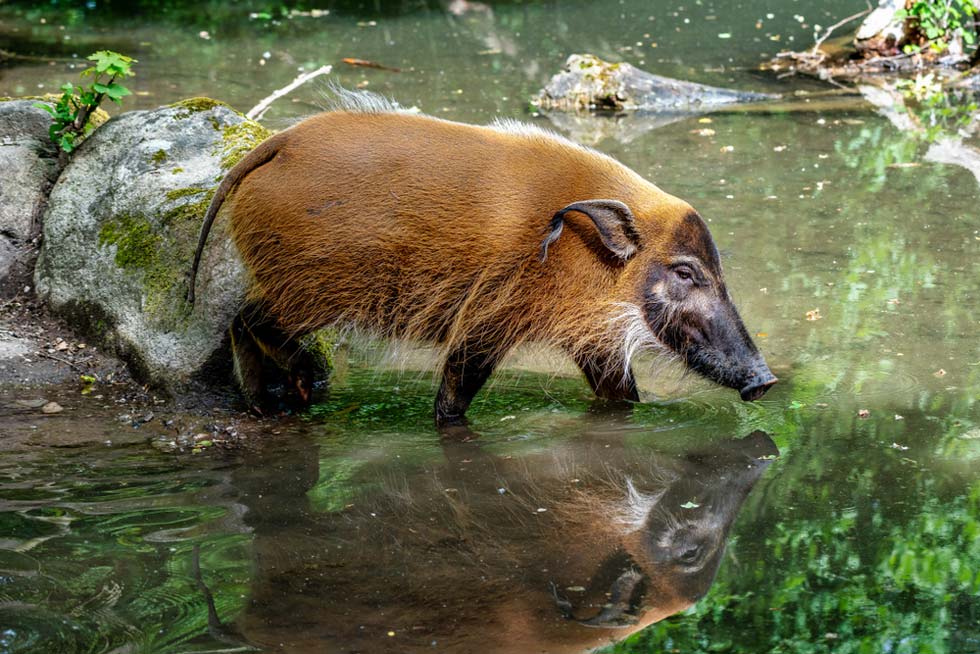
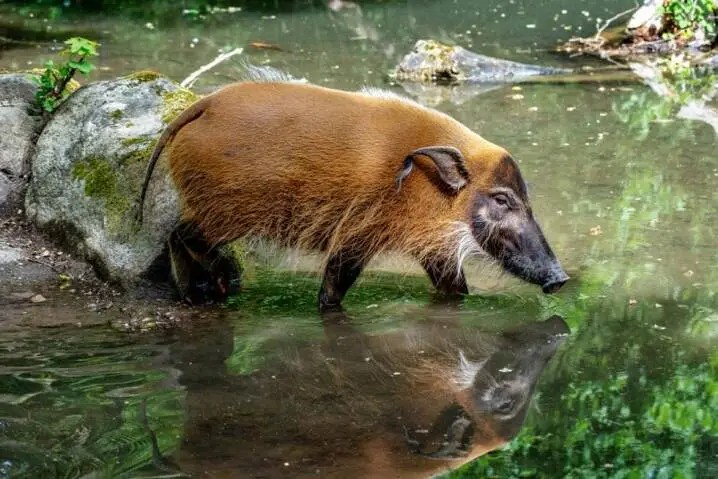
The red river hog is one of the more distinctive animals found in Central African rainforest, and one of the least predictable to encounter. Its deep red coat, contrasting markings, and forward-curving tusks make it immediately recognizable. In the forest, though, visibility changes everything. Even a striking animal disappears quickly in dense cover. For hunters, it isn’t a primary objective. The red river hog is found across Central and West Africa, with Gabon representing one of the most intact rainforest environments where the species can still be encountered.
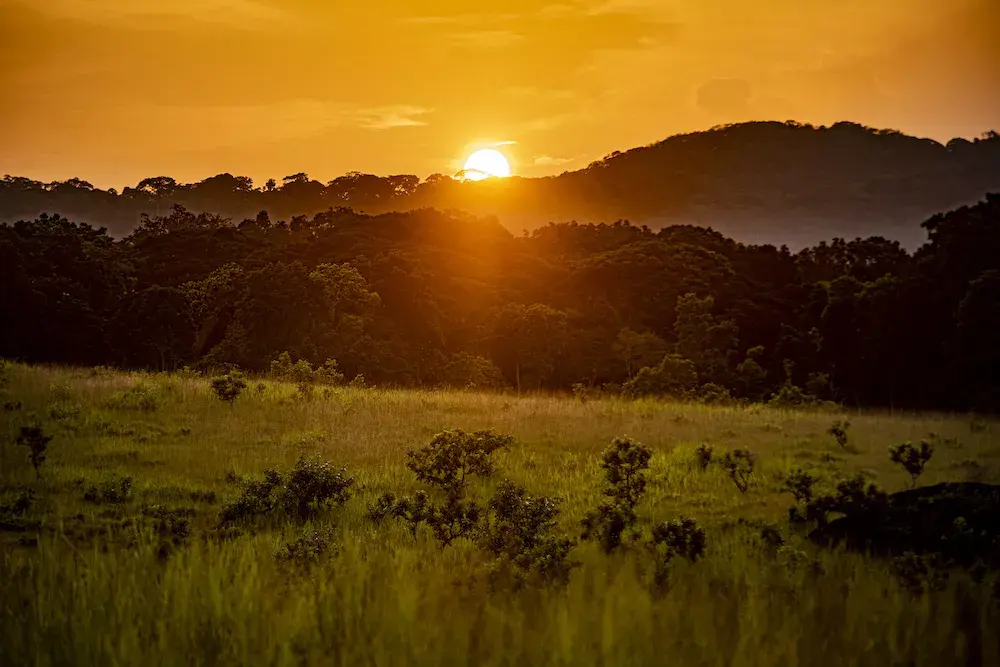
Like many rainforest species, it exists within the same dense, low-visibility environments that define hunting in Gabon, where terrain and vegetation shape how animals are encountered. It tends to appear without warning, often at close range, and just as quickly disappear back into cover. Time in the forest matters more than intent, and encounters develop as a result of conditions rather than planning.
The red river hog (Potamochoerus porcus) is a forest-adapted wild pig found across Central and West Africa. It is closely related to the bushpig, though more vividly colored and more tightly associated with dense rainforest.
Adults typically weigh between 45 and 115 kilograms, with a compact, muscular build suited to moving through thick vegetation. The elongated snout, pronounced ear tufts, and sharp tusks are all functional—used for feeding, defense, and interaction. Despite its appearance, it is not inherently aggressive. Its behavior reflects its environment: limited visibility, constant pressure, and the need to avoid detection. Movement is cautious, reactions are quick, and exposure is brief.
It feeds opportunistically, fruit, roots, vegetation, insects, and small animals, mostly along the forest floor. That keeps it tied to areas where cover and moisture remain consistent.
Red river hogs occupy the same terrain that defines rainforest hunting. Dense jungle, swamp margins, and riverine corridors dominate. Vegetation is thick, sightlines are short, and movement is dictated as much by footing as by direction.
These are not areas where animals are observed at distance. Everything happens close. Animals remain hidden until they move, and even then, only briefly. Progress through the terrain is slow and deliberate. In that environment, red river hogs pass largely undetected. Even where they are present, sign can be limited, and encounters remain inconsistent.
Red river hogs are not typically pursued as a primary species in Gabon. The reason is straightforward: the environment does not allow for it. Dense vegetation and limited visibility make it difficult to build a hunt around predictable movement. This is where rainforest hunting diverges from more familiar systems. There is no glassing from distance, no extended approach, and no consistent pattern to follow.
Instead, time is spent working through the forest itself, where multiple species may be encountered. Outcomes are shaped by conditions—terrain, visibility, timing—not by a single objective.
Red river hogs fall into that category. They may present an opportunity, but they rarely define the hunt.
For hunters traveling from the United States or other markets where safaris are often structured around a single species, this can feel unfamiliar at first. In Gabon, the experience is shaped less by targeting and more by time spent operating within the environment itself.
Red river hogs are present in many of the same forest systems where hunting takes place in Gabon, but encounters are not consistent. Unlike species that can be tracked over distance or patterned with some reliability, red river hogs move within dense cover where visibility is limited and sign can be difficult to follow. Even in areas where they are known to occur, they may pass undetected.
Hunts are not typically measured in terms of success rates for this species alone.
Instead, the likelihood of encountering a red river hog comes down to time in the forest, the areas being worked, and the overall conditions during the hunt. Extended time in dense rainforest concessions, particularly when pursuing other forest species, naturally increases the chances of an encounter. For hunters familiar with more structured safaris, this can feel uncertain at first, this is simply how the system works.
Red river hogs are not guaranteed, but they are very much part of the environment. When they are encountered, it is usually the result of time, positioning, and conditions aligning rather than a targeted effort.
Encounters tend to be sudden. In many cases, hunters only become aware of a red river hog after it is already moving through cover, with only a brief window to react before it disappears again. Visibility is limited by canopy and undergrowth. Light is filtered, and movement ahead is often obscured. Animals are usually close before they are noticed.
Detection comes from small things, a shift in vegetation, a brief sound, a shape moving through cover. When a red river hog is seen, the window to act is short. There is little time to adjust position or wait for a clearer view. More often, the animal disappears before an opportunity develops. This is consistent with how it survives: minimal exposure, rapid movement, constant use of cover.
Even in areas where they are known to occur, encounters are never guaranteed.
They are not classified as dangerous game, but they are not without risk. A red river hog is strong, fast, and equipped with sharp tusks. At close range, especially in dense cover, it is capable of defending itself effectively. Most encounters do not escalate. Like many forest animals, the first response is to withdraw. Risk comes from proximity. When visibility is limited and reaction time is short, situations can develop quickly.
As with most rainforest hunting, the environment plays as much of a role as the animal.
Red river hogs feed on what the forest provides. Fruit, roots, tubers, insects, and small animals make up the bulk of their diet. Feeding takes place along the forest floor, often in areas with consistent moisture and cover. That feeding behavior keeps them inside dense vegetation rather than moving across open ground.
From a hunting perspective, that matters. It reinforces where encounters are likely to happen—and why they tend to be close and unpredictable.
Red river hogs and bushpigs are closely related, and often confused. Visually, the difference is clear. Red river hogs are more defined—reddish coat, contrasting markings, more pronounced features. Bushpigs tend to be darker and less distinct in appearance.
The more important difference is habitat. Red river hogs are strongly tied to dense rainforest. Bushpigs, while adaptable, are found across a wider range of environments, including woodland and transitional areas. That difference affects how they are encountered.
Bushpig, in some regions, can be pursued in a more structured way. Red river hogs remain tied to conditions where visibility is limited and movement is restricted, making encounters less predictable and that distinction becomes more pronounced.
For more on bushpig hunting across Africa, see our guide to bushpig hunts.
Red river hog encounters in Gabon rarely follow a predictable pattern. Most occur while moving through dense forest, often in areas being worked for other species. Visibility is limited, and detection usually comes at close range, sometimes only as the animal is already moving through cover.
There is little buildup. A brief movement ahead, a sound in the undergrowth, or a shape crossing an opening may be the only indication before the opportunity disappears. In many cases, the encounter is over as quickly as it begins. This is not a species that presents itself in controlled conditions. Instead, encounters happen naturally while moving through the forest, where positioning, awareness, and timing matter more than planning alone. For many hunters used to more structured approaches, this can feel abrupt.
It is simply part of how the environment dictates the experience.
Hunting in Gabon’s rainforest is defined as much by conditions as by wildlife.
Humidity is constant, often heavy, and movement through the forest can be physically demanding. Underfoot, terrain varies from soft, waterlogged ground to dense root systems and thick vegetation that slows progress and limits visibility.
Equipment, pace, and positioning are all shaped by these factors.
Firearms and optics are used at close range, often in low light conditions beneath heavy canopy. Shots, when opportunities present themselves, are typically taken quickly and at shorter distances than in more open environments.
This has a direct impact on how hunts are conducted. Progress is deliberate, communication is controlled, and time in the field is measured not by distance covered, but by how effectively terrain and conditions are managed. Hunting in Gabon often feels very different from more familiar hunting environments.
Here, success is not defined by speed or visibility, but by the ability to operate consistently within the constraints of the rainforest.
Even in well-managed areas, consistent visibility is never guaranteed, and conditions can change quickly depending on rainfall and vegetation density.
A hunting safari in Gabon is defined first by environment, and only second by species.
Time is spent moving through dense rainforest concessions where visibility is limited, movement is controlled, and progress depends on terrain as much as direction. Within that setting, certain animals naturally take priority, particularly those that fall into the category of dangerous game hunts, where tracking, positioning, and sustained effort shape how a hunt unfolds.
Species such as forest buffalo often define that structure. In many cases, time in the forest is shaped around broader buffalo hunting in Gabon, where tracking, positioning, and movement through dense rainforest determine how the safari unfolds. Red river hogs do not occupy that role.
They exist within the same environment and are encountered under the same conditions, but they do not determine the direction of the hunt. Instead, they remain part of the broader system, one of several species that may present an opportunity while working through the forest. That distinction matters.
Here a safari is not built around a single outcome, but around operating effectively within a complex environment where multiple species, including red river hog, are encountered as part of the same experience.
Most search interest around red river hogs focuses on the animal itself—its appearance, behavior, or perceived aggression. That creates a gap. From the outside, it appears distinctive and memorable, leading to the assumption it can be pursued in a structured way. It exists within a much more complex environment.
Hunts are not built around a single species. They are shaped by terrain, visibility, and the ability to operate within those limits. Encounters develop as a result of time in the field, not planning alone. Understanding that is key to understanding how rainforest hunting in countries like the Republic of Congo actually works.
Are red river hogs dangerous?
They can be at close range, particularly in dense cover, but they are not typically aggressive without provocation.
What do red river hogs eat?
Fruit, roots, vegetation, insects, and small animals found along the forest floor.
How big are red river hogs?
Generally between 45 and 115 kilograms, with a compact, muscular build.
Can you hunt red river hog in Africa?
Yes, but they are rarely pursued as a primary species. Most encounters happen while hunting other rainforest game.
Search from our range of Hunts across various popular destinations in Africa.
Book Your Hunt