
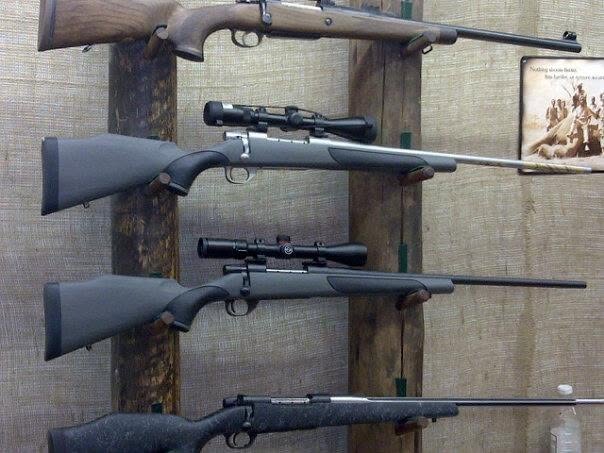
Choosing a rifle for Mozambique is not quite as straightforward as deciding what calibre you want to take on an African safari. The country offers different hunting conditions, and a rifle that makes perfect sense in one area may be less suitable in another. Before settling on what to bring, it pays to understand where you will be hunting, which animals are on your licence, and the sort of shooting opportunities the area is likely to present.
On my first buffalo hunt in the Marromeu region, I went into the safari expecting close shooting. I had prepared myself for an encounter at perhaps forty or fifty yards, where a heavy dangerous-game rifle would be entirely at home. Instead, the opportunity eventually presented itself at more than 200 yards. That is a different proposition, particularly when you have chosen your equipment around the expectation of getting considerably closer.
It is a useful lesson, particularly for American hunters planning on hunting in Mozambique. Thick woodland, open floodplains and the bush country of northern Mozambique can make one rifle setup work better than another. Add plains game, crocodile or hippo to the safari, and the decision becomes more interesting still.
The question is not simply whether a particular rifle has enough power for the animals you intend to hunt. It is whether the rifle, its sights and your ability to use it comfortably are suited to the opportunities you are reasonably likely to encounter.
The Hunt Should Choose the Rifle, Not the Country Name
Two hunters can book safaris in Mozambique and have different expectations of the rifles they bring. One might be spending most of his time following buffalo tracks through thick woodland, where an opportunity could develop quickly at close range. Another might be hunting buffalo in the Marromeu floodplains, where open ground can make a longer shot a real possibility.
Neither hunter has chosen the wrong rifle simply because his setup differs from the other's. The important question is whether the rifle suits the conditions he is likely to encounter.
The species on the hunting licence matter. A dedicated buffalo safari is one thing. A mixed safari that includes buffalo, sable, waterbuck or other plains game may call for a rifle that is comfortable to shoot accurately at a wider range of distances. That does not automatically mean bringing a second rifle, but it should influence the decision before leaving home.
Even within the same hunting area, conditions can change. A PH may plan to hunt buffalo in thick cover, only to find the animals feeding in more open country. The time of year plays a part. Visibility is better through the dry winter months, while early rains can bring fresh growth that makes it harder to see through the bush. Having a rifle that you know well, with sights suited to more than one situation, gives you options when things don't go as expected.
The first conversation about rifle choice should be with the PH who hunts the concession. Find out what the terrain looks like, what species you are likely to pursue, and what distances have been common on recent safaris. Those answers will tell you considerably more than a general recommendation for hunting in Mozambique.
Buffalo in Mozambique Is Not Always a Fifty-Yard Shot
Most hunters associate Cape buffalo with close encounters in thick bush, and there is good reason for that. Following fresh tracks through woodland can bring you within a few yards of animals you may not even be able to see. In those situations, a rifle that comes to the shoulder naturally, handles well and allows you to find your target quickly is a real advantage.
Not every buffalo hunt in Mozambique happens at close range.
As I discovered on my buffalo hunt in Marromeu, buffalo can be encountered in more open country. Some of Mozambique's hunting coutadas also offer a mixture of thick woodland, open dambos and floodplain terrain, where shooting conditions can change considerably during a hunt. Finding a suitable bull may involve studying animals at a distance before deciding whether a stalk is possible. There may be opportunities to close the distance, but the wind and position of the herd do not always cooperate.
That creates a practical consideration when choosing a rifle for buffalo hunting in Mozambique. A heavy rifle fitted with open sights might be perfectly suited to a close encounter in thick cover, yet become difficult to use when the only reasonable opportunity presents itself at 150 or 200 yards. The issue is not whether the cartridge can reach that distance. It is whether the hunter can place a shot accurately with the rifle and sighting arrangement he has brought.
A low-powered variable scope can be useful in these circumstances. At its lowest setting, a properly mounted scope can be quick to use at close range, while additional magnification can help when the shot is farther away or the hunter needs a clearer sight picture.
None of this means a hunter should prepare for long-range buffalo shooting. Getting closer remains preferable whenever the circumstances allow it. The point is that Mozambique offers enough variation in buffalo habitat that choosing a rifle solely around an expected fifty-yard encounter can leave a hunter unnecessarily limited.
Double Rifle or Scoped Bolt Action?
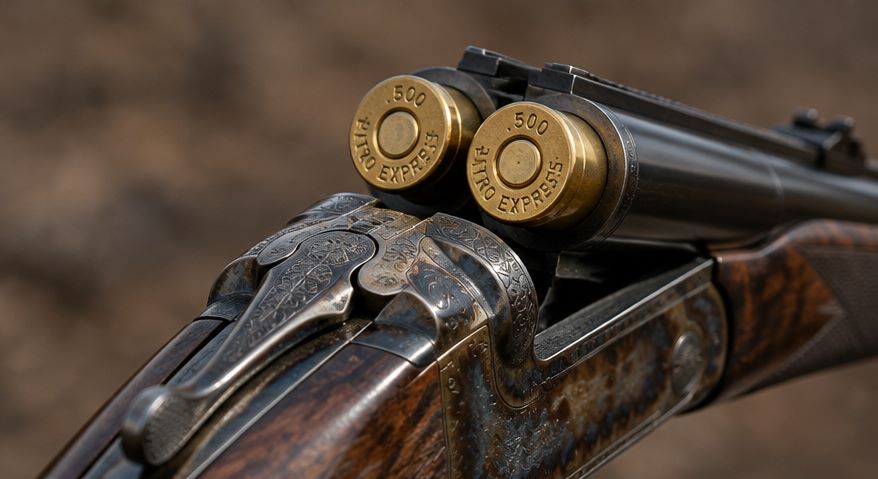
There is something about a traditional double rifle that appeals to almost every dangerous-game hunter. A big-bore double, carried through thick African bush in pursuit of buffalo, is part of the attraction for hunters. And in the right circumstances, it is an excellent choice.
A well-fitted double rifle is quick to bring onto target and offers an immediate second shot without having to work a bolt. When hunting buffalo in thick cover, that can be a real advantage. If a wounded bull suddenly turns or a follow-up shot is needed at close range, there may be little time to react. A double allows the hunter to fire that second barrel immediately, provided he has maintained control of the rifle and his sight picture. The limitations become more apparent when the hunting conditions change. Many traditional doubles are fitted with open sights, and while they can be surprisingly accurate, making a precise shot at 150 or 200 yards is a different matter from shooting a buffalo at forty yards. Some hunters fit compact red-dot sights to their doubles, while others use low-powered scopes where the rifle is suited to one. Both can make aiming easier, although adding a scope can change how a traditional double handles.
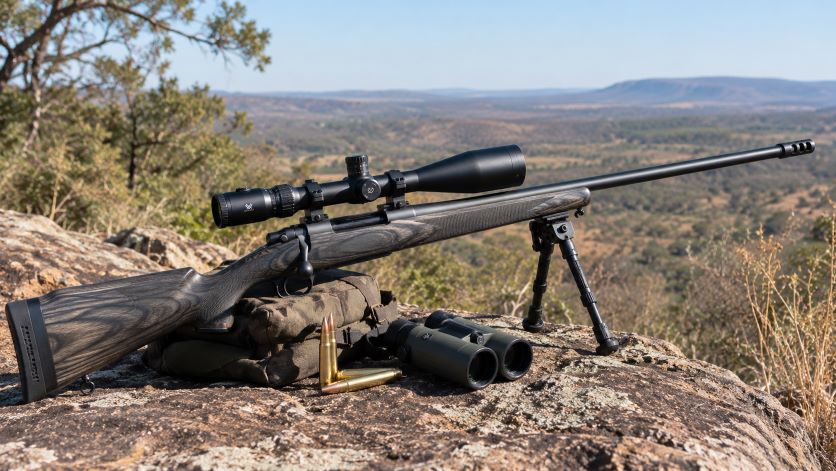
A scoped bolt-action rifle offers a different set of advantages. It is easier to equip with a suitable variable-power scope, and a hunter familiar with his rifle may find it more comfortable when a longer shot presents itself. The trade-off is having to work the bolt between shots. An experienced hunter can do this quickly, but it still requires an additional action that a double rifle does not.
Neither rifle is automatically the better choice. A hunter who has spent years shooting his .500 double may be far better prepared for a buffalo encounter than someone carrying a powerful bolt-action rifle he has barely practised with. Equally, a hunter who shoots his scoped .375 H&H exceptionally well should not feel obliged to bring a double simply because buffalo are on the licence.
Whichever rifle you choose, you must be able to handle its recoil, operate it without hesitation and place your shots accurately. That matters more than the size of the cartridge or the type of action.
What Happens When Plains Game Is Part of the Safari?
A buffalo hunter may arrive in Mozambique with his favourite big-bore rifle, only to find that sable, waterbuck, hartebeest or other plains game are also on the hunting licence. There is nothing wrong with using a heavy dangerous-game rifle for plains game hunting, provided the hunter can shoot it accurately. The question is whether it is the most practical choice for the animals he intends to pursue.
A sable bull standing in open country at 180 yards presents a different shooting opportunity from a buffalo encountered at close range. The hunter may need to take more time identifying the animal and settling on a precise aiming point. A familiar scoped rifle can make that job easier, particularly when the shot is farther than he originally expected.
Recoil and rifle weight also deserve consideration. A hunter might be comfortable firing a handful of shots from his .500 Nitro Express during a buffalo hunt, but less enthusiastic about carrying it all day while looking for plains game. And while a large-bore cartridge can certainly take an antelope, using one for every animal on a mixed safari offers little practical advantage if the hunter already owns a more suitable rifle.
This doesn't mean that a dedicated buffalo rifle should stay in camp whenever plains game is on the menu. Plenty of hunters successfully use the same rifle throughout a safari. What matters is knowing its limitations, being comfortable with the sights, and understanding the distances at which you can consistently place a shot.
The species list should influence rifle choice before the safari, not become an afterthought once the buffalo hunting is finished.
Crocodile and Hippo Can Change the Rifle Decision Again
A hunter booking a buffalo safari in Mozambique may also have crocodile or hippo on the licence. Both are large, potentially dangerous animals, but hunting them can involve different shooting situations from following buffalo through thick bush. And a rifle chosen primarily for close-range buffalo work may not be the most practical choice for either.
Crocodile hunting in Mozambique is a good example. A large crocodile lying on a riverbank or sandbar may offer a relatively small target, sometimes at a distance where getting closer is difficult without disturbing the animal. Shot placement is critical, and a rifle capable of producing considerable power is of little advantage if the hunter cannot place the bullet precisely. A familiar scoped rifle, with which the hunter has practised at the likely shooting distance, is often a more practical choice than a heavy open-sighted dangerous-game rifle.
Hippo present a different situation. A hippo hunted on land can require the stopping power expected of a dangerous-game rifle, particularly when shooting distances are short. A hippo in water, however, may offer only a small portion of its head above the surface. That demands precise shooting, and the sighting arrangement becomes particularly important. The hunter needs to understand exactly how the hippo will be hunted before deciding whether his buffalo rifle is suitable.
These differences are worth discussing with the PH before the safari. A rifle that works well for buffalo may also be entirely suitable for hippo, while a crocodile hunt could favour a different setup. Understanding shot placement for dangerous game is equally important, but the rifle you bring must allow you to make that shot accurately under the conditions you are likely to encounter.
One Rifle or Two?
Taking two rifles on a Mozambique safari can make good sense, particularly when buffalo or other dangerous game are the main objective, but plains game is also on the licence. Hunters might bring their favourite big-bore double for close buffalo work and a scoped bolt-action rifle for animals that may be encountered at longer distances. Each has its place, and there is nothing wrong with having a rifle specifically suited to each part of the hunt.
On the other hand, plenty of hunters manage perfectly well with one rifle. A familiar, properly scoped .375 H&H, for example, can be a practical choice for a mixed safari, provided it meets the requirements for the animals being hunted. There is little advantage in bringing a second rifle if the first one already covers the hunting you intend to do.
Travelling with two rifles also means additional arrangements. For American hunters flying into Mozambique, firearm documentation, airline restrictions and the possibility of connecting through another country all need consideration. A second rifle may be worthwhile, but it should serve a genuine purpose rather than simply providing reassurance.
For hunters considering big game hunting in Mozambique, the sensible approach is to discuss both options with the PH before planning. If one rifle can comfortably handle the expected shooting conditions, there is no need to complicate matters. If the safari involves different hunting situations, taking two rifles may be worth the additional effort.
Frequently Asked Questions About Hunting Rifles in Mozambique
How many rifles can I bring into Mozambique for a hunting safari?
According to the Mozambican hunting industry association (AMOS), visiting hunters may bring up to three firearms, with a maximum of 100 rounds of ammunition per firearm, subject to the necessary import permits. Airline restrictions and transit-country regulations may differ, so confirm the current requirements with your outfitter well before travelling.
Can I use my outfitter's rifle instead of bringing my own to Mozambique?
Many Mozambique outfitters can arrange a rifle for visiting hunters, avoiding much of the paperwork and inconvenience of travelling with your own firearm. Confirm the rifle, calibre, available ammunition and any rental charges before leaving home. You should also have an opportunity to shoot the rifle and become comfortable with it before hunting.
Should I practise shooting from sticks before hunting in Mozambique?
Yes. Shooting sticks are commonly used on African safaris, and they can take some getting used to if you normally shoot from a bench or fixed rest. Practise with your hunting rifle from a standing position using sticks, rather than relying entirely on range sessions from a bench. Ask your PH what type of shooting support he normally uses.
Should I check my rifle's zero after arriving in Mozambique?
Yes. Even if your rifle was properly sighted in before leaving home, it is worth checking its zero after international travel. A rifle can be subjected to considerable handling during flights and transfers. Arrange with your PH to confirm that it is still shooting where expected before heading into the hunting area.
Choosing Your Rifle for the Hunt Ahead
Rifle choice in Mozambique depends on more than the animal you intend to hunt. The concession, terrain, likely shooting distances and other species on your licence all play a part. A heavy double may be ideal for one safari, while a familiar scoped bolt-action could be the better choice for another.
Before making your final decision, find out who your professional hunter will be and speak to them directly. They will know the concession, the conditions and what has worked for hunters in that area. Their advice can help you decide whether the rifle you already own is suitable or whether a different setup would make more sense.
Whether Mozambique is your first African safari or one of several Africa hunting trips you have planned, the important thing is to choose a rifle you can handle confidently and shoot accurately under the conditions you're likely to encounter.
Author
Pierre van Wyk is the co-founder of Game Hunting Safaris and an experienced African hunter. Having hunted Cape buffalo in Mozambique's Marromeu region and crocodile on Lake Cahora Bassa, he understands how different hunting conditions influence rifle choice. He draws on his firsthand experiences to share practical advice with hunters planning their African safaris.