
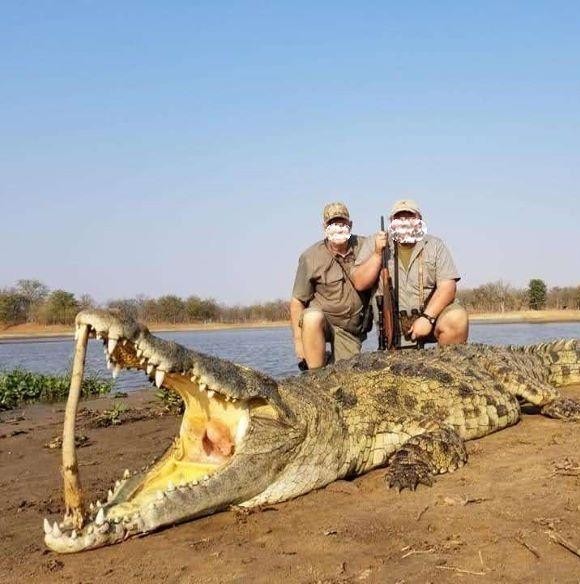
A large Nile crocodile lying motionless on a riverbank can make the hunt look deceptively simple. You have found the animal, he is over 14 feet, he is within range and the rifle is ready. Surely all that remains is to take the shot.
Not quite.
Finding a mature bull crocodile is only the beginning. Before the Professional Hunter tells you to get behind the rifle, he will be looking at where the crocodile is lying, how close it is to deep water, the angle it presents, where the hunter can establish a solid shooting position and what will happen immediately after the shot.
These decisions are a critical part of Crocodile Hunts in Africa as there is little room to recover from a poor one. A crocodile that reaches deep water after the shot can become very difficult to recover, while rushing an approach can send an undisturbed animal into the water before the hunter ever gets into position.
Sometimes that means watching a perfectly good crocodile and doing absolutely nothing.
The animal may need to move farther up the bank. The shooting angle may need to improve to break the skull. The PH may decide there is no sensible way to approach without being seen, or that the recovery risk is too high from where the crocodile is lying.
By the time the rifle finally comes out, much of the thinking behind that shot has already been done.
Finding the crocodile gives you an opportunity. What happens next determines whether it is an opportunity worth taking.
Finding a Big Crocodile Does Not Mean You Have a Shot
Once a suitable crocodile has been located, the temptation is to start thinking about how to get within rifle range. The PH may be thinking about something completely different: where does this crocodile need to be before an approach is even worth attempting?
Crocodiles do not necessarily remain in the same position while basking. Do not mistake basking for sleeping. A crocodile lying motionless on the bank can remain highly alert to movement and disturbance around it, particularly when it is out of the security of the water. An animal lying close to the water may gradually move farther onto the bank as it warms, while another may change its body position and present a different angle. Waiting can therefore turn a poor opportunity into a considerably better one without the hunting team moving at all.
The opposite can happen just as quickly. A crocodile that appeared perfectly settled can become alert, turn towards the water or slide back into it. Once that happens, trying to force the hunt usually achieves very little.
Finding the crocodile is one thing. Having an opportunity to hunt him is another. The PH now knows where the animal is, but the hunt only moves forward when the crocodile gives the team something they can work with.
How Close He Is to Deep Water Can Change the Decision
A few yards can make a big difference on a crocodile hunt. A bull crocodile lying well up a bank gives the hunting team something different to work with from an equally good crocodile stretched out at the water's edge.
The first shot needs to anchor the crocodile where it is lying. Even with a fatal shot, violent muscular contractions and involuntary movement can follow immediately. A crocodile may thrash or roll after the bullet strikes, and an animal lying at the edge of the bank can end up in deep water even when the shot has killed it.
A few extra yards of dry ground matter. If the crocodile is lying farther up the bank, there is more room for that movement to take place without carrying the animal into the water. If he is lying only a few feet from the edge, a roll in the wrong direction may be enough to turn a clean kill into a difficult recovery.
Reaching the water does not necessarily mean the crocodile is lost. In relatively still water, a recovery team may have an opportunity to locate the animal and use a grapnel to bring it within reach. That is still a recovery nobody wants to rely on when deciding whether to take the original shot.
Fast-moving rivers introduce another problem. On systems such as the Zambezi, current can carry a crocodile away from where it entered the water and make an already difficult recovery considerably harder. Other crocodiles can also damage or feed on the animal if it remains in the water for too long.
That can make patience difficult when the crocodile in front of you is exactly the animal you came to hunt. A hunter looking through binoculars at a 14-foot bull is naturally thinking about getting the rifle into position. The PH may be looking at the same crocodile and hoping he crawls another ten feet up the bank.
Sometimes he will. Sometimes he won't.
The size of the crocodile has not changed. The quality of the opportunity has.
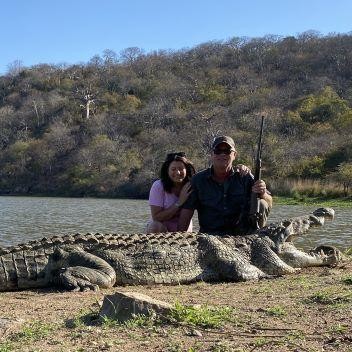
The Shooting Position Is Chosen Before the Approach
Once the PH is satisfied with where the crocodile is lying, the next decision is not simply how to get closer. He needs to decide where the hunter needs to end up before anyone starts moving.
Crocodile hunting requires a precise first shot, so closing another 20 or 30 yards means little if the hunter ends up in a poor shooting position. A slightly longer shot from a solid rest can offer a better opportunity than getting closer and trying to shoot from an awkward position on uneven ground.
The terrain does not always make that easy. In Mozambique, for example, a crocodile may be lying across a river, channel or estuary, with the hunter setting up on higher ground on the opposite side. Rocks, steep banks and uneven ground can make building a stable shooting position considerably harder than the distance alone suggests.
A tripod system such as the BOG DeathGrip can be useful in this situation. The rifle can be secured in the clamping head while the adjustable legs are set independently to deal with uneven ground. Some models also incorporate a bubble level, helping the hunter establish a stable shooting platform when the ground underneath him is anything but level.
The PH therefore needs to look at the hunt from the end backwards. Where can the rifle be properly supported? Will the hunter have a clear view of the crocodile from there? Can that position be reached without exposing the hunting team during the approach? And if the crocodile changes position while they are moving, does the setup still work?
Once the hunter reaches that position, unnecessary movement needs to stop. The rifle is settled, the range confirmed and the hunter needs to be clear on the correct Crocodile Shot Placement before the PH gives him the go-ahead.
Getting closer is not the objective. Getting the hunter into the best position to make the first shot is.
A Crocodile Can Be Shootable and Still Be Left Alone
There is a point on some crocodile hunts where almost everything appears to be right. The bull is big, he is on the bank, the hunter can get within range and there appears to be a clear shot.
The PH may still decide to leave him alone.
That decision can be difficult to understand when the hunter has spent hours looking for exactly that crocodile. But a hunting opportunity does not become a good one simply because the animal is finally in front of you.
Several small problems can quickly become one large problem. Perhaps the crocodile has become unsettled and is beginning to edge towards the water. Maybe the only available shooting position does not allow the hunter to settle behind the rifle. The animal might turn and remove the angle everyone had been waiting for just as the final approach is being made.
None of those situations needs to be forced.
Professional Hunters at Doornboom Hunting Safaris have made the same point from their own crocodile hunts: finding a big crocodile does not mean a shot needs to be taken. If the animal's position, shooting setup or recovery prospects are wrong, there is little reason to force the opportunity when waiting may produce a better one.
Patience also matters when hunting areas hold good crocodile populations. In places such as Zimbabwe and Mozambique, the first big crocodile located will not necessarily be the last one the hunting team finds. Walking away from a poor opportunity does not mean walking away from the hunt. Another chance may come with the same crocodile later, or with another mature bull somewhere else. That same patience is an important part of Dangerous Game Hunts in Africa, where knowing when not to take a shot can matter just as much as knowing when to take one.
A PH does not need every condition to be perfect. He needs enough of the important ones to be right.
Once the Approach Starts, the Crocodile Gets a Vote
A plan that looked good through binoculars can begin to change the moment the hunting team starts moving. The crocodile has no idea what has been planned on the opposite bank, and he is under no obligation to remain where everyone wants him.
He may turn, crawl closer to the water or suddenly lift his head. Another crocodile entering the area can disturb him. A bird giving an alarm call, movement along the bank or something the hunting team never even sees may be enough to put him on alert.
With a big old crocodile, that warning needs to be taken seriously. These animals do not reach 14 feet by being careless. If something looks or sounds wrong, a few seconds may be all it takes for the crocodile to slide off the bank and disappear into the water.
When that happens, the original plan is finished.
The PH may stop the approach before the crocodile detects the hunting team, change the route or back out completely. Continuing simply because the hunter has already crawled 200 yards and is almost in position makes little sense if the opportunity waiting at the end of that crawl is disappearing.
This is where patience becomes more than sitting behind binoculars waiting for a big crocodile to appear. It also means being prepared to abandon a plan after effort rather than pushing an animal that is already becoming suspicious.
The PH can choose the route, prepare the shooting position and decide when to begin the approach.
The crocodile still gets a vote. Time for plan B.
The Rifle Comes Out Last
By the time the hunter finally gets behind the rifle, the decisions have already been made. The crocodile is where the PH wants him, the shooting position is stable, the range has been confirmed and the hunter knows exactly where the first bullet needs to go.
Now there is little left to discuss.
The same discipline applies across Big Game Hunting in Africa, but crocodile hunting leaves little room for improvisation after the trigger is squeezed. A poor decision made beforehand can turn what looked like a straightforward opportunity into a problem.
The hunter settles behind the rifle. The PH takes one final look at the crocodile and confirms that nothing has changed.
Then comes the instruction everyone has been waiting for.
Take him.
Frequently Asked Questions
Why might a PH refuse a shot at a big crocodile?
A large crocodile can be within range and still present a poor opportunity. Its position near deep water, shooting angle, available rifle rest and the prospects of recovering the animal all need to be considered. If too many of those factors are working against the hunter, waiting is usually the better decision.
How far from the water should a crocodile be before taking the shot?
There is no fixed distance that applies to every crocodile hunt. The bank, water depth, current, shooting angle and position of the animal all influence the decision.
A few extra yards of dry ground can, however, provide valuable room if the crocodile thrashes or rolls after the shot.
Why is the first shot so important when hunting crocodile?
The objective is to anchor the crocodile where it is lying and prevent it from reaching deep water. Crocodile hunting requires precise shot placement and a stable rifle position, which is why the PH will normally spend considerable time preparing the opportunity before giving the hunter the go-ahead.
Should crocodile hunting be planned as part of a longer African safari?
It often can be. Crocodile may be combined with buffalo, hippo, plains game or other species depending on the country, hunting area and available quota. Hunters planning broader African Hunting Trips should discuss crocodile with their outfitter before travelling, as suitable areas, permits and quota need to be confirmed in advance.
About the Authors
Pierre and Tamlyn van Wyk are the co-founders of Game Hunting Safaris and have hunted large Nile crocodiles in Africa themselves. Their experience working with Professional Hunters and outfitters across the continent gives them first-hand insight into the planning and decisions that take place before a crocodile shot is taken.