
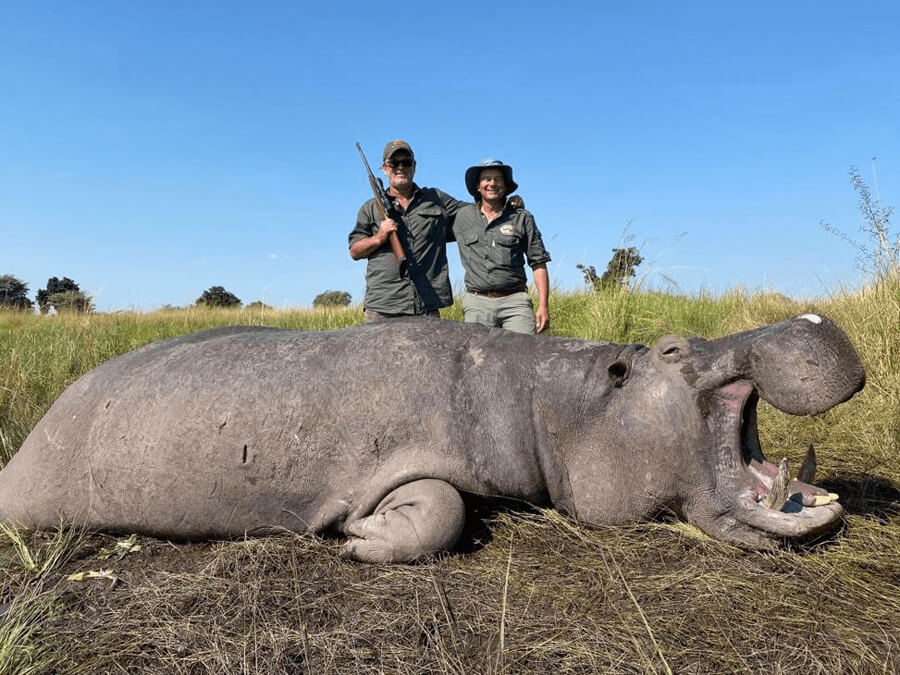
My 2022 hippo hunt in Namibia's Caprivi Strip began with a plan that looked straightforward enough: find a mature bull on land, get into a suitable position and make the shot. What I hadn't counted on was the amount of water we would encounter, or how quickly those conditions would force us to abandon that plan.
The safari eventually involved four days of searching flooded channels, close encounters with crocodiles, an unexpected meeting with a hippo cow and calf, and a final shot that left me wondering whether I had recovered my bull.
For hunters comparing available opportunities, our guide to hippo hunting in Namibia covers the hunting areas, packages and practical considerations. This is the story of how my own hunt unfolded.
[DYNAMIC-BLOGTABLEOFCONTENT]
Hippo Hunting in Namibia
Lying in a hospital bed recovering from a spinal fusion operation, worst of all with a catheter in place, that I can assure you was not at all pleasant, I knew I was losing my mind at a rapid rate. The thought of leaving the hospital and spending two months in bed nearly pushed me over the edge.
I did the only thing I could do with the internet being my best friend….research! Upon completion of my research, I booked a game hunting safari to maintain what little sanity I had left! African big game hunting is a passion, and feeling obese just lying there like a dead man, hunting a hippo in the Caprivi Strip sounded like a great idea as it felt as if I could certainly relate. It was a motivation to get up and start putting in hours of walking. I chatted with a few outfitters I knew, and before I knew it, we had booked a big game hunt in Namibia.
Travelling to the Hunting Safari Lodge
That journey was a reminder of how different the Zambezi Region is from the Namibia most hunters picture. Instead of desert and open plains, we were travelling through waterways alive with hippo, crocodiles, buffalo and elephant. It is a completely different side of hunting in Namibia, and one I had been looking forward to experiencing.
A few weeks earlier the outfitter called and asked if I did not want to move the dates as after all the rain in the area, the Caprivi had flooded, but we chose to push through as we had other commitments. This decision I later learned, made big game hunting far more of a challenge.
The sheer number of elephants in the Chobe Reserve, which is literally on the other side of the river from Namibia, is ridiculous, and the numbers climbed exponentially when the Government banned hunting in 2014. More than 50,000 elephants in an area of roughly 250,000 acres, crazy stuff! From a wildlife conservation perspective, it is heartbreaking to see what havoc the overpopulation of elephants is doing to the environment and how the resident sables, kudu, and other plains game are negatively affected.
Maneuvering our little canoe through the shallows, we arrived in a little “harbor.” After a short walk, we arrived at the lodge. The lodge was perfect in every way. The camp team members were super friendly and welcoming. The bar and dining area were fully equipped, with the deck offering beautiful African views over the Caprivi Strip. The tented accommodation was clean and spacious, with plenty of hot water. No matter what time of the day you walked into your suite, there was ice-cold water at your disposal! I do not think my hunting gear has ever been cleaned so well.
My favorite team member – if I were forced to choose one – was Maria, the chef. The only complaint I could make was that the food was too good and too much. One cannot say no to all these delicacies, and after a few days, I was feeling as much as looking like one of the local hippos.
In this area of Namibia, big game hunting mostly focused on crocodiles, buffalo, elephants, and hippos. The camp lodge was perfectly decorated with many buffalo, hippo, and elephant skulls.
Hippo Hunting Safari in Namibia: Day One
Hippo hunting in Namibia is challenging at the best of times. No fences, with land and waterways stretching as far as the eye can see. Climbing into our little canoe, we headed off on day one through the rivers and estuaries in search of a trophy bull. Hunting is an absolute privilege, with nothing matching the excitement of searching for African big game hunting safari.
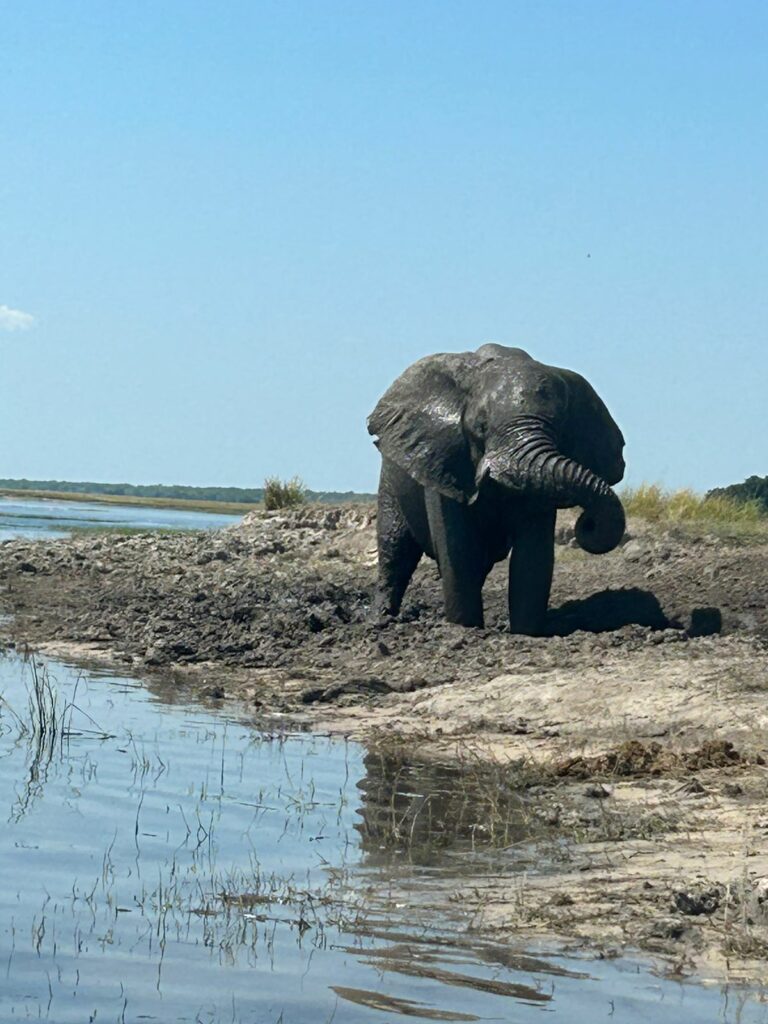
The rivers and banks were teaming with big, old, prehistoric Nile crocodiles, and plenty of elephants, and the Cape buffalo were beginning to cross the Chobe River and head north. When hunting hippos, the challenges and dangers are real, not only from hippos and other African Big Five animals but also from snakes.
Representatives of the Namibian government accompanied the hunt to ensure that there weren’t any international laws breached. We spotted a few hippo pods and some lone bulls that, unfortunately, always seemed to be on the Botswanan side of the Chobe River. With the Caprivi Strip being such a narrow expanse of land, the local Namibian government officials constantly reminded you which side was Namibia, Botswana, or Zambia. It was as if all the hippos knew they were safe in the neighboring countries, literally 30 to 50 yards away from us.
After lunch, we headed back out in the blazing sun and stumbled across a lone bull lurking next to the shoreline in the reeds in some deep water. At about a hundred yards out, the hippo sank back into the water and disappeared. Knowing an adult hippo can hold his breath, we waited to see where he would pop out. The problem was that we were still in the canoe, and there was no way I could take a shot off the water. It just was not a consideration when I remembered the accuracy required for a brain shot. As luck would have it, he surfaced about 50 yards away. Those beady eyes seemed to be chuckling as if he knew he was now in Botswana. This was getting frustrating, and I had to remind myself that it was only day one of the hunting adventure.
As the African sun set behind us, we headed to camp, to Maria and a range of cold beverages.
Maria, no hippo today!
Hippo Hunting Safari in Namibia: Day Two
Up early after another fine early morning breakfast, we headed back out into the Caprivi. African hunts require a quality, wide-brimmed hat, plenty of water, and a pair of good binoculars. The little canoes are narrow, and it feels as if they will tip over with any sudden movement. The crocodiles always seemed to be watching and waiting for this to happen and for their next meal to be delivered courtesy of the Chobe River.
We spotted a bull hippo a few hours later, who, for once, seemed to be unaware that he was in Namibia. Great news indeed. We continued about five hundred yards up the channel and moored the canoe. We made our way slowly to a vantage point opposite his lair and lay to see how we could make this happen. The hippo was not unaware of our presence. He was about a hundred across the channel, a little too far for my liking. Tamlyn, on the other hand, seemed more concerned that we might be ambushed by a crocodile from behind and become a snack!
A few hours later, with the hippo not budging and me not keen on the shot, we again packed up and headed back to the safari lodge.
Maria, no hippo today!
Hippo Hunting Safari in Namibia: Day Three
On day three, we decided to change our strategy. We walked the banks hoping to “spook” up a bull. Dragging yourself through the thick reeds and crocodile-infested waters, ankle and or waist deep, makes you wonder who the prey is! We ended up bumping into a hippo cow and her calf and slowly backed away to relative safely.
That afternoon we tried another strategy and dragged the canoe through the papyrus reeds, which was a challenge. Minimal visibility and plenty of predators. We spooked up a bull and began to follow his spoor. I use that term loosely because it looked as if a tanker had flattened the area ahead of us. The only sound is your heart pumping in your chest and the sound of the canoe through the reeds. This is big game hunting in Africa at its best.
Out of nowhere, a crocodile leaped out and bumped into the side of our canoe. Tamlyn could have reached out and touched him with minimal effort. Tamlyn seemed to be having many, “Oh my %^%&&^” moments as she called them out here in the Caprivi. Our PH advised that it is imperative that you have at least 30 minutes a day of these moments to keep the blood flowing and the adrenaline pumping! It increases one’s life span.
Continuing the search, it looked as if that bull hippo had vanished into the abyss.
Maria, no hippo today.
That night around the campfire we had some intense discussions regarding the best strategy to employ. The vast amount of water made it impossible to get a hippo on land, and it was as if all the hippos had just renewed their Botswanan passports.
Hippo Hunting Safari in Namibia: Day Four
We headed out early, with the weather perfect as usual. We started chatting to a few local fishermen to see if they had spotted anything. Nothing!
We decided to take a trip to the south and skirted the Chobe reserve borders. The elephants, as usual, were plentiful. We spotted a few monsters old “dagga boys.” Nothing like seeing Africa’s Black Death up close and personal, glaring at you from its mud pools. All Cape buffalo seem to be born with the intent of killing hunters.
We decided to head back to camp for lunch. It was hot on the water. Up ahead we spotted a bull hippo about a hundred yards out, half submerged in the water and near a steep embankment. I just knew this was my hippo. We pulled up the canoe, and I dashed to the side of the embankment. The rest of the hunting crew decided to stay in the canoe so as not to spook him. Lying at a sideway angle, I gave him a quick look through the scope. He was a monster of a trophy but began backing up into deeper water. He turned sideways, and I had the perfect kill shot between the eyes and ear. Nerves and adrenaline were at full tilt, and my aim seemed to be moved all over that monstrous head.
I did not take the shot, and I knew that I had missed my opportunity. Buck fever can be a terrible thing. I glanced at the canoe and saw the rest of the hunting team sitting, hands covering their ears. I had spent plenty of time studying hippo shot placement before the safari, but knowing where to aim and actually taking the shot are two very different things. With the bull partly submerged, the available target was small, and I knew there was little room for error.
Looking back at that old bull, he seemed to launch himself out of the water and opened his jaw showing enormous ivory tusks. A crocodile moved further up the river, and the hippo turned to look. That was his mistake. I saw the mark and squeezed the shot. He just sank into the deep water along with my heart, not making a sound.
Getting back to the canoe everyone was cheering. I was not convinced. I needed to see him. We backed off into some reeds and decided to wait. It can take anything from two hours to five hours for a hippo to begin to float to the surface. The hunting crew wanted to return to camp for lunch and wait for him to surface. I flatly refused.
We waited in the heat for a couple of hours. I said to the PH that if we did not take a look and see if he had surfaced, I would consider swimming in these crocodile-infested waters to see for myself! My nerves were shot. As we had seen no movement up or down the river since taking the shot, which was many hours past, we took a slow paddle across. One of the guides pointed down and smiled. There was the tank about two meters under.
Maria, we got a hippo!
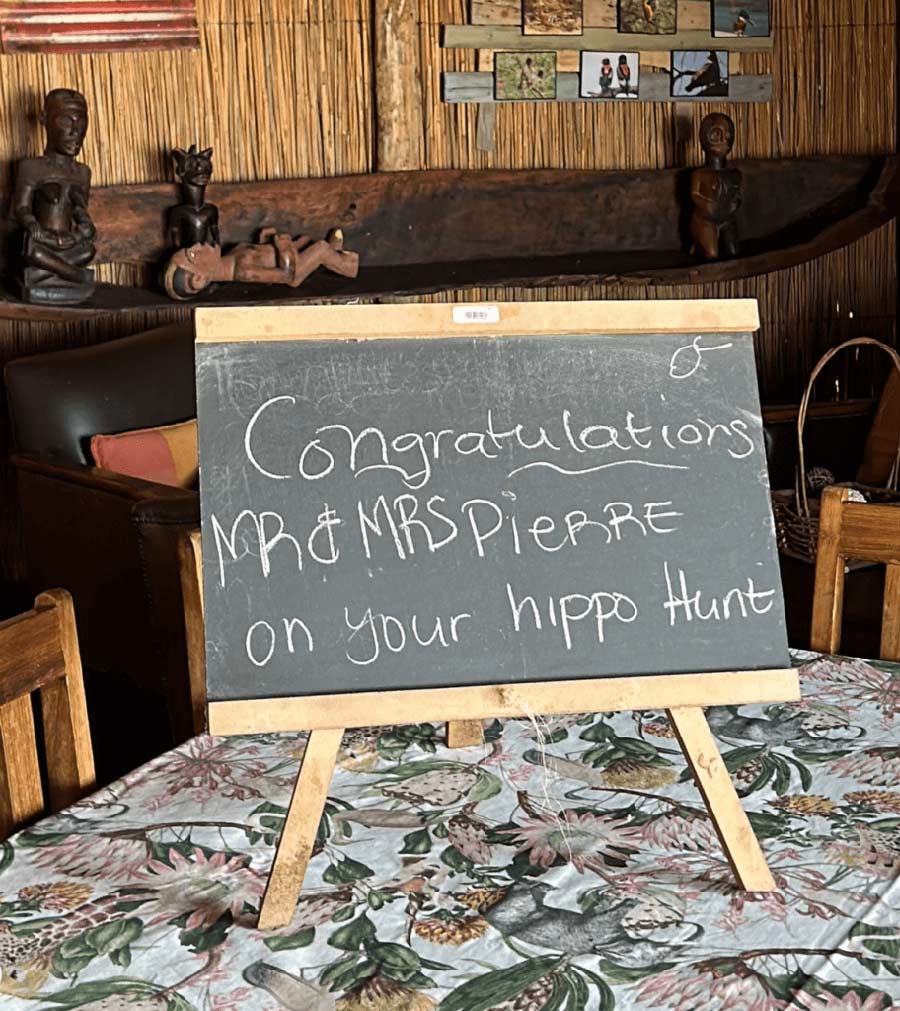
Seems like the bush telegraph moves quicker than a charging buffalo. We were met with champagne on ice, together with a huge chalkboard with words of congratulations. This outfitter was certainly on top of his game!
Recovering an African Hippo
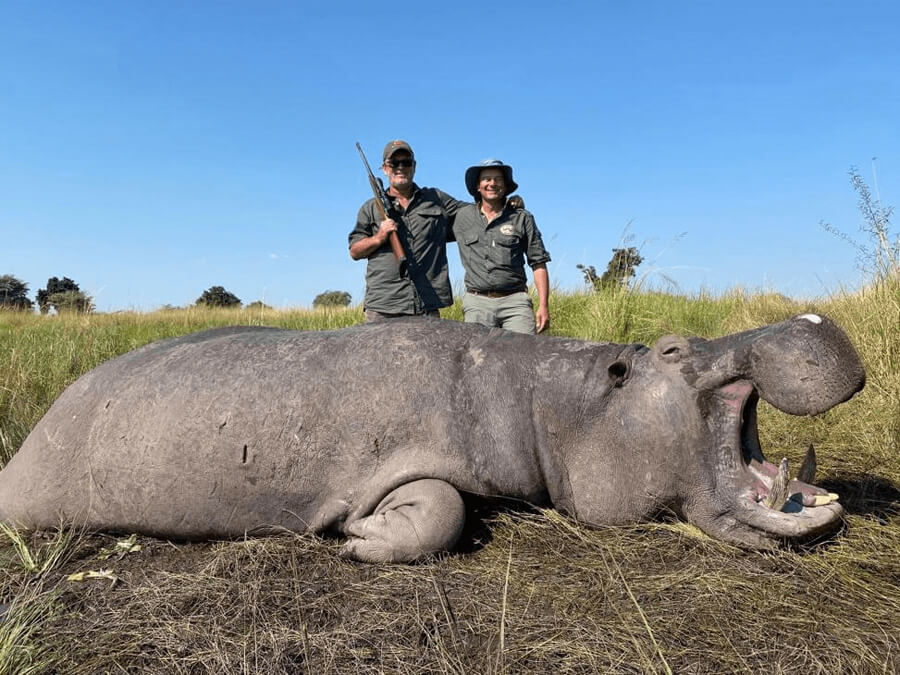
This in itself was a challenge. We tied a foot to the canoe and slowly made our way back to camp. It took approximately thirty members of the local tribe folk, who came running from every direction, to recover him from the water and roll onto the bank. Fires were burning all over the Caprivi, and there would be a feast with hippo on the menu! Looking at the sheer size of the animal the first thought I had, was that I should have used more guns. Tamlyn commented, “You did not just complete a successful hippo hunt, but you have fed an entire community. We can be proud of what we have achieved.” It turns out that it had been five months since the residents had last tasted red meat.
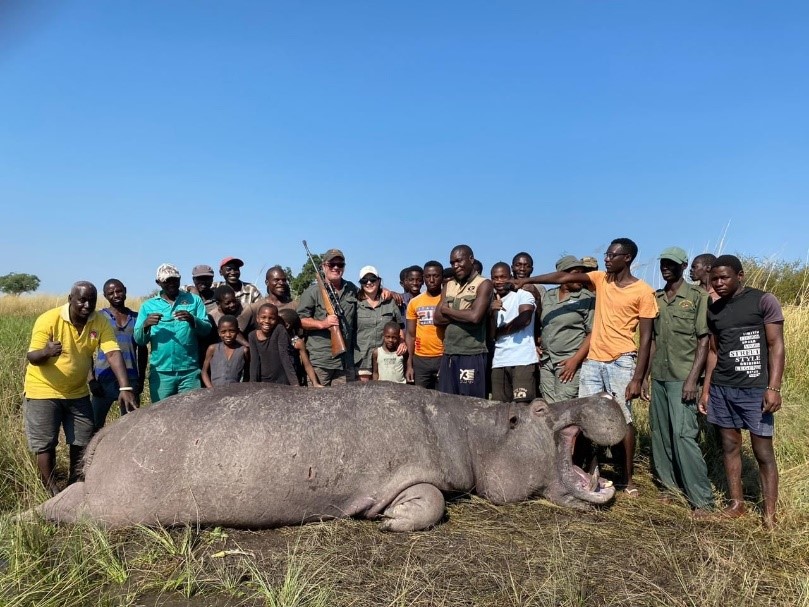
Having a closer look at that enormous head, I could not find the entry hole of the 300-grain bullet. I had pulled the shot and had severed the spinal cord. The Lord works in mysterious ways.
Watching the locals armed with knives and axes reminded me of watching the start of a motocross race with all participants revving away and waiting for the start bell to go off. In this case, it was for the skilled skinners to complete the capping process so that the butchering and processing could begin.
Four Days in the Caprivi I'll Never Forget
Looking back, that safari turned out very differently from the hunt I had planned while recovering from surgery. I had imagined finding a mature bull on land and taking a straightforward shot. Instead, we spent four days navigating flooded waterways, dealing with crocodiles, changing our strategy and watching hippos disappear across international borders.
The greatest satisfaction came after the recovery. Seeing the local community gather to help retrieve and process that enormous animal reminded me that a successful African hunt can mean considerably more than bringing home a trophy.
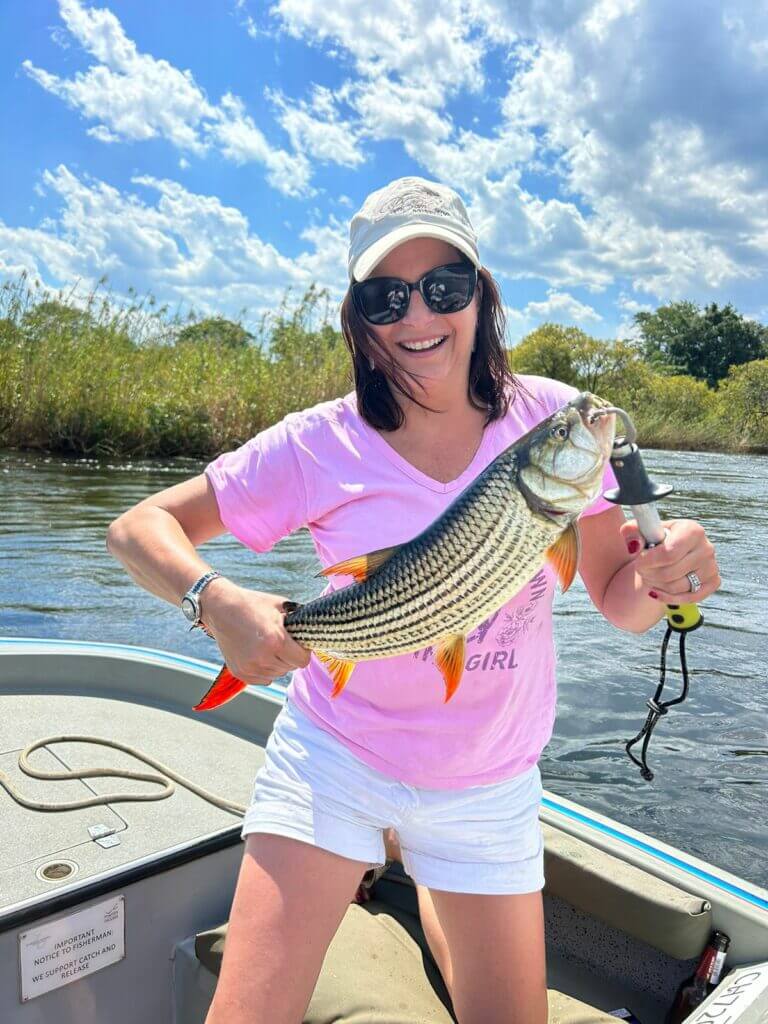
And I certainly haven't forgotten Maria's cooking, the camp's wonderful hospitality or the tiger fishing along the Chobe River. Those experiences made the trip just as memorable as the hunt itself.
For hunters planning their next safari, our African hunting trips offer opportunities to compare destinations, species and available hunting packages across Africa.
Author: Pierre van Wyk