Bongo and Forest Elephant Hunting Safari (13 Days) – Cameroon
Booking Season: 2026
Hunt Difficulty: Difficult

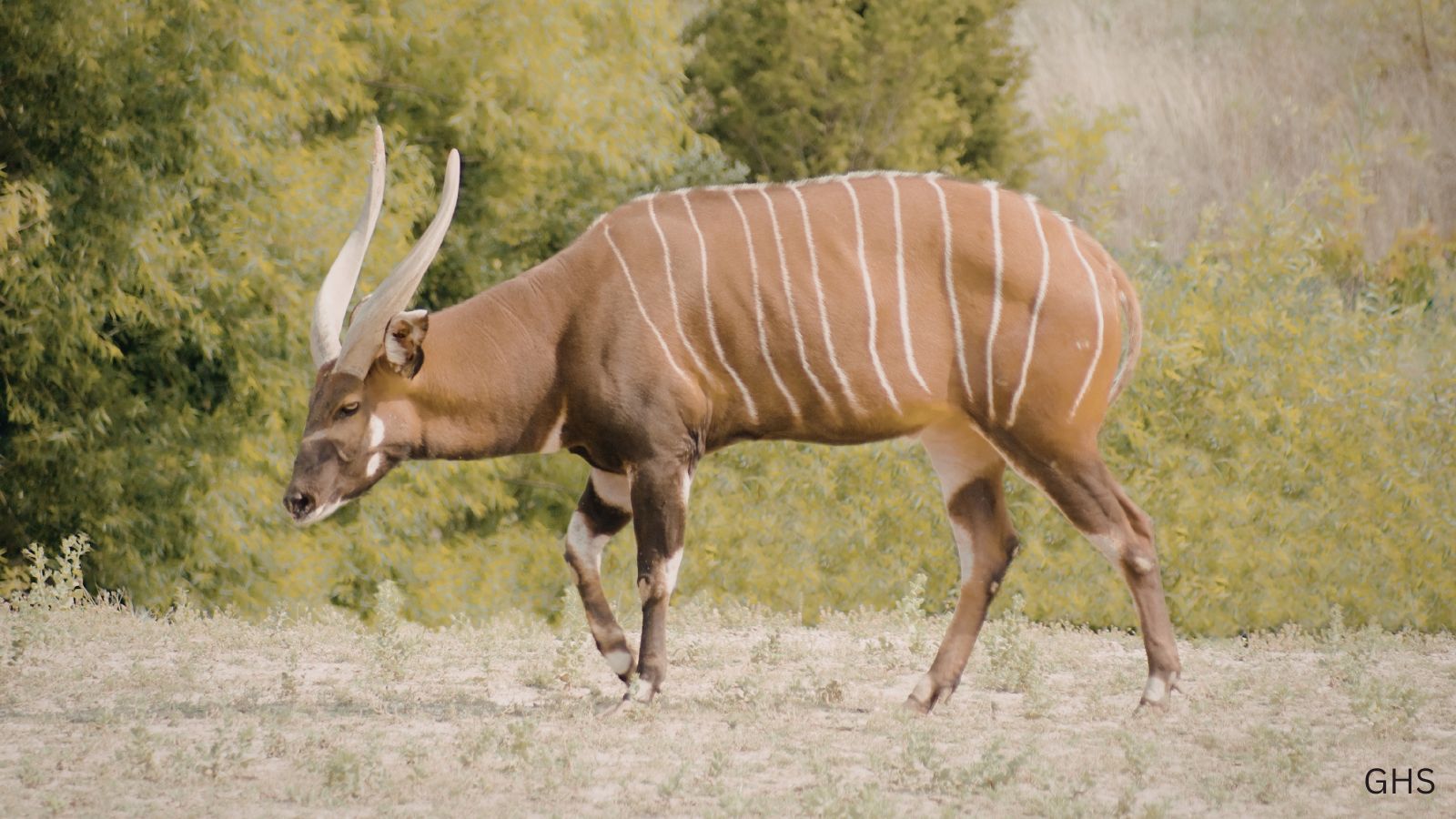
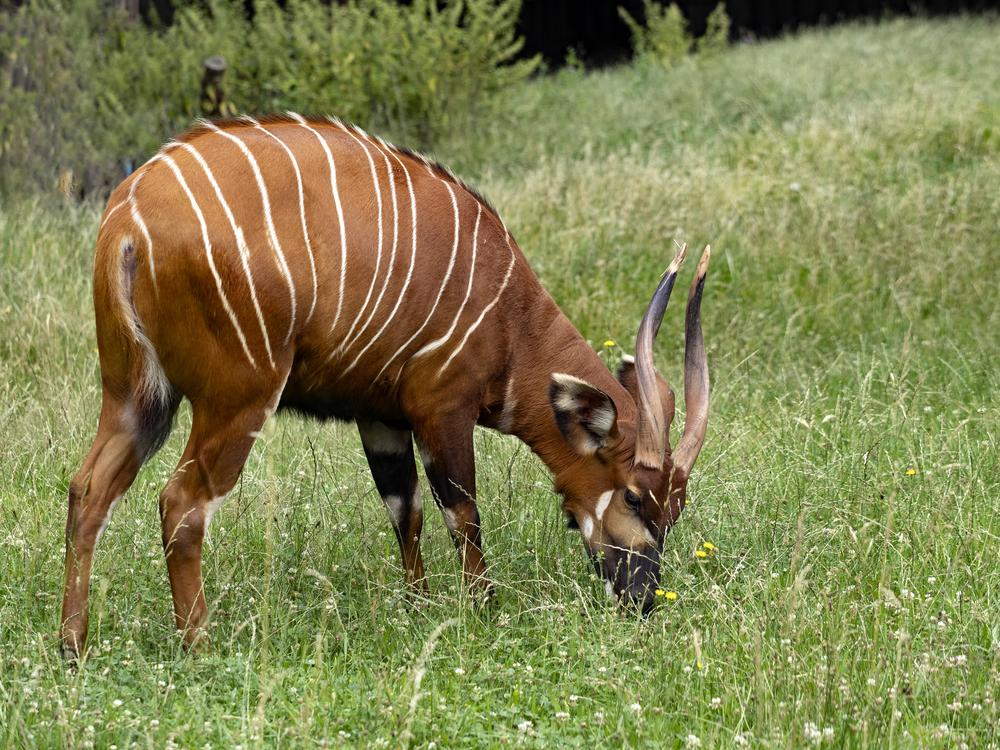
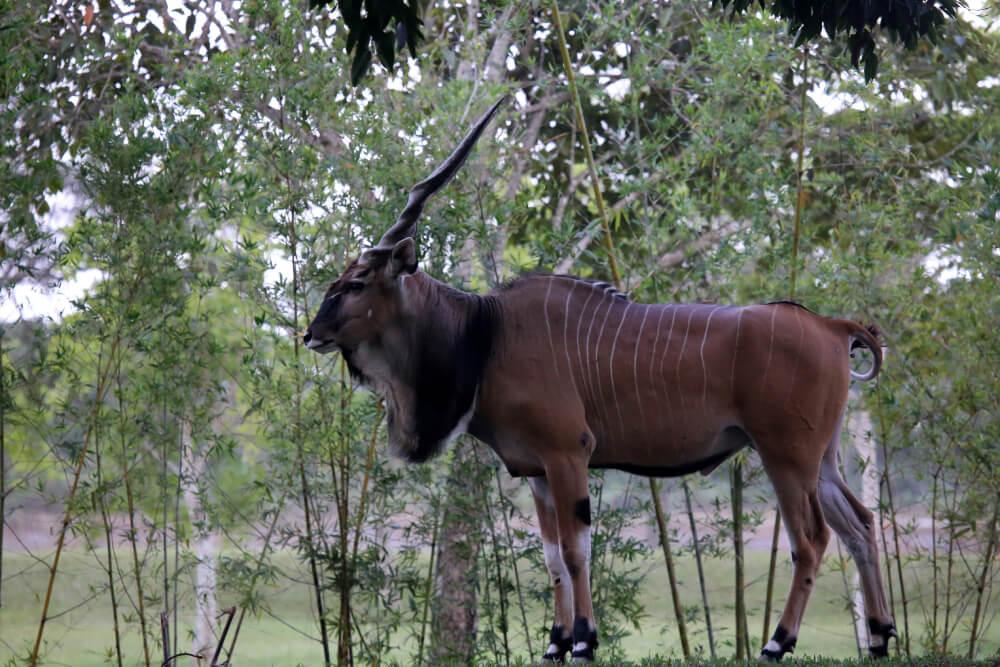
Bongo hunting takes place in the dense rainforests of Central Africa, where hunters follow fresh tracks through thick vegetation with experienced local trackers and trained dogs. A mature bongo bull weighs around 600 pounds, with larger animals exceeding 800 pounds. Despite their size and striking white-striped coats, these forest antelope are difficult to spot.
Cameroon remains the main destination for bongo hunts, with further hunting in the Republic of Congo. Hunting methods differ between concessions, but the use of skilled tracking teams and dogs has transformed bongo hunting from a pursuit known for low success rates into one where well-prepared outfitters report consistently strong results. Within Africa's wider plains game hunts, bongo stands apart as a specialist rainforest pursuit, far removed from the open-country hunting most safari veterans know.
For American hunters planning a bongo safari, the real decisions are choosing the right hunting area, understanding the full cost beyond the advertised safari price, selecting suitable dates and arranging the paperwork to bring a trophy home.
Compare the available bongo hunts below, then use this guide to assess the hunting conditions, trophy expectations and costs before committing to a safari.
Available Bongo Hunts
Bongo and Forest Elephant Hunting Safari (13 Days) – Cameroon
Booking Season: 2026
Hunt Difficulty: Difficult
13-Day Bongo Hunting Safari in the Republic of Congo
Booking Season: 2026
Hunt Difficulty: Difficult
Hunt Bongo & Sitatunga in Boumba North, Cameroon
Booking Season: 2026
Hunt Difficulty: Difficult
Africa Hunting Trip for Dwarf Buffalo & Sitatunga Cameroon
Booking Season: 2026
Hunt Difficulty: Difficult
Hunt the Elusive Bongo & Sitatunga in Cameroon’s Rainforests
Booking Season: 2026
Hunt Difficulty: Difficult
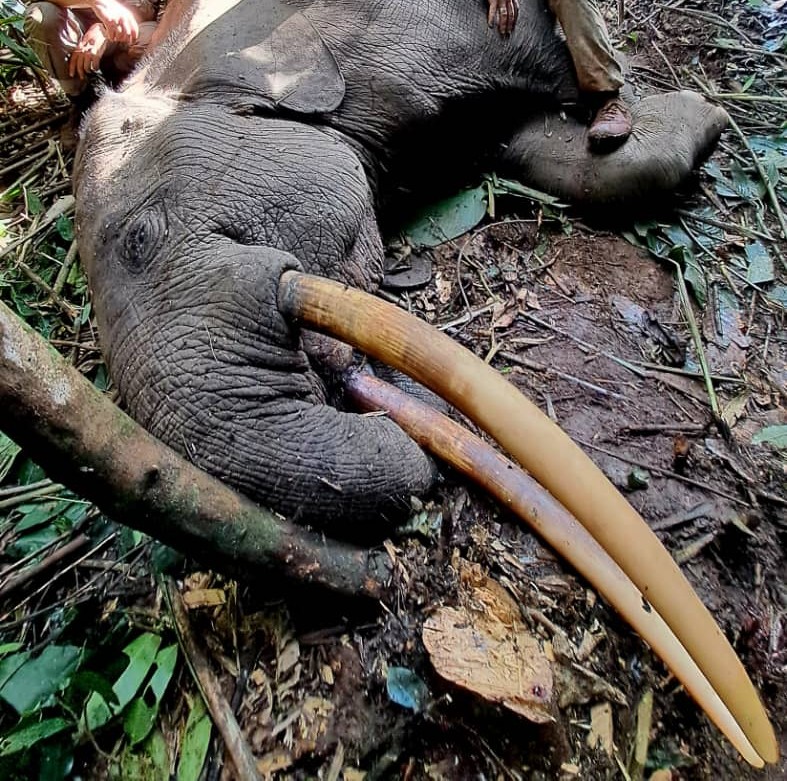
Bongo, Sitatunga & Forest Elephant Hunting in Cameroon
Booking Season: 2026
Hunt Difficulty: Moderate, Difficult
Cameroon and the Republic of Congo are the two principal destinations for the bongo safaris we offer. In Cameroon, hunting teams search for fresh tracks along forest roads before following mature bulls into thick cover with trackers and dogs. In the Republic of Congo, hunters enter remote northern rainforest concessions where tracking, salt licks and elevated blinds form part of the hunting approach.
Cameroon remains one of Africa's leading bongo hunting destinations, with productive rainforest concessions in the south and southeast, including the Lobeke and Boumba regions.
Hunters pursuing bongo hunting in Cameroon work with experienced local trackers and trained dogs to follow fresh spoor through thick forest. Much of the hunt depends on locating a mature bull's tracks and closing the distance before the animal moves deeper into cover.
Access to remote forest concessions involves charter flights from Douala in some hunting areas. Cameroon forest safaris are advertised from approximately January or February through July, with dates determined by the concession and hunting arrangements. Hunting licenses for these safaris commonly cover one bongo, one sitatunga and several smaller forest species, subject to the approved quota.
Our guide to hunting in Cameroon covers other species available to hunters and travel arrangements.
The Republic of Congo offers bongo hunting in its northern rainforest concessions, including the Tala Tala region. These remote hunting grounds contain thick forest, natural salt licks and animal crossings where bongo movement is monitored.
Hunters considering bongo hunting in the Republic of Congo generally travel through Brazzaville, continue by domestic flight to Ouesso and then make a lengthy road transfer into the forest. Tracking teams work on fresh spoor, while elevated hunting platforms near salt licks provide another method of pursuing a mature bull.
Our guide to hunting in the Republic of Congo covers the destination in greater detail.
The Central African Republic has produced some of Africa's finest bongo trophies, but the country carries the US State Department's highest travel warning. We do not currently offer hunts there.
Bongo also inhabit Gabon's rainforests, while Kenya's critically endangered mountain bongo are not hunted. Bongo occur in Liberia, although we have no verified commercial bongo hunts there.
Some high-fenced Texas ranches offer bongo hunting, but this bears little resemblance to tracking a free-ranging bull through Central African rainforest.
Bongo hunting is among the more expensive specialist safaris in Africa. The cost reflects far more than the trophy itself. Hunters are paying for access to remote rainforest concessions, experienced professional hunters, local tracking teams, trained dogs and the logistics of keeping a hunting camp operating deep in the forest.
The advertised safari price is only the starting point. A hunter comparing bongo safaris needs to know which expenses are included and which will appear on the final invoice.
The main costs to examine are:
Daily hunting rates: Accommodation, meals, the professional hunter, trackers, dog handlers, camp staff and transport within the hunting area.
Bongo trophy fee: The bongo trophy fee is charged separately from the safari package on our current listings. Check the hunt details for the applicable fee and whether it is payable on a successful hunt or under other conditions.
Female bongo: Both sexes carry horns, and taking a female instead of an authorized bull can result in additional charges or penalties. Confirm the applicable terms with the outfitter.
Hunting licenses and permits: Government charges for the hunter, firearm arrangements and the species being pursued.
Charter flights and transfers: Reaching remote rainforest concessions can involve domestic flights, charter aircraft and long road transfers.
Community development and anti-poaching levies: Some Cameroon concessions charge community development taxes or anti-poaching contributions. Check whether these charges are included in the advertised safari price or billed separately.
Trophy preparation and shipping: Dip and pack, veterinary documents, export paperwork and international freight.
Two bongo safaris with similar advertised prices can end up far apart once trophy fees, flights and government charges are added.
Ask for an itemized quotation showing the full safari cost, including what happens financially if a bongo is wounded and not recovered. The same applies to additional forest species: a combination safari needs a clear breakdown of the trophy fees and permits involved.
Our guide to African hunting safari prices explains how these charges fit into the wider cost of hunting in Africa. The bongo safaris displayed above show current advertised prices and package inclusions, giving hunters a starting point for comparing the full cost.
Bongo hunting is conducted in thick rainforest where visibility is limited and fresh tracks are worth more than hours of glassing. The professional hunter relies heavily on local trackers who know the forest, the animals' movements and the signs left along logging roads, game trails and muddy crossings.
In Cameroon's forest concessions, the hunting team searches logging roads and tracks at first light, looking for spoor left by a mature bull during the night.
Once the trackers find promising spoor, they assess how recently the bull passed through. Teams working with dogs look for tracks left within the last few hours before committing to a pursuit. The hunt then moves into the forest on foot. Experienced Baka trackers follow disturbed leaves, hoofprints and broken vegetation, working quietly through cover that gives the hunter little room to maneuver.
Tracking becomes harder as the day warms and the forest floor dries. Old spoor wastes hunting time, so the team concentrates on recent movement rather than following every bongo track they find.
Trained dogs play a central role in many Cameroon bongo hunts. Individual Baka trackers work with their own dogs in some hunting teams, keeping them under control while following spoor. The dogs are released when the trackers believe the bull is close, allowing the team to close the distance as the dogs pursue the animal through thick cover.
When the dogs catch up, a mature bongo bull sometimes stands its ground rather than running farther into the forest. The dogs hold its attention while the professional hunter and client approach.
This is called baying. It creates a brief chance at a shot, but the hunter must have a clear view of the animal and a safe shooting lane away from the dogs and tracking team.
There is little time to hesitate once the bull is identified. Shots are frequently taken at close range, with vegetation restricting the available angles.
Not every bongo safari relies entirely on tracking with dogs. In some forest concessions, hunting teams monitor natural salt licks, forest clearings and regular animal crossings.
An elevated platform, known as a machan, gives the hunter a view into an opening where bongo have been feeding or moving. The professional hunter assesses recent activity and positions the hunter where a bull might appear.
This method involves patience and offers less certainty than working fresh tracks with a skilled tracking team. It also allows hunters to observe forest game without pushing through thick cover throughout the day.
Bongo are heavy-bodied antelope, and a dependable medium- or large-bore rifle with a suitable hunting bullet is a sensible choice. The hunting team needs a rifle that handles well in tight cover, rather than equipment intended for long shots across open country.
Shots are commonly taken at short distances, sometimes within 10–30 yards. Both male and female bongo carry horns, so the professional hunter must identify a mature bull before authorizing the shot.
A bayed bull might be standing among trees with dogs moving nearby. A clear shooting lane and correct angle matter more than getting the shot away quickly. Our guide to shot placement on large antelope explains the anatomy and shot selection in more detail.
The best time for bongo hunting is closely tied to rainfall. Unlike open-country antelope hunts, where dry conditions improve visibility around water sources, rainforest hunting depends on finding fresh spoor and following it through thick vegetation.
Rain softens the forest floor, leaving clearer hoofprints along logging roads, muddy crossings and game trails. Damp leaves also make it easier for trackers to move quietly. During extended dry spells, tracks become harder to read, and following a bull through dry vegetation presents a tougher challenge.
Cameroon's forest hunting season extends from approximately January or February through July, depending on the concession. Late April through June is a productive period for hunters concentrating on bongo, when rainfall helps tracking teams identify fresh movement and follow bulls into the forest.
Earlier months remain worth considering, especially for hunters combining bongo with other forest antelope. The right dates depend on the species being pursued, the hunting area and the methods used by the outfitter.
Bongo safaris in the Republic of Congo's northern rainforest are advertised from approximately May through October. Hunters using tracking teams benefit from sufficient moisture to keep spoor readable, while those hunting near salt licks and forest openings rely more on recent animal activity at those locations.
May and June offer an overlap between the advertised hunting periods in Cameroon and Congo, making these months worth examining when comparing the two destinations.
Hunters interested in combining bongo with sitatunga need to look beyond the best dates for bongo alone. Sitatunga hunting takes place around swampy forest edges and wet ground, where access and hunting conditions change with the rains. February and March are worth discussing for Cameroon combinations, while the best dates for either species depend on the concession.
Hunters planning both species can compare our sitatunga hunts before settling on travel dates. Rainfall matters more than choosing a month from a calendar. Ask the outfitter when fresh tracks are most reliable in the hunting area and whether the proposed dates suit every species on your safari.
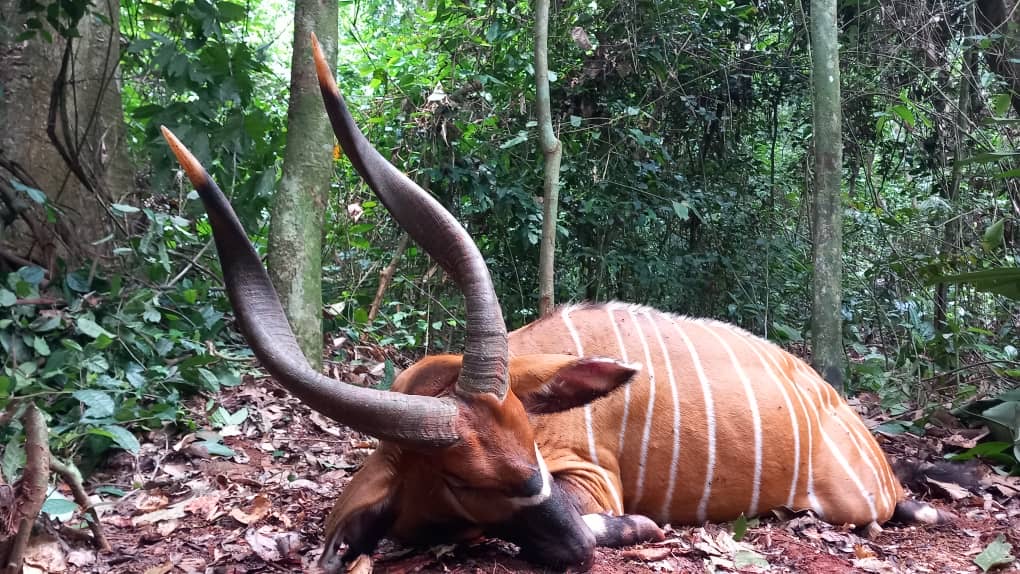
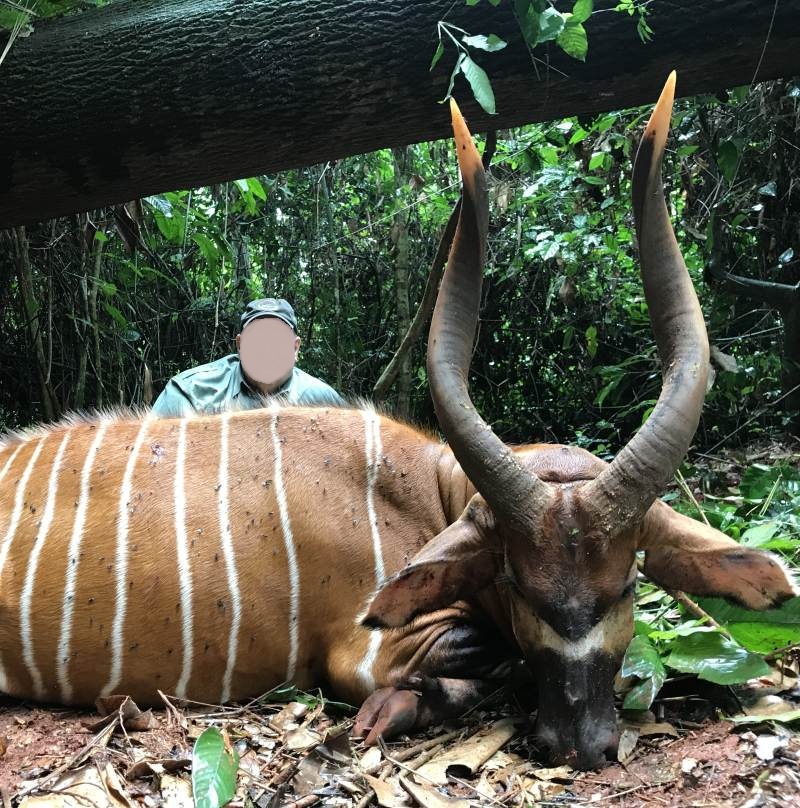
A mature bongo bull carries heavy, spiraled horns that sweep back over the head, often ending in polished ivory-colored tips. Both sexes have horns, making body size, horn development and the animal's overall maturity part of the decision before taking a shot.
Unlike antelope hunted across open plains, a bongo bull rarely gives the hunter time for a lengthy inspection. In thick rainforest, the professional hunter might have only seconds to assess an animal standing among trees or facing the tracking dogs.
Horn length is measured in inches, with the Rowland Ward minimum for western bongo set at 27 inches. A bull reaching that measurement represents a fine rainforest trophy, while horns exceeding 30 inches attract serious interest among experienced bongo hunters.
For comparison:
25–26 inches: Respectable horn length, but maturity and overall development deserve close attention.
27–29 inches: A strong trophy, reaching or exceeding the Rowland Ward minimum.
30–31 inches: An outstanding bull with impressive horn development.
Over 31 inches: A remarkable trophy and a rare find in the forest.
These measurements provide a guide, not a reason to overlook the age and condition of the animal.
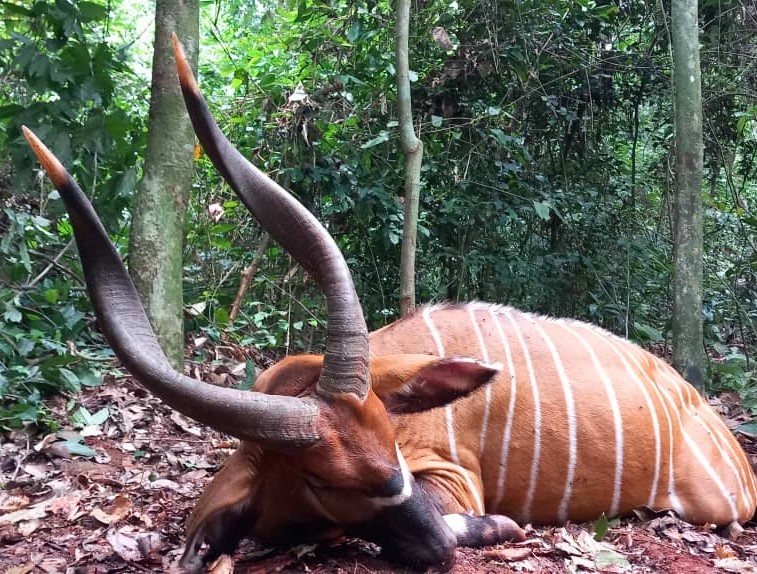
Mature bongo bull hunted in Cameroon. Photo courtesy of Pieter, one of our outfitting partners.
A good professional hunter looks beyond horn length. A mature bull develops a heavy neck, deep chest and powerful body. The horns become thicker through the bases, with worn or polished tips providing another clue to age.
Younger bulls also carry impressive horns, so length alone is not proof of maturity. The professional hunter must judge the animal's overall appearance, especially when a bull has been brought to bay and the shooting opportunity is brief.
Both cows and bulls carry the characteristic spiral horns. The difference matters because a female is not an acceptable substitute for the mature trophy bull the hunter has been authorized to pursue.
For more on the animal itself, including physical characteristics and habitat, see our bongo species profile.
Rowland Ward and Safari Club International use separate measurement systems.
Rowland Ward places its emphasis on horn length, with 27 inches as the qualifying minimum for western bongo.
Safari Club International (SCI) uses a combined scoring system that accounts for horn measurements rather than judging the trophy by its longest horn alone. The western bongo minimum is 70 SCI points.
Record-book measurements provide useful comparisons, but they tell only part of the story. For the hunter standing in dense forest with a bull in front of him, identifying a mature animal and getting a clear shot remain the immediate priorities.
Bongo hunting once had a reputation for low success rates. A hunter could spend days searching rainforest roads, checking salt licks and waiting for a bull that never appeared.
The use of experienced forest trackers and trained dogs has changed that picture. Some outfitters in Cameroon report success rates approaching 100% on their recent bongo safaris. Those are outfitter-reported results, however, not a guarantee that every hunter will take a mature bull.
The hunting method, quality of the tracking team, time available and bongo population in the concession all influence the outcome.
Finding fresh bongo spoor is only the beginning. The trackers must judge whether the tracks belong to a mature bull, follow them through dense vegetation and decide when to release the dogs.
A skilled team knows when to abandon an old track and search for fresher movement. That judgment saves valuable hunting time.
Salt-lick hunting presents another challenge. A bull might visit a clearing regularly for several nights, then disappear without presenting a shot. Success depends on recent activity, the location of the blind and whether the hunter gets a clear view of the animal.
Neither method removes the uncertainty of hunting a free-ranging forest antelope.
Success percentages mean little without knowing how they were calculated. A reported 100% success rate from a handful of hunters tells a different story from the same result achieved over several seasons.
Before choosing an outfitter, ask:
Recent results: How many clients hunted bongo over the last three seasons, and how many took mature bulls?
Trophy quality: What horn lengths and ages were recorded, rather than simply how many bongo were taken?
Hunting method: Does the team rely on dogs, tracking, salt licks or a combination?
Tracking team: How experienced are the trackers and dog handlers working in that concession?
Hunting time: How many days are dedicated to bongo rather than other forest species?
Wounded animals: What happens if a bull is wounded but not recovered?
A successful bongo safari is about more than finding an animal. The hunter wants a mature bull, a well-managed hunting area and a professional hunter who knows when to pass up a younger animal.
If you're comparing bongo hunting destinations or need help assessing an outfitter's recent record, contact our team.
American hunters taking a bongo in Cameroon or the Republic of Congo need to arrange the trophy's export and US import before it leaves Africa. A legally hunted bull still requires the correct documents, veterinary preparation and clearance when it reaches the United States.
The outfitter and trophy shipping agent handle the local export process, including the hunting license, trophy identification, veterinary documentation and export authorization required by the country where the animal was taken.
Bongo were previously listed under CITES Appendix III, but that listing was withdrawn. Hunters still need to comply with the exporting country's wildlife regulations, and any CITES requirements in force when the trophy is shipped must be checked.
The question is who takes responsibility for the paperwork after the hunt. Ask whether the outfitter arranges dip and pack, export documents and delivery to the freight agent, or whether those services are charged separately.
A bongo trophy entering the United States must be declared to the US Fish and Wildlife Service using Form 3-177 and cleared through an authorized wildlife entry point.
USDA animal-health rules also apply. Raw or insufficiently processed skins, skulls and other trophy materials need suitable treatment and handling. Depending on their condition and accompanying documentation, trophies might need to enter through an approved processing facility.
Hunters using an American taxidermist or trophy-import agent should arrange the receiving details well ahead of shipment. The agent needs the correct species identification, export documents and information about how the trophy was prepared.
For a closer look at what happens after your bongo leaves camp, see our guide to African hunting trophy shipping and clearance, covering the journey from trophy preparation in Africa to delivery in the United States.
Some Central African rainforest safaris offer forest elephant hunting alongside other forest species. For American hunters, that introduces a separate legal issue.
An elephant legally hunted in Cameroon is not automatically eligible for import into the United States. US Fish and Wildlife Service rules require an Endangered Species Act import permit and a finding that the hunt contributes to the conservation of the species. Other CITES and country-specific requirements also apply.
Hunters must not assume that a forest elephant trophy will be importable simply because the outfitter holds a hunting quota. US import approval needs to be addressed independently of the hunting arrangements.
Our guide to forest elephant hunting in Cameroon explains forest elephant hunting and the additional restrictions facing American hunters.
A bongo safari in Central Africa puts hunters into hot, humid rainforest where muddy ground, tangled vegetation and biting insects are part of the daily routine. This is a far cry from hunting open savanna country, and the physical demands deserve attention long before arriving in camp.
Hunters following bongo tracks must be comfortable walking through thick vegetation, crossing muddy ground and dealing with high humidity. The pace depends on the tracking team, but moving through wet forest with a rifle requires balance, stamina and patience.
You don't need to be a marathon runner, but reasonable cardiovascular fitness and strong legs make a difference. Walking regularly before the safari, including hills and uneven ground, is useful preparation.
Expect sweat-soaked clothing, wet boots, mosquitoes and biting flies. Lightweight, quick-drying hunting clothes, dependable boots with good traction, gaiters and spare socks are worth packing. Avoid heavy cotton clothing that stays wet throughout the day.
Cameroon and the Republic of Congo require proof of yellow fever vaccination on arrival. Both countries also have malaria risks, so hunters need to discuss suitable preventive medication with a travel medicine specialist.
Carry your vaccination certificate, personal medication and a compact medical kit. In remote forest camps, access to advanced medical treatment is limited. Hunters should also check their medical evacuation arrangements and discuss any existing medical concerns with their doctor before departure.
The lowland bongo is classified as Near Threatened, with habitat loss, illegal snaring and pressure from expanding human settlement affecting populations across Central Africa.
Regulated hunting concessions operate under government quotas intended to control the number of animals taken. Hunting revenue also contributes to concession management, local employment and anti-poaching activities where these programs are in place.
For hunters, the question is whether the hunting area has a credible management record. A well-run concession should be able to explain its bongo quota, wildlife monitoring, anti-poaching efforts and how surrounding communities benefit from the hunting operation.
Responsible bongo hunting depends on maintaining viable forest populations, protecting habitat and taking mature bulls within the authorized quota.
Search from our range of Hunts across various popular destinations in Africa.

Book Your Hunt