
Last Updated: April 2026
There’s a quiet moment on most serious dangerous game hunts that stays with you long after the photographs are framed. For hunters pursuing experienced, old bulls during African crocodile hunts, it usually happens in silence.
You’ve been sitting over bait for hours. The river — whether it’s the Zambezi, the Limpopo, or another broad African waterway — looks flat and empty. Nothing moves. Then, without warning, a heavy head lifts from the surface.
Broad across the skull. Thick between the eyes. Old.
You know immediately you’re looking at a mature Nile crocodile.
You don’t see the full body. You rarely do. Most of him is still under water. But the jaw depth tells you enough. The way he holds himself tells you more.
And then he sinks. No drama. No splash. Just gone.
Tamlyn and I have both hunted true 15-foot crocodiles. We’ve felt that moment when your pulse kicks up because you know the animal in front of you is the one you came for — and at the same time you realise you might not get another proper look.
If you hunt mature crocodiles long enough, something will eventually go wrong. The bait will be disturbed at night but untouched in daylight. A dominant male will show once and never come back. A sandbank that looked promising yesterday will feel lifeless this morning.
That’s usually where the real education begins.

[DYNAMIC-BLOGTABLEOFCONTENT]
A Giant Is Not Just a Longer Crocodile
A 16-foot crocodile isn’t simply a stretched-out 12-footer. He’s older. More settled. More cautious.
He’s survived floods that reshaped riverbanks. He’s fought off younger males. He’s endured drought when food was scarce. He’s seen boats, livestock, people, and pressure come and go.
He didn’t reach that size by being reckless. Smaller crocodiles rush bait. They compete openly. They expose more of their body and they make visible mistakes. Dominant males don’t need to. They move slower. They stop often. They watch. Sometimes they turn away without feeding at all. International hunters sometimes expect a giant crocodile to behave like a bigger version of a smaller one. It doesn’t work that way.
Once a crocodile reaches that level of maturity, behaviour becomes the deciding factor — not length.
The River Was His Long Before You Arrived
For American and Canadian hunters used to covering ground — glassing hillsides during buffalo hunts, following spoor on elephant hunts, and adjusting constantly to fresh sign — crocodile hunting can feel unusually still.
Your world shrinks down to a bend in the river. And that bend belongs to him.
A dominant male will hold a stretch of water — a sandbank, a back channel, a shallow edge near deeper current. He knows where hippos cross at dusk. He knows where livestock drink. He knows how the current shifts after rain.
When you position bait in that territory, you are stepping into a system that has worked for decades without you. When a mature crocodile appears once and then refuses to return, it’s tempting to call it bad luck.
Often it’s not.
Maybe the wind shifted slightly.
Maybe movement in the blind caught his eye.
Maybe something just didn’t feel right.
We’ve watched a crocodile rise twice in one afternoon — long enough to confirm he was the right animal — and then disappear for the rest of the safari.
That’s not unpredictability. That’s an old predator choosing caution over hunger.
Judging a Giant When Most of Him Is Hidden
There’s a particular kind of pressure that comes with judging a crocodile when most of him is underwater.
The tail is submerged.The torso is hidden. The water distorts proportion.
You’re reading head length, skull width, jaw thickness — small pieces of information — and trying to build the full picture in your mind.
When Territory Shifts — and Giants Disappear
One thing international hunters sometimes underestimate is how quickly the dynamic on a river can change.
A dominant male may control a stretch of water for months, even years. Then a younger, aggressive crocodile begins testing boundaries. You may never witness an outright confrontation, but you will notice small changes if you’re paying attention.
Fresh slide marks appear where they weren’t before. Bait is approached differently. Movement patterns shift in subtle ways.
On major African river systems tied to crocodile hunting in Zimbabwe and crocodile hunting in Mozambique, dominance patterns can change quietly over the course of a single season. A mature male that appeared predictable a week earlier may suddenly begin shifting position, avoiding exposed banks, or moving further upstream under pressure from another crocodile.
Occasionally, the giant you’ve been watching simply stops appearing. Not because he detected you. Not because something was done wrong. But because another crocodile has pressured him to adjust his territory slightly upstream or downstream.
River systems are constantly negotiating dominance beneath the surface. Understanding that changes how you interpret silence.
The Mental Fatigue No One Mentions
By the fourth or fifth day of sitting over bait, the physical side of the hunt is no longer the challenge.
It’s the thinking.
You begin replaying earlier sightings. You question whether that head was heavier than you first believed. You wonder if you were too cautious. You ask yourself whether that crocodile would have measured longer than the one you’re waiting for now.
Tamlyn and I have both experienced that quiet mental churn — sitting still, watching a stretch of river that feels empty, knowing a mature male is somewhere within reach and simply choosing not to show himself.
That’s where discipline matters most.
Sometimes the hardest decision on a crocodile hunt is to do nothing — to leave the bait alone, to resist moving position, to trust that patience is still working in your favor even when nothing is visible.
The One That Slipped Away
If you spend enough time pursuing mature crocodiles, there will eventually be one that never quite lines up the way you hoped.
He may surface long enough for you to confirm maturity, but not long enough for a clean angle or reliable crocodile shot placement. You wait — correctly — for the shot to improve. He sinks without alarm, and you’re confident he will circle back.
And then he doesn’t. Days pass. The bait is touched only at night. The daylight opportunity never returns.
There is a weight to that kind of experience. You know you made the right call in the moment. You know you didn’t rush. But you also know that true giants do not always repeat mistakes. Not every mature male gives two chances.
That lesson stays with you.

When Experience Really Shows
This is often where the value of an experienced professional hunter becomes clearest.
Someone who has worked the same river systems for years develops a sense for mature males that is difficult to explain. They recognize subtle behavior changes. They know when to leave a setup untouched rather than adjusting it unnecessarily. They understand when pressure is building, even if nothing obvious has changed.
International hunters bring deep experience from home — from elk mountains in the West, from Canadian bear country, from southern alligator swamps. That experience matters. But African river systems operate under different pressures.
When your PH quietly suggests waiting rather than moving bait, or leaving a stretch of water alone for a day, that advice is rarely casual. It comes from having watched dominant males react to small changes over multiple seasons.
More than one hunter has admitted afterward that the moment they wish they could revisit was the moment they chose action over patience. Crocodiles rarely rush. They simply disappear.
Why This Hunt Feels Different
Many hunters pursue crocodile as part of a long-term goal — sometimes as part of completing the Dangerous 7, sometimes simply because a mature Nile crocodile represents something older and more enduring than most other game.
But this is not a high-volume hunt. It is about understanding what you are seeing.
A true 15–16 foot crocodile carries presence. Not just because of length, but because of what that length represents — decades of surviving floods, territorial fights, drought cycles, and increasing human pressure along the river.
When a hunt doesn’t unfold perfectly — when the giant vanishes, when judging size feels uncertain, when patience wears thin — those moments are not failures.
They are reminders that you are dealing with an animal that has earned its caution. And that understanding makes success, when it comes, far more meaningful.
The Difference Between Success and Satisfaction
There is a difference between harvesting a crocodile and understanding one. The photograph captures size. The experience captures perspective.
Hunters who approach mature Nile crocodiles with patience, humility, and respect for behavior often walk away with something that lasts longer than the mount itself.
They walk away with a clearer appreciation of what it takes to survive on a wild African river for thirty or forty years. And that appreciation is part of what makes pursuing a giant crocodile worth it in the first place.
From certain angles, a heavy 14-footer can look enormous. From another angle, a long 16-footer can look smaller than he is. Light, distance and refraction all play tricks.
And you know you may only get one proper look.
Tamlyn and I have both sat there knowing the crocodile in front of us might be the one that completes a Dangerous 7 or closes a long chapter of hunting — and feeling the weight of that decision in real time.
On land, you see the whole animal. On a river, you don’t. You make a call based on fragments and experience. That part rarely gets talked about, but every serious hunter feels it.
The Alligator Experience — Helpful, But Not the Same
Many North American hunters begin their reptile experience with the American alligator. That teaches patience. It teaches composure in wetlands. It teaches controlled shooting under pressure.
It helps. But a wild African river isn’t a managed swamp.
Alligator hunts are often conducted at night. Water depth and retrieval can be more predictable. Once an animal is located, opportunities may feel more contained.
A mature Nile crocodile moves in daylight. He has deep water behind him. He can vanish in a single movement and not show again for days. There’s no containment. No fence line. Just current. Alligator experience builds confidence.
But territorial confidence in open river systems is something different.
When It Doesn’t Go to Plan
At some point, every serious international hunter pursuing a giant crocodile runs into a moment where something slips.
The crocodile shows once and never returns.
The bait is hit under cover of darkness but ignored during shooting light.
The river goes quiet when you expected movement.
In those moments, it’s easy to replay every detail. Should we have waited? Should we have adjusted the bait? Did we move too soon?
There’s another lesson that creeps in over time.
Professional hunters who have worked the same river systems for years develop a feel for mature males — when to leave something alone, when to resist the urge to “improve” a setup, when to simply wait.
More than one international hunter has later admitted that the moment they wish they could replay was the moment they didn’t listen to quiet advice to hold off just a little longer. Crocodiles have a way of humbling confidence without ever making a sound.

What This Means for International Hunters
Understanding how dominant Nile crocodiles behave is fundamental to successful crocodile hunts in Africa, particularly when targeting mature river males.
For American, Canadian and other international hunters, the biggest adjustment is usually mental. You’re not just hunting length. You’re stepping into territory shaped by decades of survival.
When a hunt doesn’t unfold exactly as planned — when a giant vanishes, when judging size feels uncertain, when patience wears thin — those moments aren’t just setbacks. They’re part of learning what makes a mature crocodile worth pursuing in the first place.
And that understanding changes the way you approach the next opportunity.
FAQs About Mature Nile Crocodiles in Africa
How big is a mature Nile crocodile in Africa?
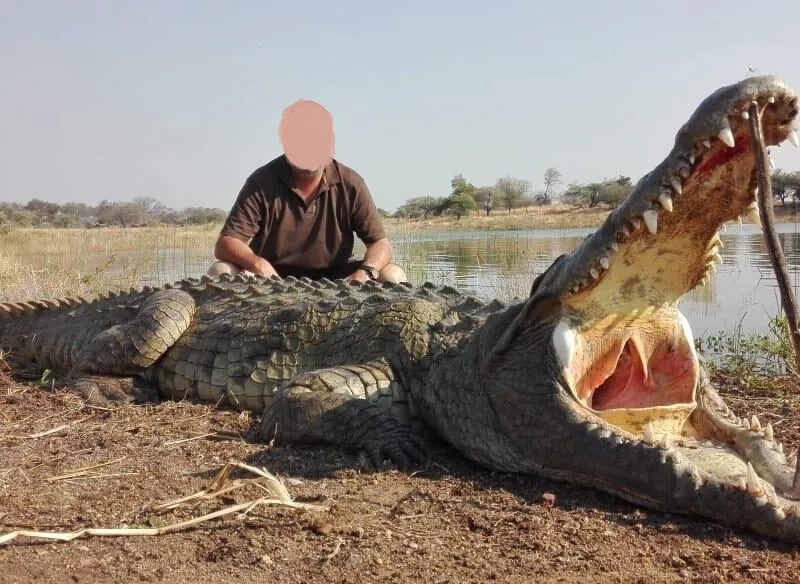
A mature Nile crocodile is very different from younger river crocodiles both in size and behavior. While many crocodiles encountered on African rivers are considerably smaller, truly mature males often exceed 14 feet, with exceptional specimens reaching 15–16 feet. What makes these animals impressive is not just length, but skull width, jaw depth, territorial confidence, and the years of survival behind them.
Why are old Nile crocodiles so difficult to hunt?
Large Nile crocodiles survive by becoming cautious. Younger crocodiles often approach bait aggressively and expose themselves openly, while mature males move slowly, observe carefully, and avoid unnecessary risk. Many experienced hunters eventually realize that patience and discipline matter more than speed when pursuing old crocodiles on African river systems.
Where are the best river systems for crocodile hunting in Africa?
Some of Africa’s best crocodile habitat is found along major river systems associated with crocodile hunting in Zimbabwe and crocodile hunting in Mozambique, as well as sections of the Zambezi and Limpopo rivers. These waterways provide the deep channels, sandbanks, territorial structure, and food sources that allow mature Nile crocodiles to reach exceptional size.
How do professional hunters judge crocodile size?
Judging crocodile size is challenging because most of the animal usually remains underwater. Professional hunters often focus on skull width, jaw depth, head length, and the spacing between the eyes rather than trying to estimate full body length. Light, distance, water distortion, and viewing angle can all affect perception, which is why experience becomes so important on mature crocodile hunts.
Why do mature crocodiles disappear after showing once?
Dominant Nile crocodiles often react to subtle pressure long before hunters notice anything has changed. A shift in wind direction, movement near the blind, territorial pressure from another crocodile, or unusual activity along the riverbank may cause a mature male to avoid an area entirely. Old crocodiles rarely survive by making repeated mistakes.
Is crocodile hunting considered part of Africa’s Dangerous 7?
Yes. Nile crocodiles are widely regarded as part of Africa’s Dangerous 7 because of their unpredictability, power, and the unique challenges involved in hunting them safely. Unlike many other dangerous game animals, crocodiles spend much of their time submerged, forcing hunters to make difficult judgments based on limited visibility and brief opportunities.
About the Author
Pierre van Wyk is co-founder of Game Hunting Safaris and has guided and personally hunted dangerous game across Southern Africa, including mature Nile crocodiles exceeding 15 feet.
Together with Tamlyn van Wyk, he works directly with international hunters pursuing buffalo, elephant, leopard and crocodile across established river systems. Their focus remains consistent: honest advice, experienced guidance, and respect for the animals that define African hunting.
