
Bow hunting in Namibia offers a different challenge from a traditional rifle safari. Whether stalking kudu through thornveld or waiting for gemsbok to approach a waterhole, the hunter must get considerably closer to the animal while paying particular attention to movement, wind direction and shot placement.
Namibia permits regulated bowhunting for certain game species, subject to equipment requirements, hunting permits and supervision by a suitably qualified hunting professional. Hunters considering a bow safari should understand which animals may be hunted, the applicable arrow-energy requirements and whether their chosen hunting property is authorised for bowhunting.
For an overview of the country's hunting regions, available species and safari options, see our guide to hunting in Namibia.
[DYNAMIC-BLOGTABLEOFCONTENT]
Why Namibia Is Popular for Bow Hunting
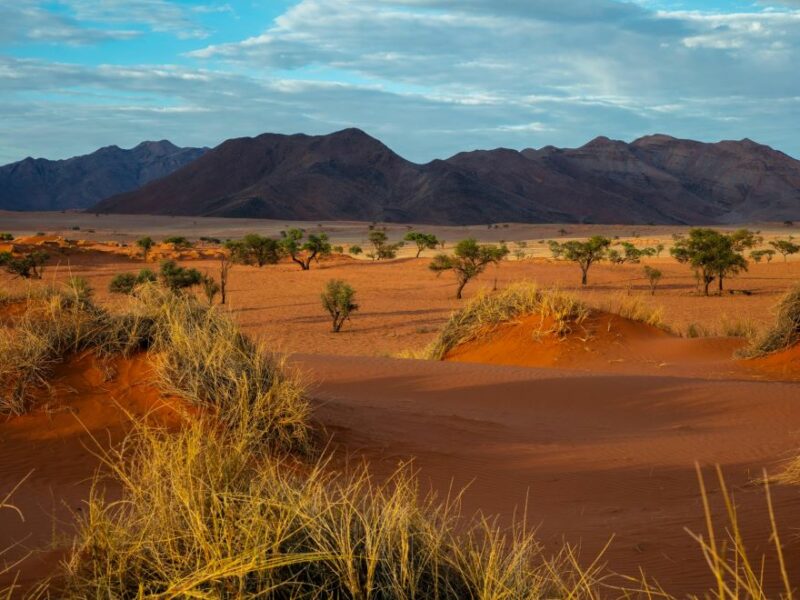
Namibia offers bowhunters opportunities to pursue plains game such as kudu, gemsbok, springbok, eland and wildebeest across different hunting environments. Some properties have established blinds overlooking waterholes, while others offer spot-and-stalk hunting through thornveld, rocky hills and the red dunes of the Kalahari. The hunting method, available species and size of the property should all be confirmed before booking.
Namibia's trophy-hunting season runs from February through November, with conditions changing considerably throughout the year. The warmer, greener months can provide better cover for stalking, while the dry winter months often favour hunting from blinds near established water sources. Winter nights can drop below freezing in the interior, although daytime conditions are generally mild to warm. Bowhunters should discuss the expected conditions and hunting methods with their outfitter before choosing their safari dates.
A Bow Hunting Safari in Namibia: Targets and Methods
Bowhunting in Namibia is primarily a plains-game pursuit. Kudu, gemsbok, eland, wildebeest, springbok and zebra are among the species that may be hunted with archery equipment, provided the hunting property is approved, the necessary permits are in place and the hunter meets the applicable equipment requirements. Namibia's varied terrain offers opportunities for both spot-and-stalk hunting and hunting from established blinds.
Namibia does not permit bowhunting for elephant, rhinoceros, hippopotamus, Cape buffalo, lion, leopard or crocodile. Hunters interested in bowhunting should therefore concentrate on the country's extensive plains game hunting opportunities and confirm which species are available on their chosen property. The bowhunting regulations, minimum arrow-energy requirements and permitted hunting methods are covered further below.
Plains Game Species Available to Namibia Bowhunters
Wildebeest
Nicknamed the “poor man’s buffalo,” both species of Wildebeest can be hunted in regions across Namibia hunting grounds, from the free desert to private game farms.
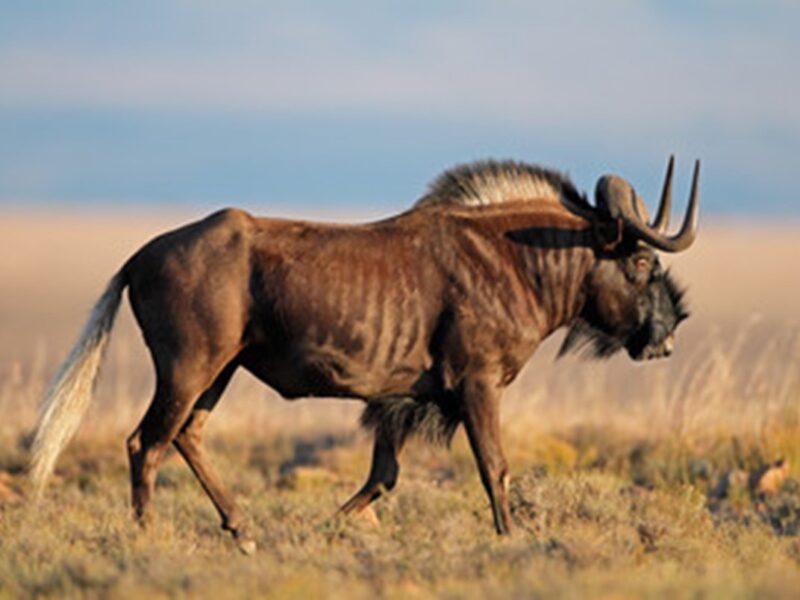
The blue wildebeest (Connochaetes taurinus) is a tough animal to bring down and is commonly found spread from the southeast semi-arid area right up to the Caprivi, where conditions can be more tropical. Black wildebeest (Connochaetes gnou) were brought to Namibia (among other countries) from their native homeland of South Africa. Numbers of this wildebeest are lower than those of the blue but aren’t cause for alarm. Black wildebeest are a bit smaller than their counterparts and are usually found in set populations across Namibia’s grassland.
Eland
The common eland (Taurotragus oryx) is a trophy specimen to behold, as the second largest antelope worldwide and boasting impressive horns to boot. This antelope can be found across Namibia’s hunting safari grounds from the north to the east and south. A less common eland found only in the north or Caprivi region is the Livingstone eland (Taurotragus oryx livingstonii), a rarer subspecies found in this part of Africa.
Eland are known for their size, endurance, and ability to cover surprising distances when pressured, making them a rewarding challenge for both rifle and bow hunters. Learn more about available hunting areas and what to expect on an Eland Hunt in Namibia.
Red Hartebeest
“Why the long face” is a phrase that can easily describe the only hartebeest species of Namibia. With an unusually shaped facial structure and recognizable markings, the Red or Cape hartebeest makes a distinct trophy. Living in small herds well-adapted to the blazing Namibian desert, red hartebeest calls the arid Kalahari Desert region home.
Oryx
The gemsbok (Oryx gazella) is one of Namibia's most recognisable plains-game animals. Known for its characteristic light-colored coat of hair marked by dark patches along the side of the belly and hind legs, as well as dark face markings and white socks, the gemsbok makes for a beautiful trophy whether for the skin or horns.
This Namibian Oryx utilizes its brilliant eyesight to scan the expanse of the Kalahari Desert region it calls home, worth noting to stay out of sight (and avoid casting shadows). Hunters interested in pursuing this iconic desert antelope can learn more about hunting areas, trophy expectations, and safari planning in our Gemsbok Hunts in Namibia guide.
Burchell’s zebra
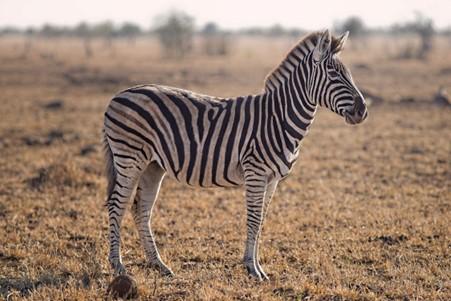
One cannot think of Africa and not picture herds of zebra galloping across the savanna. The most common of the plains zebra species, Burchell’s zebra (Equus quagga burchellii) are distinguished through their light brownish-colored shadow stripe between the signature black and white as well as the fact that their stripes meet under the belly. The Burchells can be found in Namibia’s less arid central areas due to their need for water, however, they can handle lower-quality grazing fare by munching through long grasses.
For hunters interested in pursuing one of Africa’s most recognizable plains game species, our Zebra Hunts guide provides additional information on hunting areas, trophy quality, and safari planning.
Common waterbuck
The common waterbuck (Kobus ellipsiprymnus) is the most commonly found waterbuck subspecies when it comes to game hunting across Africa. A large antelope known for their darker colored shaggy haired coats and horns of up to 39 inches (only the males). Waterbuck are sedentary and can never be too far away from a source of water, meaning waterbuck hunting safari in Namibia tend to take place on private ranches in Namibia’s central areas.
Impala
Another water-dependent species that has managed to adapt and survive in the sands of Namibia is the impala. There are two subspecies of this medium-sized antelope found in the country; namely the common impala (Aepyceros melampus) in the eastern regions, and the black-faced impala (Aepyceros melampus petersi) in the north.
Kalahari springbok
If ever there was a species of animal made to survive the harsh African landscape, it’s the Springbok. Notably, the Kalahari subspecies known for their thicker horns and slightly larger build can be found across Namibia’s Kalahari region in large free-ranging herds.
Greater kudu
Known as the “gray ghost,” the greater kudu (Tragelaphus strepsiceros) is a large antelope famous for its impressive jumping abilities that ensure hardly a fence gets in their way. Males of the species can measure around 5 feet at the shoulder and grow impressive spiral-shaped horns.
This majestic antelope can be found nationwide, with many of the best opportunities concentrated around the central region near Windhoek. For hunters hoping to pursue one of Africa's most sought-after spiral-horned antelope, our Kudu Hunts in Namibia guide provides more information on hunting areas, trophy expectations, and safari planning.
Blesbok
Originally a native antelope to neighboring South Africa, the Blesbok (Damaliscus pygargus phillipsi) is a subspecies of Bontebok and is famous for the white patch that runs across their muzzle and forehead. This patch is how the Blesbok got its name; the word “bles” in Afrikaans means “bald” and this patch gives the antelope a look as though their copper-toned coat doesn’t quite cover their face. Blesbok are water dependent and their hunting safari in Namibia can be planned not far from water sources.
Alternative plains species
Giraffe
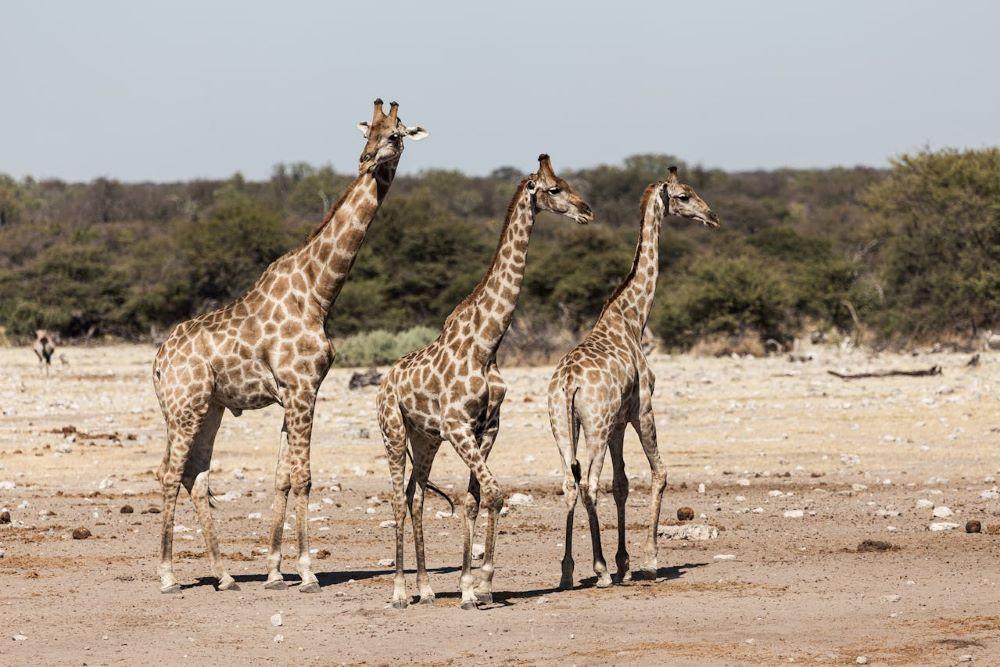
A species needing no introduction, the giraffe is an icon of the African savannahs. Most commonly found in Namibia is the Angolan or Namibian giraffe (G. c. angolensis) which are distinguished by their lighter base color and lack of markings on the central and upper face, as well as white ear tips. Hunters considering giraffe as part of their safari can review our giraffe hunting in Namibia guide for available hunting opportunities and arrangements.
Chacma baboon
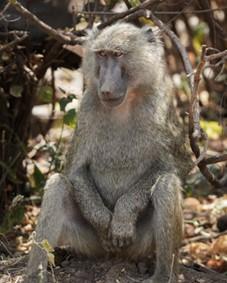
One of the largest members of the monkey family, the Chacma baboon (Papio ursinus) is commonly hunted for being a “problem species.” These primates can be challenging hunts due to their intelligence and incredible eyesight, both strengths employed by the “sentries” of the troop to keep an eye out for danger. Chacma can be found across Namibia from the grassy plains to the savannah, and even the hills; but be warned, an injured baboon can be a danger thanks to their large canine teeth.
Damara dik-dik
The Damara dik-dik is one of Namibia's smallest antelope and a member of the Tiny Ten. Found mainly in Namibia, with populations extending into southwestern Angola, this small antelope inhabits rocky, brush-covered country. Its size and tendency to remain close to cover make it a challenging animal to pursue with a bow, where a clear shooting opportunity at close range is essential.
Small Predators in Namibia
Caracal
A medium-sized wildcat native to Africa (among other countries), the caracal (Caracal caracal) has a striking appearance thanks to their slender yet powerful build and unusual markings around the face and ears. Caracal are both nocturnal and secretive in nature meaning they require a bit of effort and patience when a part of your hunting safari. These desert felines are spread across Namibia and are known as keen hunters themselves, sometimes taking down fully grown springbok.
African wildcat
Calling the savannah areas of Namibia home, the African wildcat (Felis lybica) is known for its strong resemblance to typical domestic cats. With short grey to sandy – grey color fur and ear tufts similar to the caracal, these nocturnal felines are known for strong climbing abilities and their solitary nature. Hunters interested in pursuing African wildcat with a bow should first confirm whether the species is authorised for hunting on their chosen property and covered by the applicable permit.
Jackal
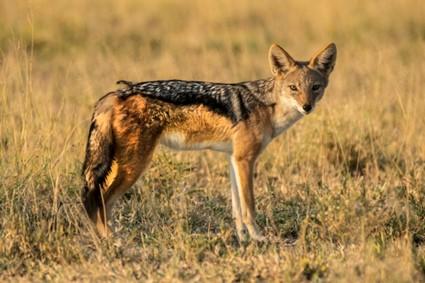
Namibia is home to both the black-backed jackal and the side-striped jackal. Black-backed jackals occur across much of the country's drier regions, while side-striped jackals are associated with the wetter northeastern areas, including the Zambezi Region. Both are alert, adaptable predators, making a close approach with a bow challenging. Hunters should confirm whether jackal hunting is permitted on their chosen property and whether the necessary authorisation covers the intended hunting method.
Bow Hunting Safari Guidelines
Namibia has specific minimum arrow-energy and arrow-weight requirements for bowhunting. These requirements depend on the classification of the animal being hunted, not simply the draw weight of the bow. Hunters should confirm that their equipment meets the applicable requirements before travelling.
Small Game
Small game includes species such as springbok, Damara dik-dik, duiker and certain small predators.
Minimum arrow kinetic energy: 25 ft-lb (33.9 joules).
Minimum arrow weight: 350 grains.
Medium Game
Medium game includes species such as baboon and warthog.
Minimum arrow kinetic energy: 40 ft-lb (54.24 joules).
Minimum arrow weight: 400 grains.
Large Game
Large game includes kudu, gemsbok, eland, wildebeest, zebra, giraffe and waterbuck.
Minimum arrow kinetic energy: 65 ft-lb (88.13 joules).
Minimum arrow weight: 450 grains.
These are minimum legal equipment requirements, not necessarily the ideal setup for every species. Hunters should discuss arrow weight, broadhead selection and practical shooting distances with their qualified Namibian bowhunting professional before booking.
Namibia Bowhunting Laws and Regulations
Bowhunting in Namibia is regulated separately from rifle hunting. Hunters must use approved equipment, hunt on properties authorised for bowhunting and be accompanied by a registered Namibian hunting professional holding the additional bowhunting qualification.
The following requirements are particularly important:
-
Permits: A valid trophy-hunting permit must be issued before the hunt begins and must authorise bowhunting for the relevant species.
-
Qualified supervision: Bowhunters must be accompanied by a registered hunting professional with the appropriate bowhunting qualification.
-
Hunting properties: Bowhunting may take place only on properties authorised for this method of hunting.
-
Permitted bows: Longbows, recurve bows and compound bows are permitted. Crossbows are prohibited.
-
Arrows: Permitted shaft materials include aluminium, wood, fibreglass and carbon-based materials. Arrows must meet the prescribed minimum length.
-
Broadheads: Broadheads must meet the legal requirements for cutting edges and dimensions. Barbed, serrated and poisoned arrowheads are prohibited. Hunters using mechanical broadheads should confirm that their specific equipment complies with Namibia's regulations before travelling.
-
Hunting hours: Trophy hunting is permitted from half an hour before sunrise until half an hour after sunset. Hunting at night or using artificial light is prohibited.
-
Fair chase: Hunting must comply with Namibia's fair-chase requirements. Hunting from a moving vehicle is prohibited.
-
Trophy limits: A maximum of two trophies per species may be taken by each hunting client per permit, subject to the applicable species restrictions and permit conditions.
Hunters should confirm the current requirements with their outfitter and qualified bowhunting professional before travelling. The outfitter should also confirm that the property, species and equipment are covered by the necessary authorisations.
Bowhunting Methods in Namibia: Spot-and-stalk vs Blinds
Spot-and-Stalk Bowhunting
Spot-and-stalk hunting requires the bowhunter to locate suitable game, assess the wind and approach on foot until a clear shot is possible. Namibia's rocky hills, thornveld and broken terrain can provide cover, although animals such as kudu and gemsbok are exceptionally alert. An unsuccessful stalk may mean starting again with another animal rather than forcing a difficult shot.
The greener months, generally from February into May, can offer additional vegetation for concealment. However, hunting conditions vary by region, and open areas remain challenging regardless of the season.
Hunting from a Blind
Many Namibian bowhunting properties have established ground blinds or temporary blinds overlooking waterholes and regularly used game trails. During the dry season, animals may visit established water sources more predictably, making blinds a practical option for hunters who prefer to wait for a suitable shooting opportunity.
A blind allows the bowhunter to prepare for a close-range shot without having to complete the final approach on foot. However, success still depends on wind direction, animal behaviour and remaining undetected while drawing the bow. Hunters should confirm whether blinds are available on their chosen property and the typical shooting distances before booking.
Bowhunting Equipment and Preparation for Namibia
A bowhunter preparing for Namibia needs to consider more than the minimum legal arrow-energy requirements. The equipment must be suitable for the intended species, and the hunter should be comfortable shooting accurately at the distances expected during the safari. Practising from realistic hunting positions, including seated positions if hunting from a blind, is particularly useful.
Shot placement deserves careful attention when pursuing larger antelope such as kudu, eland, wildebeest and gemsbok. Hunters should understand the vital area, avoid unsuitable shooting angles and allow for the animal's position before releasing an arrow. Our guide to shot placement for large antelope provides useful anatomical information, although bowhunters must also account for arrow penetration and their equipment's limitations.
Travelling bowhunters should bring suitable spare parts and the equipment needed for minor repairs. While some outfitters can provide hunting rifles, visitors should not assume that a correctly fitted bow and matching arrows will be available in camp. Confirm equipment arrangements with the outfitter before travelling.
A practical bowhunting equipment checklist should include:
- Extra strings
- Release aid or finger protection
- Sights and peeps
- Spare broadheads and field points
- Bow case or sling
- Armguards, gloves, or face protection if used
- Sharpening tools
- Glue
- Weight tubes
- Targets
For hunters considering a bowhunting safari in Namibia, the choice of hunting property, available species, qualified hunting professional and permitted equipment all deserve attention before booking. If you are comparing Namibia with other African destinations or considering a different type of safari, explore our African hunting trips to review available hunting opportunities.
Author: A. Baker