
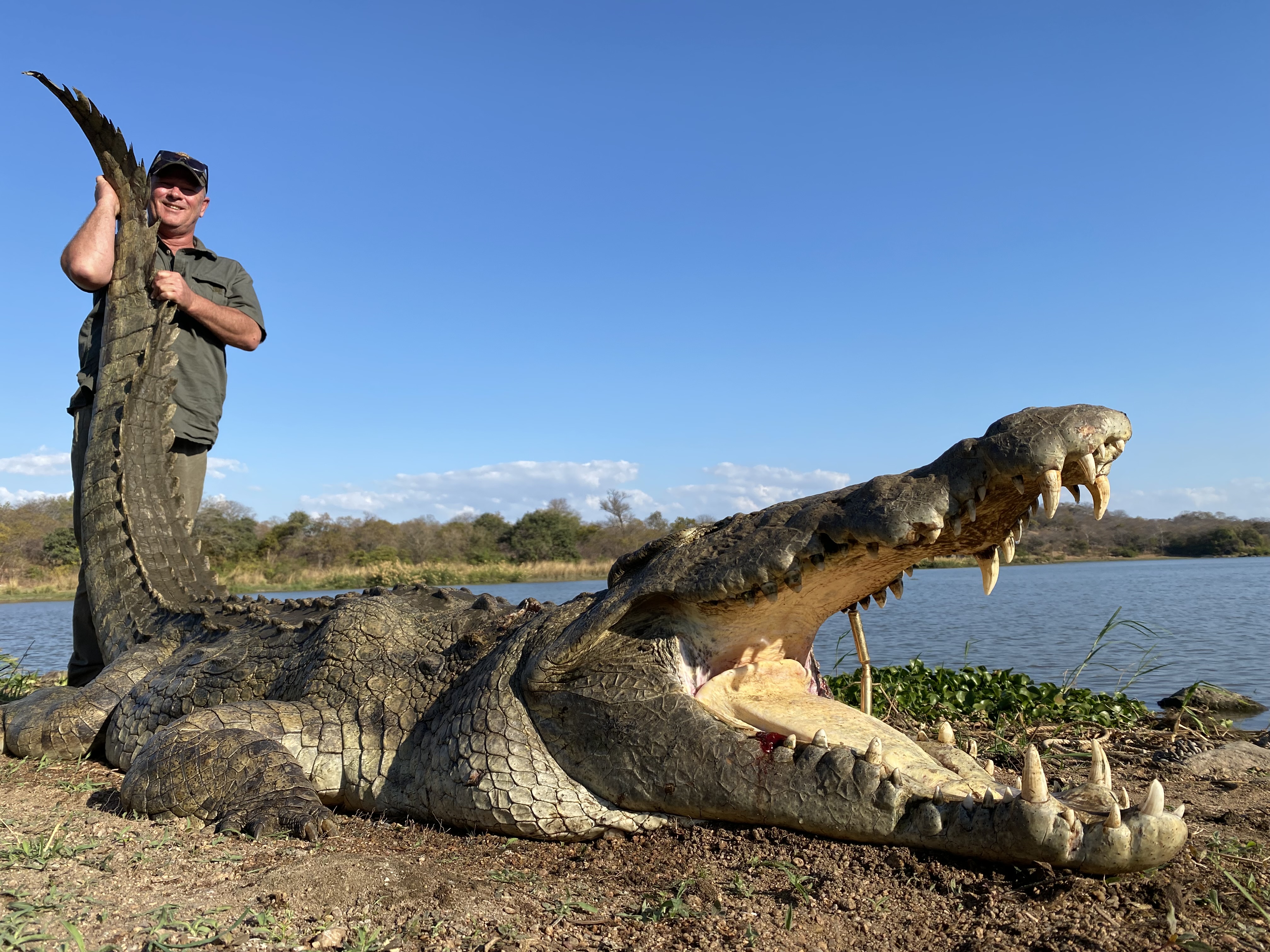
A giant Nile crocodile does not reach exceptional size in a few good seasons. The biggest crocodiles are old animals that have survived for decades, and Mozambique contains some of the habitat where they can do exactly that.
Lake Cahora Bassa has a history of producing exceptional crocodiles, but the lake itself is relatively young. The reservoir began filling in 1974 when the Cahora Bassa Dam transformed a section of the Zambezi River system. Nile crocodiles were already native to the Zambezi, and the creation of the reservoir gave them a large new body of suitable habitat.
What happened during the following decades is also interesting. War and instability limited development, commercial fishing and access around much of Cahora Bassa. Historical surveys from the late 1980s recorded little human activity across long stretches of the lake and shoreline, while crocodiles were distributed throughout the system. Regulated crocodile hunting on Cahora Bassa resumed in 1987 under Mozambique's CITES quota.
That history helps to explain part of Cahora Bassa's reputation today. A large body of water, productive fish populations, remote shoreline and limited disturbance gave crocodiles the ingredients to grow, but food and habitat alone do not produce a giant.
An exceptional crocodile must survive territorial fights, changing water levels, competition, hunting pressure and countless other challenges year after year. Age is the ingredient that cannot be replaced.
That combination of age, habitat and survival is one reason Crocodile Hunting in Mozambique has earned such a strong reputation among hunters looking for genuinely old Nile crocodiles. Finding crocodiles may not be difficult in productive water systems. Finding an ancient, heavy crocodile is something different.
Mozambique's reputation is therefore not simply about having plenty of crocodiles. It is about having waters capable of allowing a small number of them to become old animals.
A Giant Crocodile Is an Old Crocodile
Length is what catches a hunter's attention, but the impressive thing about a giant Nile crocodile is how long the animal has survived.
Crocodiles continue growing throughout much of their lives, although growth slows as they get older. Reaching exceptional size takes time. A crocodile approaching 14 or 15 feet has survived years of competition with other crocodiles.
Older males tend to dominate the best territories. Deep water, productive feeding areas, sheltered bays and established basking sites can all provide advantages, but large males still must defend their position against other crocodiles.
Judging a genuinely exceptional crocodile of over 16 feet involves more than simply estimating its length. An old bull crocodile develops a massive head, thick neck, heavy body and pronounced armour, giving him a completely different appearance from a younger crocodile that may still be long but lacks the same overall mass.
On Cahora Bassa, the objective is therefore not simply to find a long crocodile. It is to find an old one.
A Giant Crocodile Needs a Lot of Food
Age gives a crocodile the time to become exceptional, but there also needs to be enough food to support decades of growth.
Lake Cahora Bassa is a productive freshwater system supporting large fish populations and a wide range of other prey. Fish form an important part of a Nile crocodile's diet, while larger animals can also take birds, reptiles and mammals that come within reach along the shoreline.
For a big crocodile, opportunity matters. An animal occupying productive water does not need to travel constantly looking for its next meal.
Sadly, people living and fishing along Cahora Bassa also become victims. Crocodile attacks have long been a serious problem around the lake and the wider Zambezi system, where communities depend on the same water for fishing, transport and everyday life. Historical records almost certainly underestimate the number of attacks because many communities are remote and incidents have not always been formally reported.
This close relationship between people and crocodiles is another part of Cahora Bassa's story. Crocodiles are not simply animals occupying distant wilderness. They share the lake with fishing communities that use its shoreline and waters every day, sometimes with tragic consequences.
Cahora Bassa Gives Crocodiles Room to Grow Old
It is difficult to appreciate the scale of Lake Cahora Bassa until you are on it. The reservoir stretches roughly 150 miles from end to end, reaches almost 25 miles across at its widest point and covers more than 1,000 square miles of water. Its irregular banks create more than 1,100 miles of shoreline. To put that into perspective, the lake's surface area is roughly six times the size of Barbados.
For a crocodile, that means an immense amount of country. Bays, river mouths, islands, rocky banks, sheltered water and remote stretches of shoreline provide places to feed, bask and disappear. Some sections are easily accessible; others receive considerably less disturbance.
The lake can also behave more like an inland sea than the picture hunters have of an African reservoir. Wind across the open water can build substantial waves, and conditions can change enough to make travel in small boats dangerous.
That scale matters when trying to understand how a crocodile survives long enough to become exceptional. A mature male does not have to spend his life in one visible pool or along one short stretch of riverbank. He can occupy a huge system of deep water, bays and shoreline where finding him again may not be straightforward.
A lake more than 150 miles long provides plenty of places for an old crocodile to disappear.
Why Only a Few Crocodiles Become Giants
Cahora Bassa may provide the conditions for crocodiles to grow large, but that does not mean every crocodile living there will become a giant.
The first hurdle is simply survival. Young crocodiles face predation, competition and fluctuating water conditions before they are large enough to dominate a section of shoreline. As they grow, the threats change. Competition with other crocodiles becomes more important, particularly among mature males occupying feeding and basking areas.
Large bull crocodiles can inflict serious injuries on one another. Missing feet, damaged tails, scars and broken teeth are all evidence of the years an old crocodile has spent competing with other animals. A crocodile that eventually reaches 15 or 16 feet has survived these encounters repeatedly.
Human pressure adds another filter. Crocodiles living close to fishing communities encounter boats, nets and people regularly, while legal hunting removes a few mature animals from the population. Crocodiles may have relatively small brains, but the ones that grow old do not survive by being careless. Years of disturbance can make a big crocodile extremely wary.
That is what makes a genuinely giant Cahora Bassa crocodile unusual. The habitat gives him the opportunity to become old, but he still has to survive long enough to use it.
What Does a Giant Cahora Bassa Crocodile Actually Look Like?
Length matters when judging a trophy crocodile, but it is only part of the picture. An ancient Cahora Bassa crocodile carries other signs that help a Professional Hunter judge what he is looking at.
The head and skull are particularly important. Old male crocodiles develop broad heads, with heavy jaws and pronounced structure around the eyes. When much of the body is difficult to see clearly, the size and proportions of the skull can provide valuable clues to the age and overall size of the animal.
Body condition can be more deceptive. At certain times a big crocodile may be fat and heavy, with a thick neck and large body that immediately makes him look impressive. At other times, after periods of mating and territorial activity, the same old male may be leaner and appear smaller than his true size suggests.
PHs do not judge a crocodile on body thickness alone. The head, eyes, skull proportions, neck, armour and overall length all need to be considered together.
Distance makes the job more difficult. A crocodile lying across a wide stretch of water can look big through binoculars, while another exceptional animal may be underestimated because of his position, body condition or how much of him is visible. This difficulty is one reason careful trophy assessment matters during Crocodile Hunts in Africa.
Cahora Bassa Is Part of a Much Bigger River System
Lake Cahora Bassa does not exist in isolation. It forms part of the Zambezi River, a water system that stretches across southern Africa before reaching the Indian Ocean in Mozambique.
For Nile crocodiles, that connection matters. The lake is surrounded by river channels, tributaries and extensive stretches of suitable habitat rather than being a closed body of water with a small, isolated crocodile population. Crocodiles are not confined to the reservoir itself and can move into river sections and connected waterways, giving them access to habitat beyond the open waters of Cahora Bassa.
The Zambezi also brings nutrients and supports the fish populations and other wildlife on which crocodiles depend. Seasonal changes in water levels continually alter feeding areas, exposed banks, islands and channels, creating different opportunities throughout the year.
Cahora Bassa combines something relatively unusual: the scale of a huge reservoir with the ecology of a major African river system.
For a crocodile capable of living for decades, that creates a huge area of productive habitat in which to feed, compete, breed and survive.
Why Mozambique's Giant Crocodiles Still Matter to Hunters
There are places in Africa with healthy Nile crocodile populations, but finding a genuinely old crocodile is different from simply finding plenty of crocodiles. Hunting in Mozambique provides access to some of the water systems where these exceptional animals can still occur.
Mozambique, and Cahora Bassa in particular, has the combination required to produce these animals. Productive water provides the food, the size of the lake provides space, the wider Zambezi system provides connected habitat, and time allows a small number of crocodiles to reach exceptional age and size.
For hunters, that is ultimately what matters. A 15- or 16-foot crocodile represents decades of survival in one of Africa's great river systems. He has competed with other males, survived changing conditions and human pressure, and avoided every other threat that prevented countless crocodiles from reaching the same age.
A giant Nile crocodile can also form part of a broader Big Game Hunting safari in Mozambique, depending on the hunting area and available quota. Hunters considering Mozambique as part of their African Hunting Trips are therefore not simply travelling somewhere with crocodiles. They are hunting a country containing water systems with a proven ability to produce genuinely old animals.
FAQs About Giant Nile Crocodiles in Mozambique
Why do Nile crocodiles grow so large in Mozambique?
Mozambique has several water systems capable of supporting large Nile crocodiles, with Lake Cahora Bassa being well known. Abundant food, extensive habitat and connected waterways provide good conditions for growth, but the biggest factor is time. A crocodile must survive for decades to reach exceptional size.
How big do Nile crocodiles get in Lake Cahora Bassa?
Cahora Bassa has a reputation for producing crocodiles exceeding 14 feet, while exceptional old males can reach 15 feet or more. Crocodiles approaching or exceeding 16 feet are rare animals and should not be considered typical, even in waters known for producing large crocodiles.
Why is Lake Cahora Bassa so good for crocodiles?
Cahora Bassa covers more than 1,000 square miles and has over 1,100 miles of shoreline. Its fish populations, bays, islands, river mouths, deep water and connection to the wider Zambezi system provide crocodiles with extensive feeding and living habitat.
How can you tell if a Nile crocodile is old?
Size is only one indicator. Older male crocodiles typically develop broad, heavy heads, large skulls, thick necks and pronounced armour. Scars, damaged tails, missing feet and worn or broken teeth can also provide evidence of an animal that has survived many years.
Are 16-foot crocodiles common in Mozambique?
No. Mozambique can produce exceptionally large Nile crocodiles, but genuine 16-foot animals are rare. Even in productive waters such as Cahora Bassa, only a small number of crocodiles survive long enough to reach that size. That rarity is precisely what makes an old 16-foot crocodile exceptional.
Where should you aim when hunting a Nile crocodile?
Shot placement on a large Nile crocodile requires considerable precision because of the animal's anatomy and the relatively small target presented when it is lying near the water. Hunters preparing for a crocodile safari can review our Crocodile Shot Placement guide for the recommended brain and vital-area shots.
About the Authors
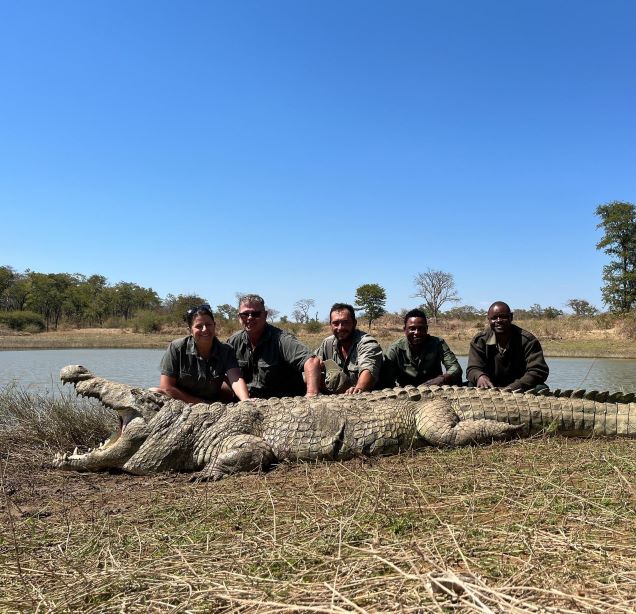
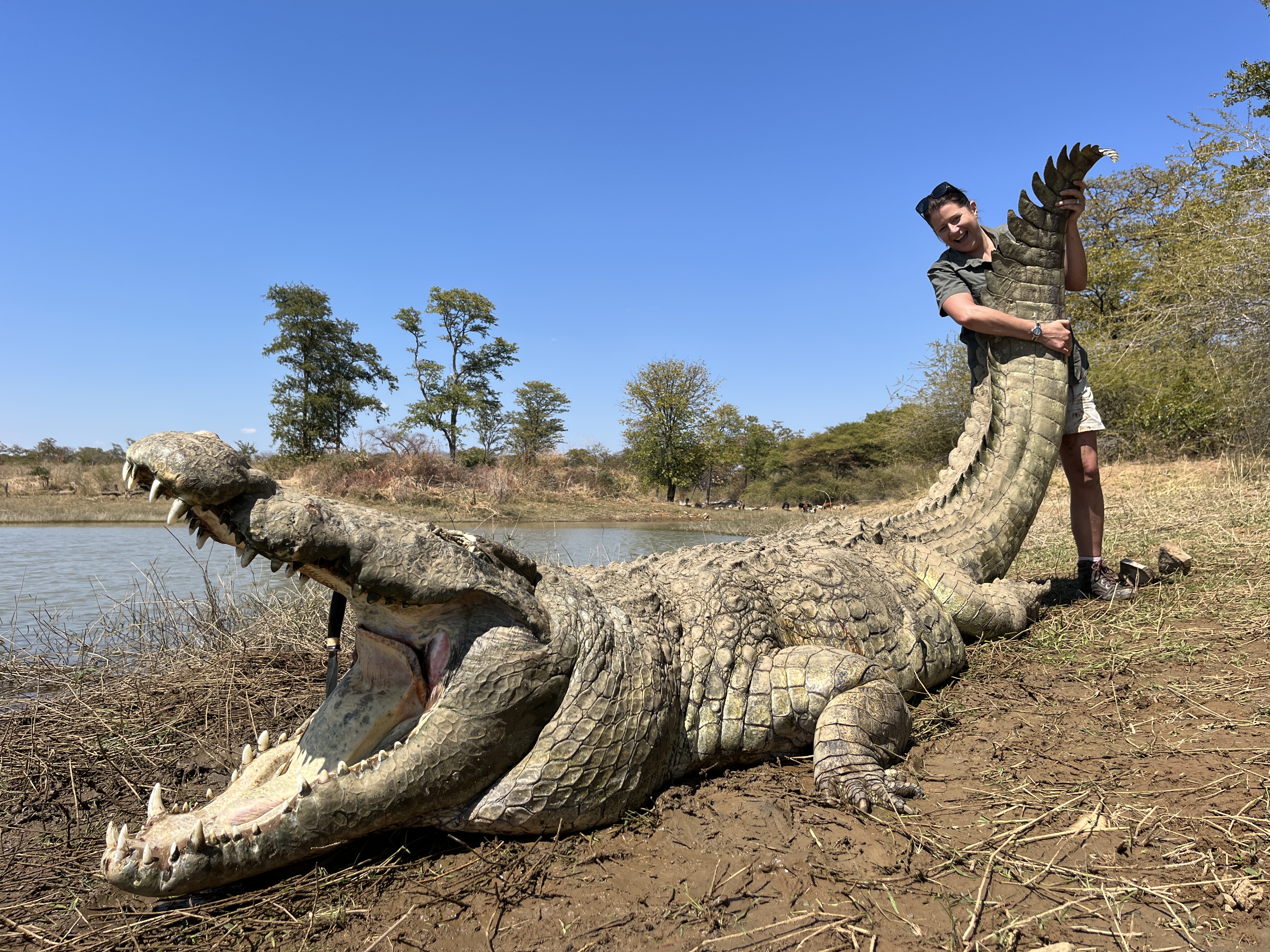
Pierre and Tamlyn van Wyk are the founders of Game Hunting Safaris and both have firsthand experience hunting Nile crocodiles on Lake Cahora Bassa in Mozambique. Pierre's crocodile measured 14.9 feet, while Tamlyn's measured 15.1 feet, a difference Pierre is regularly reminded about.