
Updated: June 2026
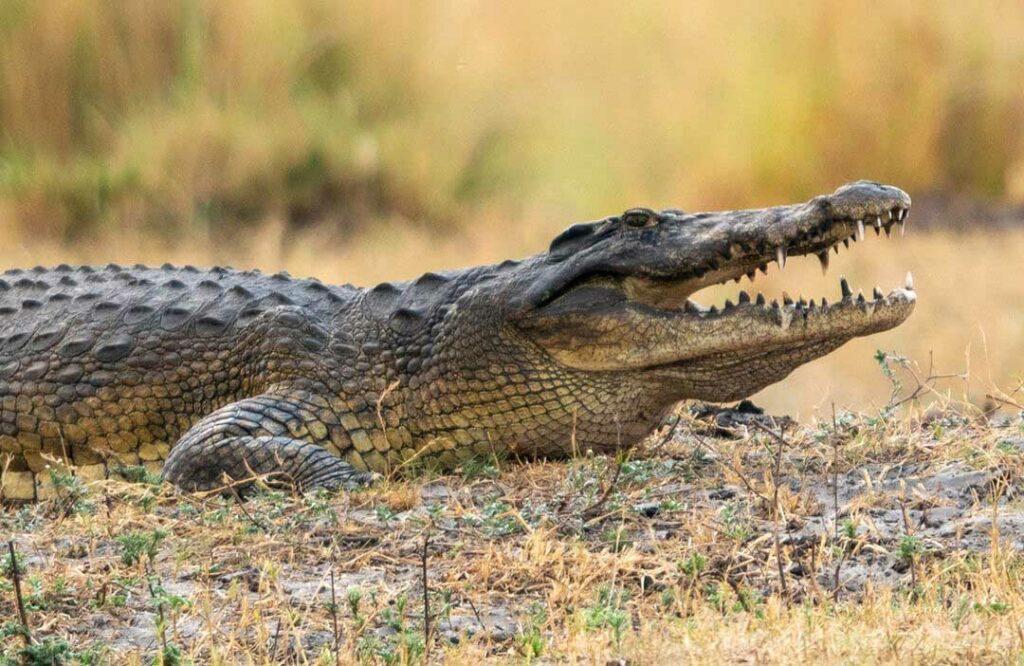
Crocodiles, Scientific name (Crocodylidae).
Primitive Crocodile representatives, namely Protosuchia, made their first grand appearance 201,4 million years ago. They continued to evolve, and the “modern-day” crocodile appeared 60 million years ago, give or take a few. More than enough time to become the perfect apex predator, and a great challenge when crocodile hunting in Africa.
Crocodiles, like all other reptiles, are diapsids.
[DYNAMIC-BLOGTABLEOFCONTENT]
Why Crocodiles Challenge Experienced Hunters
Many first-time crocodile hunters assume the hunt will be straightforward. After all, the animal spends much of its time lying motionless on a riverbank.
The reality is very different.
A mature Nile crocodile presents one of the smallest effective target areas in African hunting. Trophy judging can be difficult, recovery planning becomes critical, and opportunities often last only a few seconds before the crocodile slips back into the water.
These are some of the reasons experienced hunters frequently rank crocodile hunting among the most mentally demanding forms of big game hunting in Africa.
What Challenges will the Nile Crocodile bring to a Hunting Safari?
- This man-eating beast evolved before the part of the brain that processes imagination and feelings in animals evolved. So, basically when crocodile hunting, know the game hunting opponent has no remorse, is mindless, and is only focused on killing.
- If, while crocodile hunting, the crocodile manages to get a grasp on any part of the hunter, know that it has the strongest bite in all of the animal kingdom. If the crocodile loses a few teeth while tearing his opponent apart, this big trophy bull crocodile will not at all be concerned as his teeth regenerate.
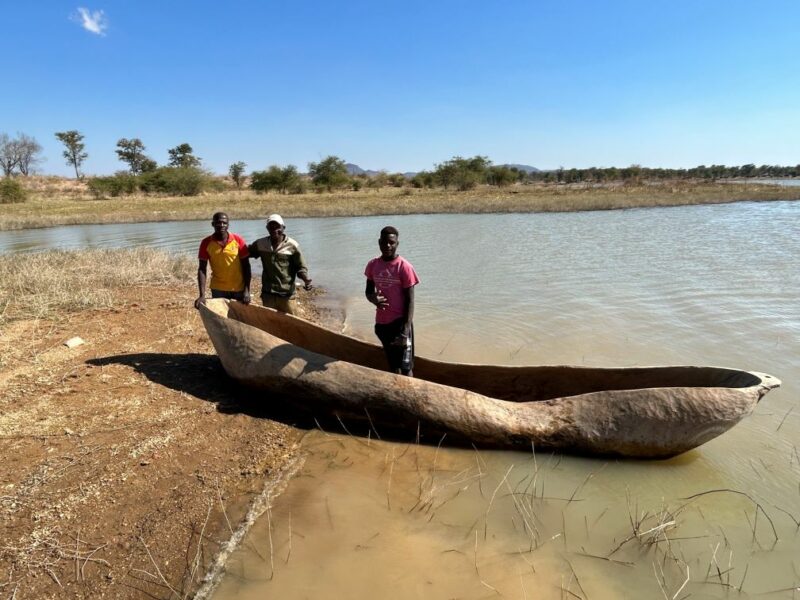
- Crocodiles are speedy swimmers and can torpedo themselves at more than 22 miles per hour through water. Should the hunter fall out of mokoro while crocodile hunting, the odds will most certainly be against them.
- This big game hunting opponent has some serious body armor. A crocodile’s skin is nothing but a network of rock-hard scales varying in size. These scales, also known as scutes, are as hard as bone. Bony deposits called Osteoderms form on the scales making it almost impossible to penetrate the skin.
- Should the hunting safari be a success and the trophy crocodile is hung from a tree, the hunter needs to be very careful not to come into contact with any of the stomach contents. Enzymes in the stomach are very strong, almost like acid, and flesh, bones, cartilage, and sinew are rapidly digested. The stomach is also filled with some of the nastiest bacteria around and is to be avoided at all costs.
- When prepping for a crocodile hunt, know that a crocodile’s brain is small and very well protected by a mass of thick and dense bone. Take this into account for rifle choice and shot placement.
- The safari hunter’s opponent is also equipped with sensory pits that cover the crocodile’s jaw. These pits enclose bundles of nerve fibers that can detect the slightest vibrations. So, not only will the crocodile hunt be a challenge as the adversary has exceptional hearing, but it will also be able to feel any movements made by the challenger.
A Crocodile That Refused to Die
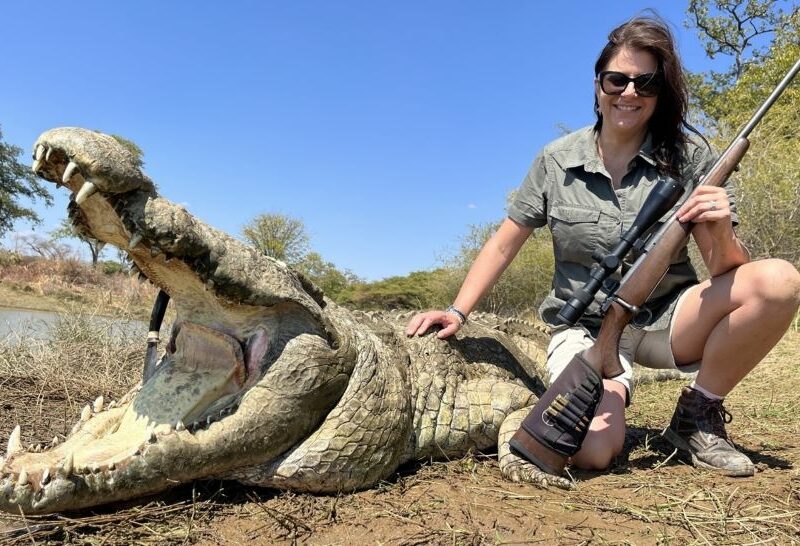
One of the most impressive Nile crocodiles we have encountered was taken during a crocodile hunting safari in Mozambique on the southern shores of Lake Cahora Bassa.
Tamlyn harvested this giant crocodile using a Mauser .300 Winchester Magnum loaded with 180-grain monolithic bullets. The old bull measured an astonishing 15.1 feet and weighed more than 1,750 pounds.
Take a close look at the webbed feet, the heavy scales along the back, and the sheer size of the head. This was not a young crocodile in its prime. It was an old survivor that had spent decades dominating one of Africa's most productive crocodile habitats.
Professional hunters estimated the crocodile's age at more than 95 years. During that lifetime it survived droughts, floods, territorial battles with other crocodiles, and even multiple civil conflicts that shaped the region around it. Animals like this are rare, which is one reason crocodile hunting in Mozambique continues to attract hunters from around the world.
Of course, there is one additional detail that still irritates me. Despite years of reminding Tamlyn who introduced her to hunting, her crocodile ended up measuring larger than mine. Some trophies never let you forget them, and this one is mentioned with remarkable frequency whenever crocodiles become a topic of conversation.
FAQs when Crocodile Hunting in Africa
What is the Rate for Crocodile Hunting?
A hunting safari for a giant Nile Crocodile will cost between US $ 10,000 and US $ 13,500, depending on the choice of African country as your game hunting destination. Some of the most popular destinations include hunting in Zimbabwe, hunting in Zambia, and crocodile hunting in Mozambique, although opportunities also exist in South Africa, Namibia, and Tanzania.
Towards the end of the hunting season, many African outfitters may have extra tags or quotas left. Crocodile hunts often then get sold and marketed as a “discount hunt”. To take advantage of the discount hunt, know that often the hunter will have to travel at relatively short notice.
How are Crocodiles Hunted?
Crocodile hunting takes place using a variety of methods.
- Spot, walk, and stalk: On the embankments of rivers, estuaries, and swamps.
- Baiting: where your African outfitter will then construct a temporary blind.
Attempting a “kill shot” from a Mokoro is definitely not recommended!
What is the Best Caliber for Crocodile Hunting?
To successfully hunt a Nile crocodile, a high-powered rifle with sufficient muzzle energy is a requirement. Any thirty calibers (in my opinion excluding a .308), using a 180-grain monolithic bullet will work. The bullet needs to be able to smash through the very thick skull and penetrate the brain. A 300 win-mag loaded with a 220-grain bullet, or a .375 loaded with 300-grain is highly recommended.
Shot Placement: Where to aim when Crocodile Hunting
Crocodile hunting is no different than hunting any other animal species, whether it be African plains game, dangerous game, or specialty game.Understanding Crocodile Shot Placement is critical.
In my opinion, successfully harvesting this beast via a brain shot, from the front or back is maybe not more difficult, but the pressure certainly is a lot more on this hunting safari.
The reality is that a crocodile’s brain, while hidden and protected by walls of thick bone, is between the size of a golf ball and a baseball. The problem is, that there is no room for any error whatsoever. A miss of an inch or two will result in the crocodile slithering back into the dark, swampy waters. If the crocodile is not anchored on the spot, any death convulsions may result in it rolling in the water, so it is indeed a challenging African hunt!
The Most Expensive Missing Foot in Africa
One challenge rarely discussed in crocodile hunting is that much of the animal often remains hidden beneath the water when the shot opportunity presents itself.
Experienced professional hunters frequently spend far more time studying a crocodile than first-time hunters expect. A large head and thick neck may suggest an exceptional trophy, but until more of the animal is exposed, accurately judging overall length can be surprisingly difficult.
Older crocodiles often carry the scars of decades spent defending territory and fighting rivals. Missing claws, damaged feet, and partially missing tails are not uncommon. A crocodile that appears enormous from the shoulders forward may lose significant trophy length if part of the tail has been damaged during previous encounters.
The challenge for the hunter is deciding whether to wait for a better view or take the opportunity presented. A mature crocodile may only remain exposed for a few moments before slipping silently back into the water.
This is where experience becomes invaluable. The difference between an exceptional trophy and a good crocodile can sometimes be hidden beneath the surface.
I hunted this crocodile pictures above in Mozambique. Mozambique is renowned for producing world-class crocodile trophies.
A Nile crocodile needs to measure 14 feet to be classified as a trophy crocodile using the Rowald Ward measuring system. This Crocodile came in at 14,9 feet (200mm smaller than Tamlyn’s). Luckily, no part of the tail was missing, quite unbelievable when considering the age. Per the SCI measuring system, a trophy crocodile has reached 9 feet and 7 inches.
Should I bring my own Rifle when Hunting Crocodile in Africa?
An African hunt for trophy crocodiles is only classified as successful when the monster crocodile is not only shot but successfully recovered and measured.
My suggestion would be if you are safari hunting in one only African country, pack your rifle. As crocodile shot placement is critical, it is important to be comfortable and familiar with your own rifle.
Traveling through multiple countries and arranging all the permits can result in additional admin. African outfitters have a good supply of high-quality rifles that the hunter may consider renting at a daily rate. It certainly can make an African hunt far more simplistic.
Crocodile Hunting and Why We Cannot Dispose of Them All
Besides a crocodile reptilian nature, these perfectly constructed killing machines add a great deal of value to the African environment.
If rotting animal carcasses were not devoured by crocodiles, bacteria released in the water systems would turn this valuable resource into pure poison. Local communities are tolerant of these predators as residents understand the value that they add to their lives, if of course, legally hunted and creating investment.
With crocodiles killing thousands of people every year, I think it can be assumed that every crocodile over a certain age can be classified as a potential man-eater. Harvesting a trophy crocodile can only bring joy in local communities, where the death of friends, family, and children can be avenged.
When crocodile hunting in Mozambique, we were advised by our outfitter that skinners refuse to cut open the bellies of the trophy crocodile as it is soul-destroying to continually find skulls, shoes, and body parts inside, and that I can well believe.
Accommodation while Crocodile Hunting in Africa
As big game hunting safaris take the hunter to remote corners of the “Dark Continent” African outfitters provide basic but adequate lodges.
The beds will be comfortable, the local cuisine fantastic and the beverages will always be cold with plenty of ice available. Just check the local cell phone and data signal and confirm that the outfitter has an emergency satellite phone. If you are like us African folk and enjoy beer, advise the outfitter to please “stock up!”
Accommodation throughout Africa will always vary. On a previous safari, we went hippo hunting in Namibia's famous Caprivi Strip. That area of the world has enormous populations of crocodiles and is one of Southern Africa's most productive river systems for both hippo and crocodile hunting. Accommodation in that area was in the form of three-star tents, which were exceptionally comfortable.
Your booking broker can always assist with providing images of the African lodges before the commencement of the crocodile hunting safari.
The below image is typical of what can be expected when crocodile hunting in Mozambique. Very rustic, with the theme being carried through the hunting lodge.
Targeting Man-Eating Beasts
There is something very different about hunting an animal that has spent its entire life at the top of the food chain.
The Nile crocodile has survived virtually unchanged for millions of years, earning its place among Africa's most respected predators. Powerful, patient, and perfectly adapted to its environment, it remains one of the most unique trophies available during a dangerous game hunting safari in Africa.
Unlike many hunts, crocodile hunting is rarely defined by long stalks or physical endurance. Instead, it rewards patience, judgment, precise shot placement, and the discipline to wait for the right opportunity. Success often comes down to a few seconds after hours, or even days, of observation.
Whether pursued along the shores of Lake Cahora Bassa, the Zambezi River, or one of Africa's many remote waterways, a mature Nile crocodile is a trophy that commands respect. It is not simply the size of the animal that hunters remember, but the challenge, uncertainty, and anticipation that accompany every shot opportunity.
For hunters interested in dangerous game hunting with a difference, few African safaris deliver an experience quite like a Nile crocodile hunt. It is a pursuit that tends to stay with you long after the safari has ended.
Author: P.C. van Wyk