
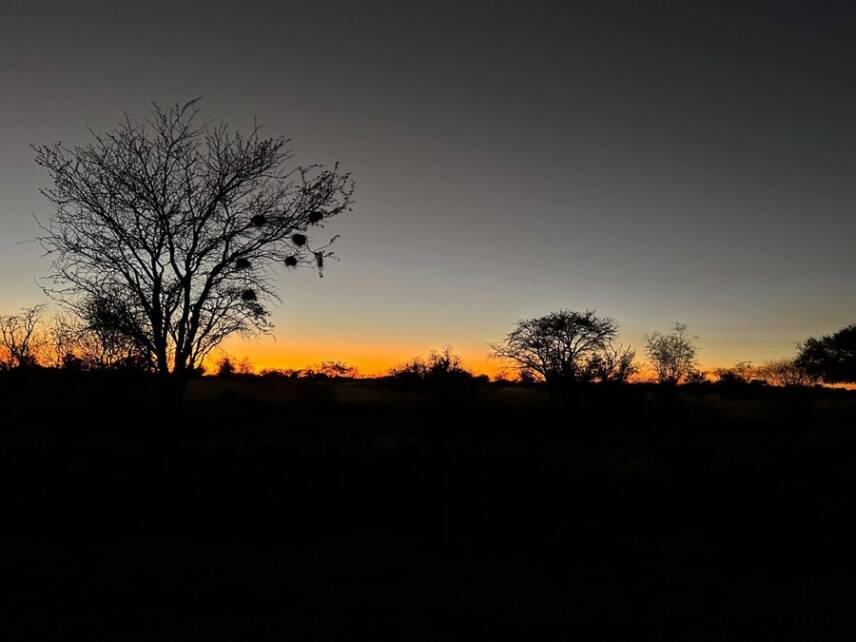
Is the Kalahari Desert good for plains game hunting in South Africa?
Yes — the Kalahari Desert is one of the best destinations for plains game hunting in South Africa. Known for its vast open landscapes and exceptional game quality, the Kalahari offers hunters a unique and rewarding African hunting safari experience.
Located in the northern regions of South Africa, the Kalahari is a premium destination for a wide variety of plains game hunts, with trophy quality that consistently exceeds expectations. The diversity of terrain, combined with challenging hunting conditions, makes it a favourite among both first-time and experienced hunters.
An interesting fact about the Kalahari Desert is that it is not a desert, but a semi-desert, as it receives moderate annual rainfall of approximately 6-12 inches per annum. Water rapidly filters through the desert sand, leaving only a few natural springs and water holes. Retaining water reserves is challenging, and groundwater levels are at great depths. The Kalahari in Tswana aptly means “the great thirst.”
“Though the hunter may leave the desert, the desert will never leave the hunter.”
The Kalahari Desert is an exceptionally “special place,” and most international hunters regularly return once captivated by its beauty and charm.
For a more detailed look at hunting in this region, see our guide to plains game hunting in the Kalahari Desert.
[DYNAMIC-BLOGTABLEOFCONTENT]
Kalahari Desert Facts
- Temperatures range from some rather cold mid-winter nights at 5 degrees Fahrenheit to 120 degrees Fahrenheit in the summer days, because the desert is situated at a relatively high altitude.
- The Kalahari Desert covers an area of 350 000 square miles, stretching from South Africa into Namibia and the majority of Botswana.
- Many reptiles are residents in the Kalahari, from the famous Cape cobra to puff adders, and many species of lizards. Birdlife includes the giant eagle owl, the secretary bird, and the martial eagle.
- Trees include a wide variety of Acacias and the endemic Camel Thorn responsible for all the famous evening fires enhancing the ambiance of the desert.
- In size, the Kalahari Desert is only smaller than the Great Sahara Desert in Africa.
- African Plains Game Hunting offers the hunter a wide variety of choices, and on a seven-day hunting safari bagging 4 to 6 trophies is quite achievable.
Plains Game Species in the Kalahari
The hunters’ choices when on this hunting safari are diverse. Large to medium plains game include giraffe, gemsbok (oryx) lechwe (common and red), kudu, sable, roan, Cape eland, golden, blue and black wildebeest, waterbuck, and tsessebe. Medium plains game comprise springbok (gold, white, copper, and common), nyala, and blesbok.
The Kalahari also offers a few members of the Tiny Ten, namely the steenbok and the common duiker. Ostriches, caracal, baboon, jackal, and, of course, warthog are also available. Nothing like a warthog adding a little action to an African plains game hunting safari!
When is the best time to hunt African plains game in the Kalahari?
Traveling to the Kalahari Desert
- From Oliver Tambo, hunters either have an option of road travel from Oliver Tambo to the hunting lodege in the Kalahari. This trip usually takes between 6 and 8 hours and can be arranged. It is a pleasant drive and a good way to see the countryside and landscape when hunting in South Africa
- The second is to charter a small plane that the outfitter will arrange, usually a small Cessna or similar.
- As the charter planes generally leave early in the morning or around 14h00, depending on international arrival times, it is sometimes necessary to overnight. The outfitter will make these arrangements in advance based on the hunter’s itinerary.
- The cost for the air charter will range between $2000 and $4000 depending on the size of the game hunting group. The charter takes less than two hours. It is always advisable to check for any weight restrictions.
On two previous African hunts to the Kalahari, we chartered a plane. On both occasions, our luggage items were capped at 12 pounds, which was not much. Fortunately, we also had separate convoys driving, and luggage limits didn’t apply there.
Activities for non-hunters
Due to the sheer remoteness of the game hunting destination, activities, there are limited activities for non-hunters. Relaxing in camp and unwinding or joining as an observer are the only options. Depending on the outfitter, game drives and sundowners in remote areas of the ranch can be arranged.
Rifles and Shot Placement
On this hunting safari, we decided to take a few of our junior members along to experience plains game hunting at its best in the middle of the coldest winter month. As they wanted a rough and rustic safari experience, we chose not to stay in the main ranch house. We chose the little safari-tented camp.
We decided to take the 6-hour drive and left around 02:00. It was bitterly cold outside the Land Cruiser.
It seemed as if the evening and morning cold while traveling and exiting the vehicle for rest stops bothered only me. I wondered if I had packed enough warm clothes and jackets! The younger members were too excited about their first hunting safari in the Kalahari to be concerned about the icy weather. After a hot breakfast outside the small town of Tosca in the Northern Cape, we arrived at about 10:00.
It came to the fore that the ranch did not focus on African Plains Game Hunting. The core business activity was cattle ranching, crop spraying, and breeding Arabian stallions. This took me a little by surprise. I had not booked the safari, so I thought it best to go with the flow. Wrongly, at the outset, I had just assumed that the ranch concentrated on plains game hunting.
Because of the cattle on the ranch, I knew now that taking a trophy blue, or black wildebeest would not be an option. Wildebeest calves contract the Malignant Catarrhal Fever virus in the uterus shortly after birth. They secrete large amounts of the virus in their nasal and ocular secretions. This virus becomes airborne, and ruminants (cattle), if not treated timeously, will face a certain death.
During the drive from the main entrance to our tented camp, we spotted plenty of plains game in the distance, so there was no reason to panic. Springbok, kudu, waterbuck, gemsbok (oryx), and a few members of the Tiny Ten were plentiful. We would have to wait and see what this ranch could deliver!
Understanding shot placement is critical when hunting African plains game, especially in open Kalahari terrain where longer shots are common. Reviewing a detailed shot placement guide before your safari can make a significant difference in ensuring clean, ethical kills.
The ranch owner confirmed they had to chase out a few cheetahs with safari vehicles. They had decided to take up residence on the ranch! It is illegal to hunt cheetah in South Africa, and a permit is not obtainable.
Arriving at the temporary bush camp, it was exactly as described. A slab, a few safari tents, a makeshift “kitchen” and a toilet surrounded by a little netting. This was going to be fun! It seemed as if the young hunters had packed every piece of hunting equipment known to man…
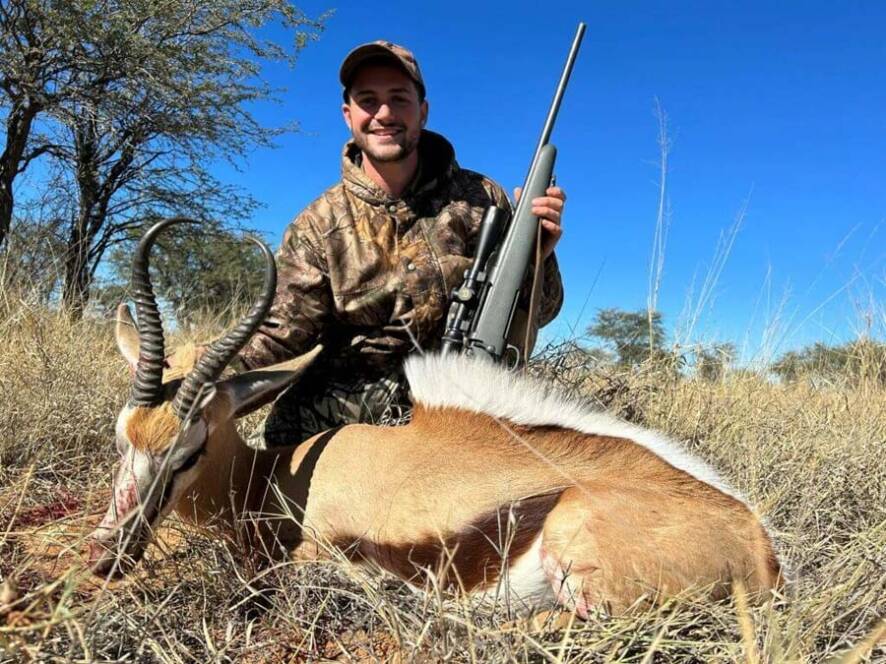
That afternoon, we decided to head out. In the Kalahari Desert, due to the landscape and size, hunting is generally done by either setting out on foot to see what you can find, or hopping on board a Landcruiser and covering more ground. Once an antelope is spotted, it becomes a stalk, resulting in a fair chase. After defrosting early morning of day two, Keenan and Slade set out on a walk. They were successful with a warthog caught unaware. We managed a few more springbok later in the day, and another crew member bagged a nice old gemsbok bull for the pot. Due to genetics, not all gemsboks grow horns more than 38 inches, becoming trophies.
They either seem to have long horns or are big in the body. We came across a herd of about 20 elands resting in the afternoon shade. They seemed to know they were not a target species for this hunting safari.
As a word of advice, when looking for a trophy gemsbok always consults with your professional hunter. Gemsboks are extremely difficult to judge horn size at a distance. I have seen many a hunter make the call himself, only to have made a fatal mistake and have shot a small young animal.


Day three turned out to be a long day of walking and searching. Logan took a long shot at a gemsbok bull. On the impact, the gemsbok turned, left the small group, and headed in the opposite direction. We found a few drops of blood, but that was about it. We walked the area and came with horses to cover the ground quickly. No luck at all.
Day four, our last day, started early by returning to the area where we shot the gemsbok for a final check. No sign, not even vultures in the air, that would normally be a good sign.
Logan, feeling a little miserable, decided to pack his rifle away and observe for the last day, but that’s how plains game hunting goes! Hunters that say they have been hunting for years and never missed, well, basically, they are lying. Keenan bagged a nice kudu bull, and we loaded a few more warthog.
Warthog in this area of the Kalahari are plentiful, and regarded as vermin. They destroy fences and dig up water pipes, causing mayhem wherever they go. They, however, thrive in this environment, and as any plains game hunter who has been to the Kalahari will tell you, they are fun to hunt, and the smoked cheeses sausages even better! When it comes to pigs, it’s permanently exciting.
For any hunter planning a hunting safari to the Kalahari and who has the want and means to include young aspiring hunters on the safari, it is well worth the trip. Jackal hunting at night is lots of fun along, with hunting rabbits, and the springhare, who, despite the name, is not a hare but a burrowing rodent.
I do not hold the gift of using the correct words to describe the beauty, charm, and charisma of the Kalahari Desert. A hunt based on trophies taken falls far short of the ultimate goal. Immerse yourself in the outdoor experience. It will cleanse your soul and make you a better person.
Plan Your Plains Game Hunting Safari in the Kalahari, South Africa
Plains game hunting in South Africa remains one of the most accessible and rewarding hunting experiences in Africa, and few regions offer the same combination of variety, challenge, and natural beauty as the Kalahari Desert.
From stalking wary springbok across open plains to tracking kudu and gemsbok through the thornveld, every day in the Kalahari presents a new and memorable hunting experience. Whether you are a first-time visitor or a seasoned hunter returning to Africa, the region offers something truly special.
If you are considering a hunting safari in South Africa, exploring available plains game hunting packages is the best place to start. With the right outfitter and preparation — including a solid understanding of shot placement and species behaviour — your Kalahari hunt can become one of the most rewarding safaris you will ever experience.
Author: Logan van Wyk