
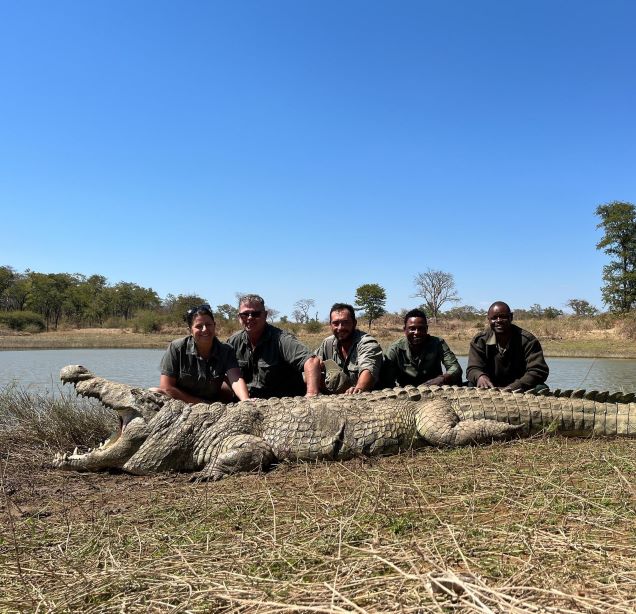
A river or lake full of crocodiles can look like easy hunting. There are animals on the banks, more heads in the water, and fresh slides everywhere. To a hunter seeing that for the first time, it can feel as though finding a mature bull should simply be a matter of choosing one.
It rarely works that way. Most of the crocodiles you see may be females, younger males or animals that simply do not have the age, body mass or head structure the PH is looking for. Even when the right crocodile is found, he may be lying among several others, partly submerged, badly positioned or too close to deep water for the shot to make sense.
Crocodile Hunts are often more about selection than numbers. A good area gives the hunter options, but plenty of crocodiles does not guarantee the right old male will be easy to identify, isolate or hunt. The real job is not finding crocodiles. It is finding the right one.
Lots of Crocodiles Does Not Mean Lots of Suitable Males
A healthy crocodile population can still contain relatively few old, big males. Females and younger crocodiles often make up much of what hunters see along banks, sandbars and shallow water, so a busy stretch of river can look more promising than it really is for trophy hunting.
Survival is part of the reason mature bulls are uncommon. Studies of wild Nile crocodile populations suggest that only a small percentage of hatchlings survive to maturity, and maturity is only the first hurdle. A crocodile must then survive many more years of drought, flooding, territorial competition and human pressure before becoming one of the truly old, heavy males hunters are looking for.
A 15-foot-plus male represents decades of growth and survival. In much the same way that an experienced buffalo hunter may look beyond horn width and search for an old, hard-bossed bull, crocodile hunting becomes more about age and maturity than simply finding the biggest animal visible.
The mature bulls are the animals everyone is trying to identify. They tend to carry greater head width, jaw depth and body mass, and they are usually far less common than the number of visible crocodiles suggests. A hunter may spend hours looking at animal after animal before the PH finds one worth studying properly.
Raw crocodile numbers can be misleading. Plenty of animals is a good sign for the area, but the more useful question is how many genuinely mature males are present and what that specific water has produced in recent seasons.
The Biggest Crocodile Is Not Always the Longest One
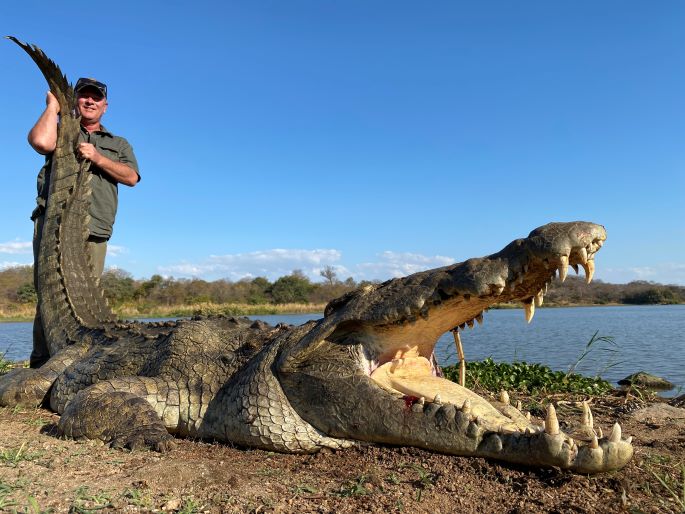
Length is the measurement hunters often hear first, but it does not always tell the full story. An old male may carry a broad skull, deep jaws and enormous body mass without being the longest crocodile seen on the water.
Tail damage is one reason. Mature crocodiles can lose part of the tail through territorial fights, injury or other damage, which means an old, heavy animal may measure shorter than his build suggests. A younger crocodile with a complete tail can sometimes put more feet on the tape without having the same age, head or body mass.
Experienced PHs therefore spend time looking at more than overall length. Head width, jaw depth, the
thickness through the neck and body, and the general proportions of the animal can all help build a better picture of maturity. For crocodile hunters, the lesson is simple: do not become so fixed on a number that you overlook the crocodile itself. An old male with a massive head and heavy body may be a far more impressive animal than a slightly longer crocodile that has not reached the same level of maturity. Missing sections of tail, worn or damaged scales, old scars and other signs of years spent surviving on the river can add plenty of character to a mature bull.
Females and Younger Males Can Make an Area Look Better Than It Is
A stretch of water can hold many crocodiles and still be disappointing for a hunter looking for a trophy bull. Females and younger males are often more visible, especially around productive banks, shallow water and feeding areas, so sheer numbers can give a misleading impression of trophy quality.
Photographs of dozens of crocodiles on a riverbank do not tell the whole story. They show that the area supports crocodiles, which is useful, but they do not tell you how many of those animals are old males, how often those males are seen, or what size class the area has produced.
For the PH, this means sorting through a lot of animals that may never become serious candidates. Some will be too young. Some will lack the head and body mass of an old bull. Others may simply be females that look impressive at first glance because of distance, angle or poor visibility. For crocodile hunters, the better question is not, “How many crocodiles are there?” It is, “How many mature bulls are being seen and what have hunters taken from this water in the last few seasons?” That is the difference between a crocodile-rich area and a strong trophy area.
Finding the Right Crocodile Is Only Half the Problem
Identifying a suitable bull does not mean the hunt is ready to finish. The crocodile may be lying among several others, partly covered by water, facing the wrong way, or positioned where another animal overlaps the shot. In a busy stretch of river, that bull can be surrounded by ten or twenty others and still offer no clean opportunity.
Patience comes back into the hunt. The PH may have already decided that one animal is the bull they want, but the hunters still must wait for him to separate, expose enough of the body, and settle into a position where the shot makes sense. A crocodile can be the right animal and still be in the wrong place. Hunters unfamiliar with the angles involved should also understand proper Crocodile Shot Placement before the opportunity develops.
For hunters accustomed to judging antlered or horned game, crocodiles require a different eye. Much of the animal may be hidden by water, distance can distort size, and there is rarely one obvious measurement that tells the whole story. The PH is often working from fragments: head shape, body mass, proportions, position and how the crocodile compares with other animals around him.
American hunters with experience in the southern United States should also understand that crocodile hunting is very different from alligator hunting. The animals may look similar at first glance, but the way mature Nile crocodiles are located, judged and selected can be quite different. That becomes especially important when the objective is not simply to find a large reptile, but to identify one old male among many others.
Finding the right bull is therefore only the first part of the problem. The second is getting that same crocodile alone, visible and positioned well enough for the PH to finally say, “That’s him.”
A Crocodile You Find Today May Not Be There Tomorrow
Finding a suitable bull does not mean you have solved the hunt. Crocodiles move, water levels change, other animals shift pressure around them, and a bull that showed well on one bank may simply not be there when the hunters return.
We have seen this ourselves while crocodile hunting in Mozambique on Lake Cahora Bassa. Moving between the northern and southern banks, a mature crocodile that had been located and studied on one stretch of water could be difficult to find again once conditions changed. On a lake that size, a bull can shift position, disappear into another part of the shoreline or simply stop showing where you expected him to be.
That is especially true with older males. They may use the same stretch of river repeatedly, but not necessarily the same sandbank or the same piece of shoreline every day. A change in wind, boat activity, livestock, fishing pressure or another dominant crocodile can be enough to alter where the animal feels comfortable.
Experienced PHs pay attention to more than a single sighting. They want to understand where the crocodile is moving, when he tends to show, and whether he is using the area consistently enough to build a realistic plan around him. For crocodile hunters, the important point is simple: seeing a mature bull once is encouraging, but it is not the same as having him available to hunt. Sometimes the hardest part is finding the same bull again under conditions that finally give the team a proper opportunity.
The Same Water Can Produce Different Trophy Quality
A strong crocodile area can produce an excellent bull one season and something much more ordinary the next. The area has not necessarily declined. Mature males are a small part of the population, and the animals using a particular bank, channel or section of river can change from year to year.
Recent results from the exact waterbody matter more than broad claims about a country or region. A lake may hold plenty of crocodiles, but the useful question is what mature males have been seen and taken from that specific stretch of water in the last few seasons. Hunters should also remember that trophy quality is not measured only in length. One area may produce longer animals, while another may be known for older and bigger males. Both can be excellent hunting, but they are not necessarily offering the same kind of trophy.
The best information therefore comes from recent, local evidence: photographs, measurements and results from the exact concession, river, lake or property being discussed. That tells a hunter far more than simply hearing that a destination has “lots of big crocodiles.”
Decide What the Right Crocodile Means Before the Hunt
The right crocodile does not mean the same thing to every hunter.
One hunter may be looking for maximum length. Another may care more about age, head size and the heavy build of a genuinely old male. A third may want an animal suitable for a particular mount, while someone else may place more value on the skin.
Those objectives can lead to different choices on the same stretch of water.
An old crocodile may have a massive head, deep jaws, heavy body and all the character that comes with years of fighting and surviving, yet be missing part of the tail. On the tape he may lose inches to a younger animal with a complete tail, but few experienced hunters would argue that automatically makes him the lesser trophy. The same applies to scars, damaged scales, worn teeth or old injuries. To one hunter those are imperfections. To another they are exactly what makes the crocodile worth hunting.
Mounting plans can matter as well. A hunter wanting a full-body mount may place more importance on the condition of the tail, feet and hide than someone planning a skull or head mount. A hunter hoping to use part of the skin for leather may have different priorities again, because old crocodiles can carry heavy scales, scars and damage accumulated over many years.
None of this means one type of crocodile is better than another. It simply means the hunter and PH should agree on what they are looking for before serious hunting begins. If maximum length matters most, say so. If age and character matter more than the tape, say that too. If an intact hide or mounting plan is important, the PH should know before he starts passing or selecting animals.
That conversation can save a lot of uncertainty later. The PH may find what he considers an exceptional old crocodile, while the hunter is quietly measuring everything against a number he had in his head before arriving in Africa. Both can be looking at the same animal and judging it by completely different standards.
The better approach is to decide what the right crocodile means before the hunt starts. Once that is clear, trophy size can also become a contract question.
Trophy Size Can Become a Contract Question
Crocodile hunts are sometimes sold around an expected size class, and that can create questions the hunter should settle before the safari starts. A package built around a 12-foot crocodile is not necessarily the same product as one advertising the opportunity for a 14- or 15-foot bull.
The important issue is not only what size the area can produce, but what the hunter is paying for. Some operators may price larger crocodiles differently, use upgrade fees, or define trophy categories in the contract. Others may structure the hunt differently. There is no single rule that applies everywhere.
South Africa is a good example. On many crocodile hunts in South Africa, the hunt may be sold around a defined size category, with larger animals carrying a different price or upgrade structure. That is different from many free-range river hunts elsewhere in Africa, where the hunter may be pursuing whatever mature bull the area produces.
That makes one question especially important: what happens if the PH judges the crocodile incorrectly and the animal measures above or below the booked category? The answer should be clear before the hunter reaches camp, not argued about beside the skinning shed.
A good agreement should explain the expected trophy class, any upgrade charges, and who carries the responsibility for judging the animal in the field. That removes uncertainty from a decision that often must be made quickly once the right crocodile finally appears.
What Crocodile Hunters Should Also Ask Before Booking
How many full hunting days are reserved for crocodile?
A crocodile may show on the first day, but a mature bull may also take several days to locate, identify and put into a workable position. If the safari includes buffalo, hippo or plains game, ask how many days are genuinely available for crocodile rather than assuming the species will simply fit around everything else.
Is crocodile the main objective or an add-on to another safari?
That can change the whole hunt. A dedicated crocodile safari allows the team to build the days around the right water, the right animal and the right conditions. An add-on hunt may still be excellent, but the hunter should know how much time and attention the crocodile will realistically receive.
What recent mature bulls has this exact waterbody produced?
Ask for recent photographs and measured results from the specific river, lake or property you will hunt. Broad claims about a country having good crocodiles are less useful than knowing what that actual stretch of water has produced over the last few seasons.
What happens if the size class I booked is not available?
If the hunt is sold around a defined trophy size, ask what happens if the expected class of crocodile is not found. Can the hunt be extended? Can the hunter take a smaller animal? Is there any refund or credit? The answer should be clear before the safari starts.
Will hunting other species reduce the time spent looking for crocodile?
Hunters planning buffalo, hippo or other Big Game Hunts should ask how the days will be divided and whether crocodile remains a genuine priority once the safari begins.
The Right Crocodile Matters More Than the Number You See
Seeing twenty crocodiles on a bank is impressive. Seeing the one old male you came to hunt is something different.
Good crocodile hunting is ultimately about selection: finding mature bulls, judging them properly, understanding how they use the water, and having enough time to wait for the right animal to give you a genuine opportunity. High crocodile numbers certainly help, but numbers alone do not make a great crocodile area. For hunters comparing Hunting Trips in Africa, that distinction matters. Ask what the exact waterbody has produced, how the hunt will be structured and what kind of crocodile you are realistically hunting before being impressed by photographs showing a river full of them.
Plenty of crocodiles is encouraging. The right crocodile is what matters.
Authors
Pierre and Tamlyn van Wyk are the founders of Game Hunting Safaris and have spent many years hunting across Africa. Their experience includes dangerous game and large Nile crocodiles, giving them first-hand insight into the realities of selecting mature animals, judging trophy quality and understanding how different one hunting area can be from another.