

Trophy Hunting in the Eastern Cape: Eland, Springbok, Kudu & Mountain Reedbuck
Booking Season: 2026
Hunt Difficulty: Moderate, Difficult

South Africa is the most structured and operationally efficient hunting destination on the African continent. It is not the most remote. It is not defined by vast government concession blocks stretching for millions of acres. It is not built around month-long expedition safaris. What it offers instead is something different — and for many American and Canadian hunters, something more practical.
South Africa combines established wildlife management systems, developed transportation infrastructure, clear firearm import procedures, high species diversity, professional camp standards, flexible safari structures, and a wide range of pricing models. A hunter can land at O.R. Tambo International Airport in Johannesburg, move through a formalised firearm import process, and within hours be in active hunting country.
South Africa is not built for hunters seeking exclusively unfenced government concession hunting, extended dangerous game expeditions in remote wilderness, or isolation as the primary measure of authenticity. Those environments exist in Africa — South Africa's strength lies in structure, not isolation. Understanding that distinction ensures satisfaction.
More About Hunting in South Africa 


South Africa remains one of the strongest plains game destinations on the continent. Because of habitat diversity and managed populations, multiple species can be pursued within a single property or region. Seven to ten days in South Africa can be highly productive when planned properly — species density, road access, and structured property systems allow effective use of limited vacation time.
South Africa allows structured combinations of plains game, premium spiral-horn species, and potentially buffalo within a single itinerary. For hunters traveling internationally, that logistical flexibility is difficult to replicate elsewhere without increasing travel days and cost. Because of developed infrastructure, it is also realistic to add tourism days, photo safari extensions, coastal experiences, and urban stays — South Africa integrates hunting and non-hunting travel more easily than most African countries.
The Bushveld Core (Limpopo, Mpumalanga, North West)
When many hunters imagine "classic Africa," they are picturing bushveld. The bushveld is defined by mixed thornveld vegetation, scattered trees, rolling terrain, and dry riverbeds. Visibility fluctuates constantly — in some sections a hunter may see 150–200 yards through light vegetation; in others, sightlines collapse to under 75 yards within a few steps. Most rifle shots occur inside 200 yards. This terrain rewards discipline and patience rather than long-range shooting ability.
The Kalahari & Northern Cape Red Sand Regions
The Kalahari presents a different landscape entirely. Red sand dunes roll in long parallel lines across open country. Visibility can extend 400–600 yards across open valleys. Shot distances commonly extend beyond 200 yards and may approach 300 or more. This region demands comfort with wind reading and steady shooting positions.
The Eastern Cape
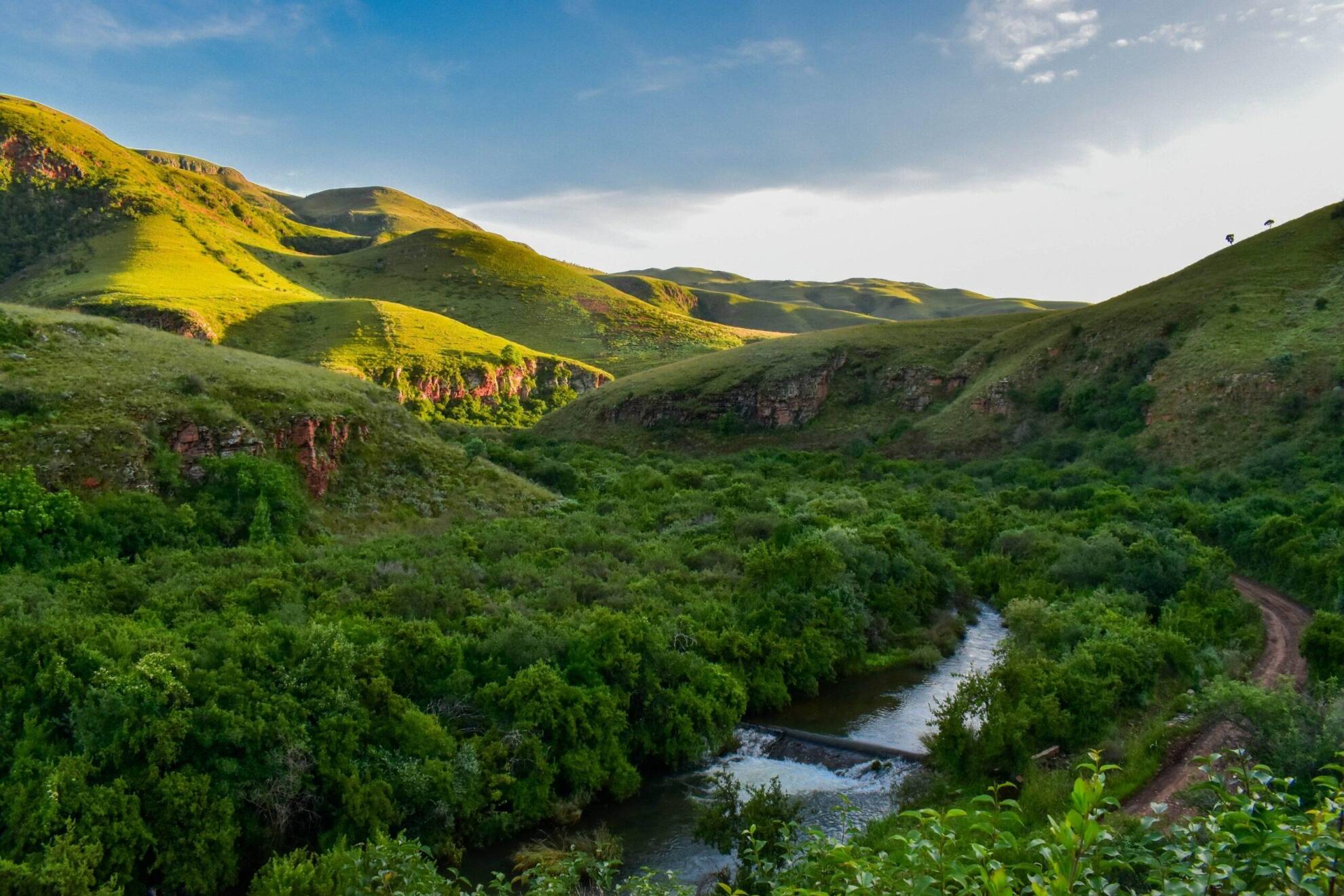
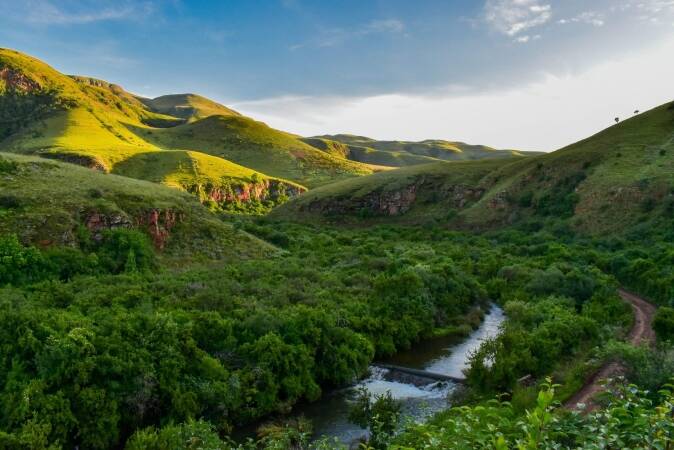
The Eastern Cape offers some of the most visually dramatic hunting terrain in South Africa — steep hills rising above deep valleys, ravines cutting sharply into slopes, and vegetation alternating between brush-covered hillsides and open grass slopes. Shot distance varies significantly. The Eastern Cape demands physical readiness and strong shooting fundamentals across varied terrain.
South Africa's reputation in the hunting world is built primarily on plains game diversity. Across different regions, hunters can pursue medium-bodied antelope, larger spiral-horn species, open-plains herd animals, and region-specific habitat specialists. What makes South Africa distinct is not simply the number of species available — it is the ability to pursue several within a single property or region without relocating camps.
South Africa operates primarily under a private wildlife ownership and management framework regulated at provincial level. Over several decades, large areas of former livestock farmland transitioned into wildlife-based land use. Landowners discovered that properly managed wildlife populations created long-term sustainability where cattle farming often struggled. That shift produced measurable results: expanded wildlife habitat, reintroduction of species in multiple regions, improved age structure in certain populations, and financial incentive aligned with conservation. Hunting revenue supports that model directly.
South Africa is not a wilderness myth. It is a structured hunting environment built on privately managed wildlife land, regulated through provincial authorities, and supported by developed infrastructure. That does not make it inferior to other African destinations — it makes it different. Hunters seeking multi-week buffalo tracking in vast unfenced concession blocks may find Tanzania or certain regions of Zimbabwe better aligned with those goals. Hunters seeking multi-species plains game hunts, combination buffalo and plains game in a condensed timeframe, defined firearm procedures, logistically efficient travel, and predictable cost structures will find South Africa exceptionally well suited.
For American and Canadian hunters, three practical realities influence destination choice: travel distance, cost structure, and operational predictability. South Africa performs strongly in all three. Flights are regular and established. Airports are modern and organised. Road networks reduce dependence on charter aircraft. Firearm importation is structured and documented. For a first African safari, reducing uncertainty is often the deciding factor. Many hunters who begin in South Africa later explore other African destinations. Very few regret starting there.
South Africa excels for first-time African hunters — the structured environment reduces hesitation, the firearm process is defined, camps are established, professional hunters are licensed and regulated, and communication standards are generally high. It also excels for plains game-focused safaris, hunters with limited time windows (seven to ten days can be highly productive), combination safaris incorporating plains game, premium spiral-horn species, and potentially buffalo within a single itinerary, and family-inclusive trips where tourism days, photo safari extensions, and coastal experiences can be added around the hunt.
South Africa allows for flexibility, but flexibility should be structured around habitat, region, and realistic time constraints. The most common planning mistake is attempting to pursue too many animals in too few days. A stronger approach is strategic layering: select one primary objective species, choose one secondary "premium" objective, then add additional opportunities based on terrain and time. This structure maintains focus while allowing flexibility. Seven to ten days can be highly productive when planned properly.
South Africa is not designed around vast government dangerous game concessions. However, dangerous game — particularly buffalo — is available within regulated provincial systems and designated properties. Buffalo hunting in South Africa occurs on privately managed land under specific legal frameworks. Property size, herd management philosophy, and provincial regulation vary. Hunters should confirm property structure, legal minimum calibre, trophy fee structure, and management philosophy. For hunters seeking to combine buffalo with plains game within a condensed timeframe, South Africa offers logistical efficiency.
When many hunters imagine classic Africa, they are picturing bushveld. The terrain rewards discipline and patience — stalks often involve tracking fresh spoor in sandy soil, cutting wind across low ridges, moving slowly through broken cover, and taking advantage of narrow shooting windows. Most rifle shots occur inside 200 yards.
Red sand dunes roll in long parallel lines across open country. Visibility can extend 400–600 yards across open valleys. The topography is gradual but exposed — dune crests offer vantage points but also expose movement. Shot distances commonly extend beyond 200 yards. Hunting strategy shifts accordingly, with glassing becoming more important and stalks using dune slopes for concealment.
Broad, gently rolling grasslands stretch across significant portions of the province. Natural cover is limited. Wind plays a dominant role. Shot distances frequently extend beyond those common in bushveld. The Highveld rewards careful planning, patience, and precise shot execution under wind pressure.
Steep hills rise above deep valleys with ravines cutting sharply into slopes. Elevation change becomes a meaningful factor. Glassing from ridge tops is common. Shot distance varies significantly — one opportunity may present at 120 yards in broken cover, another may require a 300-yard cross-valley shot with wind influence. The Eastern Cape demands physical readiness and strong shooting fundamentals.
South Africa's primary hunting season runs from April through September, corresponding with the country's cooler, drier winter months. Vegetation thins, water becomes more limited, and animal movement patterns become more predictable. The period from June through August is considered peak winter season in many provinces — cold early mornings, clear skies, minimal rainfall, and reduced foliage. September brings warmer afternoons but late season hunts can still be highly productive.
South Africa offers one of the widest pricing spectrums in Africa. A South African safari typically consists of three core cost components: daily rates (commonly ranging from approximately $350 to $600 per day for plains game), trophy fees (which vary by species and region, with buffalo significantly increasing total safari cost), and post-hunt expenses including gratuities, taxidermy or dip-and-pack services, shipping, and export documentation. Plains game safaris commonly range from approximately $6,000 to $15,000 depending on species count and duration. Buffalo-inclusive safaris often increase total investment significantly. Clarity before travel removes nearly all financial uncertainty.
Most international hunters arrive via O.R. Tambo International Airport. Upon arrival, firearms are declared, temporary import documentation is processed, and serial numbers are verified. When paperwork is prepared correctly in advance, the process is administrative rather than stressful. From Johannesburg, most hunting areas are accessible by road within a single day. Unlike certain remote African destinations, additional bush flights are not usually required. Camp life follows a steady routine — meals are typically substantial, evenings are spent reviewing the day and discussing strategy, and the rhythm becomes familiar quickly. Most rifle shots in South Africa are taken from tripod shooting sticks. Shot distances vary significantly by region, from 75–200 yards in bushveld terrain to 250+ yards in the Kalahari or Free State.
Safety is one of the most common concerns expressed by first-time international hunters. South Africa is a modern constitutional democracy with developed infrastructure — but it also faces socioeconomic challenges and crime in certain urban environments. Crime in South Africa is concentrated primarily in specific metropolitan areas and urban environments. Hunting safaris, however, take place in rural, privately managed properties far removed from major city centres. The majority of international hunters travel, hunt, and return home without incident. As with travel anywhere in the world, common-sense precautions apply, and coordination with a reputable outfitter mitigates most risk.
South Africa's wildlife management system is built largely on private land ownership. Fencing is common in South Africa — that fact alone does not define the quality of a hunt. Properties vary significantly in size, from a few thousand acres to tens of thousands of acres with varied terrain and natural behaviour patterns. Wildlife in South Africa carries economic value. Landowners protect what has value. Habitat is preserved when it is financially viable. Hunting remains one of the financial engines supporting that system. Over the past several decades, Namibia has increased wildlife numbers in many regions under this model.
South Africa offers a structured, accessible, and highly adaptable hunting environment. It delivers species diversity, logistical efficiency, defined regulatory systems, flexible safari structures, and opportunities for combination hunts. The most common source of dissatisfaction in international hunting is not the country — it is misalignment of expectations. Hunters who invest time in researching terrain, season, cost structure, and property philosophy almost always report smoother and more rewarding experiences.
Written by Pierre van Wyk, who has hunted extensively across Southern Africa for more than three decades, with significant experience in South Africa's bushveld, Kalahari, Free State, and Eastern Cape regions.
Most hunting in South Africa takes place on privately managed land that is fenced. Property sizes vary widely, from a few thousand acres to tens of thousands of acres. Within those properties, animals behave naturally, breed freely, and respond to pressure, wind, and terrain. The presence of fencing alone does not determine the quality or challenge of a hunt — property size, habitat diversity, and management philosophy are more meaningful indicators.
The majority of international hunters travel to South Africa each year without incident. Hunting safaris occur in rural, privately managed areas far removed from high-crime urban zones. Urban crime exists in parts of the country, and international media coverage reflects that. However, safari environments are structured, controlled, and professionally managed. Common-sense travel precautions and coordination with a reputable outfitter mitigate most risk.
The primary hunting season runs from April through September during the cooler, drier winter months. Vegetation thins, visibility improves, and animal movement becomes more predictable. June through August is considered peak winter season in many provinces.
Plains game safaris commonly range between approximately $6,000 and $15,000 depending on duration and species selection. Buffalo-inclusive hunts significantly increase total cost. Pricing includes daily rates and trophy fees, with additional costs such as gratuities and export services budgeted separately. Clear planning eliminates financial surprises.
Yes. Its developed infrastructure, structured regulatory system, and species diversity make it one of the most accessible African destinations for first-time safari hunters. The predictable logistics reduce uncertainty for international travelers. Many hunters who begin in South Africa later explore other African destinations. Very few regret starting there.
26 January 2026

15 November 2025

Search from our range of Hunts across various popular destinations in Africa.
Find A Hunt


