
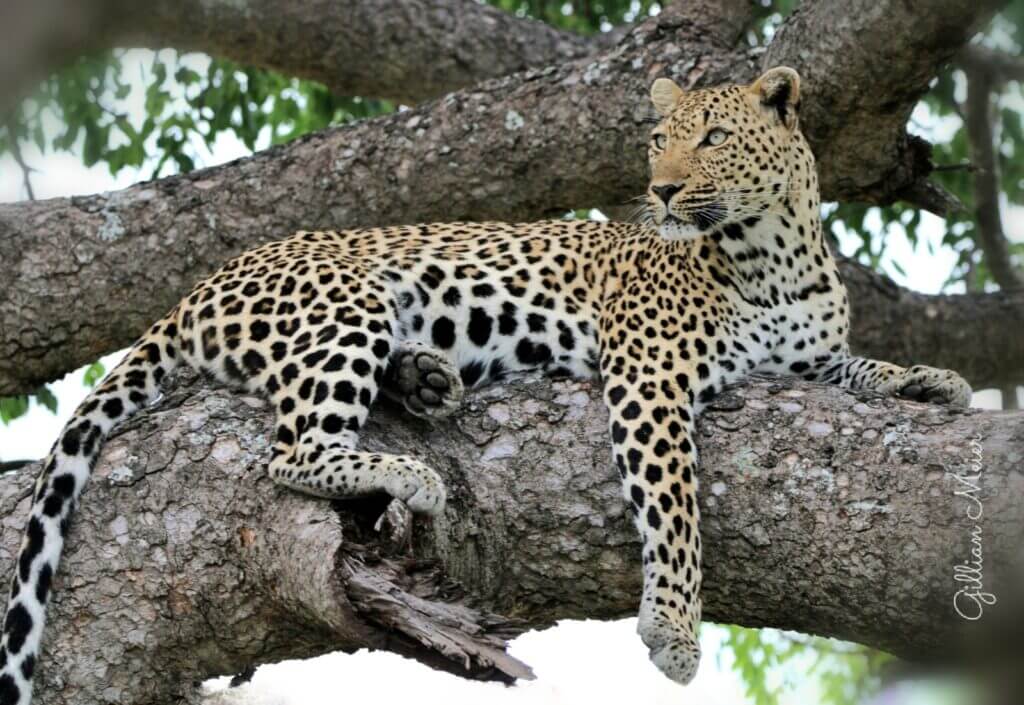
When it comes to authentic dangerous game safaris, few experiences compare to leopard hunting in Zimbabwe. The country has earned a global reputation for producing exceptional leopard trophies, experienced Professional Hunters, and vast unfenced wilderness areas where dangerous game still moves freely. Areas such as the Omay Concession along Lake Kariba continue to attract hunters seeking a genuine African safari that combines challenging leopard tracking with some of the finest African leopard hunts available today.
The Omay region is particularly respected for its healthy leopard population, strong success rates, and classic bait-and-blind hunting methods conducted in rugged wild country. Hunters visiting the concession also have the opportunity to combine their safari with other iconic dangerous game species including Cape buffalo hunts and African elephant hunts, creating a more complete Zimbabwe dangerous game safari experience.
Beyond the hunting itself, properly managed Zimbabwe hunting safaris continue to play an important role in anti-poaching initiatives, wildlife management, and rural community support programs across remote safari areas. Within concessions like Omay, strict quota systems and experienced operators help maintain sustainable leopard populations while preserving the untamed character that makes this part of Africa so unique.
[DYNAMIC-BLOGTABLEOFCONTENT]
Key Takeaways
• Zimbabwe is a prime destination for big game hunting in Africa, including members of Africa’s Big 5 and Dangerous 7, as well as large antelopes such as the kudu, eland, and sable.
• There are estimated to be between 12-14,000 leopards in Zimbabwe.
• This nocturnal African cat is not only a master of camouflage, but is cunning and clever, using its climbing abilities to evade hunters and other predators.
• The Omay Concession has an exceptional track record with leopard hunting, with around a 90% success rate, some years rating even higher.
• Leopard hunting methods in the region are generally bait and blind, and hounds are not used on the concession, although they are used in other areas of Zimbabwe.
• Night hunting is allowed on the Omay Concession, adding another level of excitement to enjoy this hunting adventure at night.
• The Omay Concession allows hunters the opportunity to experience an authentic African hunt within a large, unfenced concession of around 200 million acres.
Leopard Hunting in Zimbabwe
Leopard hunting in Africa is a sought-after experience, with many African countries offering spectacular hunting safaris, experiences, and trophies. But what makes leopard hunting in Zimbabwe so different? What sets it apart from other African destinations?
• Zimbabwe is renowned for the exceptional leopard trophies it has produced previously and has a large leopard population.
• The country is known for its experienced dangerous game Professional Hunters, who know the area, species, and animal behavior.
• Some concessions, including the Omay Concession, have a success rate of up to 90% or more, making them an attractive option and location for leopard hunting in Africa.
• Zimbabwe allows night hunting of leopards in some concessions, such as the Omay Concession. This, in turn, increases the probability of a successful hunt targeting this elusive nocturnal predator.
• Hunters can combine a night leopard hunt with other hunts during the day, allowing them to actively experience both day and night hunts, which in turn allows a better and more diverse hunting safari.
• Leopard hunting in Zimbabwe contributes to anti-poaching initiatives as well as habitat conservation and renewal. It also contributes to community development by aiding the building of schools and healthcare clinics, amongst other things.
• Leopard hunting in the area can also assist in targeting a specific animal that has been causing human-wildlife conflict by preying on livestock or other domestic animals.
The Omay Concession
The Omay Concession is seen as one of the most beautiful and fruitful concessions for dangerous game hunting in Zimbabwe. Situated in northwestern Zimbabwe, the Omay Concession comprises almost 200 million acres of free-range hunting, along with 124 miles of shoreline, perfect for targeting dangerous game hunting species such as the Nile Crocodile and Hippo. The concession shares its eastern border with Matusadona National Park.This region is one of several areas where properly managed leopard hunts continue to produce mature toms under strict quota systems.
Landscape & Terrain
The Omay Concession lies within the Zambezi Valley along Lake Kariba, and the area includes a combination of flood plains, river valleys, and escarpments. The landscape has hills, densely wooded areas, mopane forests and rolling plains, with numerous rivers and tributaries running through it. These diverse vegetation types create a variety of habitats in which an array of wildlife thrives. The 124-mile shoreline is the perfect habitat for two members of the Dangerous 7, the Hippo and Nile Crocodile.
The landscape is largely unfenced, necessitating the perfect backdrop for a dangerous game hunting safari in untamed Africa! The area’s largely untamed areas of dense bush, open plains, and large bodies of water, including Lake Kariba, provide a welcoming habitat for large game such as Elephants, Nile Crocodiles, Hippos, Cape Buffalos, Lions, and Leopards.
Species
The landscape is largely unfenced, creating the perfect backdrop for an authentic dangerous game hunting safari in untamed Africa. Dense bush, open plains, and the waters of Lake Kariba provide ideal habitat for large game species including elephants, Nile crocodiles, hippos, Cape buffalo, lions, and leopards. Hunters visiting the concession often combine Hippo hunts or hunting hippo in Zimbabwe with dangerous game safaris targeting leopard and buffalo within the same region.
Why go Leopard hunting in the Omay Concession?
• The region allows hunters to experience an authentic hunt in wild and untamed Africa.
• The Concession is renowned for having a large population of leopards, increasing the probability of success.
• The Concession allows night hunting, increasing the chance of success.
• The diverse and varied vegetation found within the concession suits the leopard and also provides the perfect habitat for its range of prey.
• The Omay concession is home to numerous other dangerous game, as well as a variety of African plains game to enhance the Zimbabwe hunting safari experience.
• A hunt within the concession is challenging, yet rewarding, with a 200 million acre, unfenced, free-range hunting ground.
• The concession allows the best of both worlds: A wide and abundant range of big, dangerous and African plains game on land, as well as dangerous game options within Lake Kairba.
• Hunting within the concession will not only provide the hunter with a great experience, but also contribute to bettering the lives of the local community, as a portion of the trophy fees are utilized within the community.
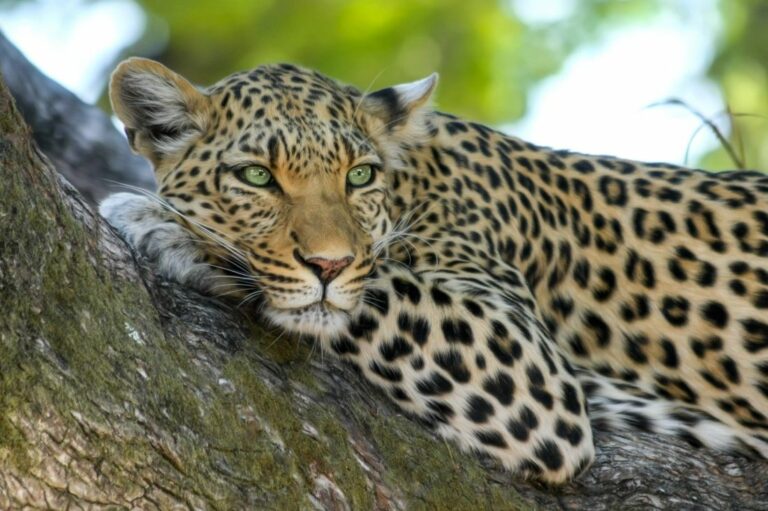
Economic, Financial & Social Impact of Hunting in Zimbabwe
There is much more to a hunt than purely the trophy or the experience. By hunting in Zimbabwe, hunters become part of a larger international community that assists local communities and supports wildlife conservation across remote safari regions. Whether participating in African leopard hunts, Cape buffalo hunts, or African elephant hunts, hunters directly contribute toward maintaining vast wilderness concessions and sustainable wildlife management programs.
While the hunt may result in unforgettable memories and impressive trophies, it also assists impoverished rural areas throughout Zimbabwe:
• Local community members are employed as skinners, trackers, camp staff, and cooks, allowing rural communities valuable employment opportunities.
• No meat from any game hunting safari goes to waste, with harvested meat distributed among surrounding communities. For many households, this provides an important source of protein in difficult rural environments.
• Portions of licensing fees and trophy revenue help support community development projects, including schools, clinics, boreholes, anti-poaching initiatives, and road infrastructure.
• Properly managed safari concessions also help preserve habitat for a wide range of dangerous game and plains game species while reducing illegal poaching activity in vulnerable wildlife areas.
Leopard Hunting Methods
• Leopards are an extremely challenging species to target, which makes a leopard trophy even more rewarding!
• While leopard hunting in Zimbabwe often utilizes hounds, this method is not used within the Omay Concession.
• Baiting from hides is the main method for leopard hunting in the Omay concession, with spot-and-stalk less commonly used for leopard hunts in this area.
• Antelope or zebra meat is hung in locations where leopards have been spotted. This baiting takes place a couple of weeks before the actual hunt, with trail cameras monitoring the various areas that may be of significance.
• Once the leopard is seen as having taken the bait, a blind is set up from which the animal will then be hunted.
• Hunters will now stake out the area, in the hopes that the leopard will continue to return to the area. This may sound easier than it is, as leopards are very cautious and will disappear into the night should they become spooked.
• Hunting from a blind allows the hunter to calmly focus and take his perfect shot, undetected by this majestic African cat.
Leopard Shot Placement
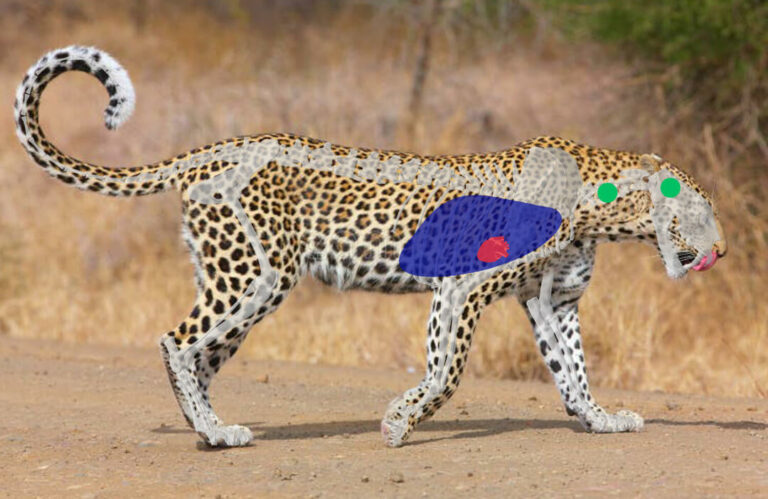
When on a dangerous game hunting safari, the minimum caliber rifle that is legally required is a .375 with a 300-grain bullet. An expanding bullet tip is recommended. The rifle should be fitted with an excellent-quality tactical scope. Leopards are soft-skinned cats that very seldom retain bullets from high-powered rifles.
Accurate leopard shot placement is critical. The leopard is seen as one of the most dangerous, if not the most dangerous, animal when wounded. It is sly and cunning and will seek revenge when injured. Make your first shot count.
Tips when Leopard Hunting in Zimbabwe
Leopard hunting is an exceedingly dangerous yet extremely rewarding dangerous game hunting safari. Keep the following tips in mind as you hunt this cunning African cat:
• Never let your guard down. The leopard is seen as one of the most dangerous animals worldwide to hunt, and for good reason. This clever predator will defend itself tooth and nail when injured and will attack to seek revenge.
• A minimum of a .375 caliber with 300-grain expanding bullets is recommended, as well as a good tactical scope.
• Do your homework with regards to leopard anatomy. Only take the shot if you are sure your shot placement is accurate…you do not want an injured leopard on your hands!
• Patience is key. Leopard hunting is a marathon, not a sprint. Be prepared to wait long hours in silence to harvest the perfect trophy.
• Leopards are nocturnal and are more active in late afternoons, during the night, and early mornings. Time your hunt during these times.
• Remember, safety first. Only load your firearm when you are ready to shoot.
• Listen to your PH.
• Never follow up on a wounded leopard alone, they are renowned for attacking and seeking revenge. Don’t become a statistic.
Traveling to the Omay Concession
Hunters traveling to the Omay Concession will fly to Harare International Airport in Harare, Zimbabwe. From Harare, there is an option of a charter flight that takes approximately 90 minutes and lands in the concession, or hunters can take a 6–8-hour road transfer to the Omay Concession.
For many American hunters, a leopard safari in Zimbabwe represents the culmination of years of dangerous game hunting ambitions. However, hunting leopard in Africa differs significantly from most North American hunting experiences and requires careful preparation well before arriving in camp.
What American Hunters Should Know Before Booking a Leopard Hunt in Zimbabwe
Hunters traveling from the United States should ensure all firearm documentation, travel paperwork, and import permits are properly arranged before departure. Zimbabwe generally allows visiting hunters to temporarily import hunting rifles, although regulations and airline requirements can vary depending on transit countries and final destinations.
Physically, leopard hunting can also be more demanding than many first-time African hunters expect. Long hours spent sitting quietly in blinds, late-night hunting activity, and the mental pressure of waiting for a mature tom to approach bait all require patience and discipline. Unlike many plains game safaris, leopard hunting often becomes a test of endurance and concentration rather than constant movement.
Many experienced Professional Hunters also recommend that American hunters spend time becoming familiar with dangerous game rifle handling before arriving in Africa. Fast target acquisition, calm shot execution, and confidence with larger calibers can make a significant difference when hunting one of Africa’s most elusive predators.
For many international hunters, particularly those visiting from the United States, Zimbabwe remains one of the more respected destinations for authentic free-range dangerous game safaris due to its experienced PHs, established safari infrastructure, and strong leopard hunting reputation.
Frequently Asked Questions
Is it legal to hunt in Zimbabwe?
Yes, hunting in Zimbabwe is legal. Although there is no fixed hunting season and hunting occurs throughout the year, it is more popular during the dry season running over June, July and August.
Are there leopards in Zimbabwe?
Yes, there are leopards in Zimbabwe, with some sources estimating between 12,000-14,000, although this is difficult to verify due to the elusive nature of the animal.
What other members of the Big 5 can be hunted in Zimbabwe?
Africa’s Big 5 consists of the Lion, Elephant, Leopard, Cape Buffalo, and Rhino. With the exception of the Rhino, the remaining four members of the Big 5 can be hunted on a Zimbabwe hunting safari.
What hunts leopards?
Lions have been known to target and hunt leopards when prey is scarce, but it is very unusual.
What do Leopards hunt?
Leopards hunt a variety of prey, usually focusing on small to medium-sized animals, but will focus on any animal that they can take down successfully. This list includes mice, hares, baboons, small antelope, birds, rodents and even larger prey such as bushbuck, steenbok, springbok, duiker, and kudu.
What is the most difficult animal to target on an African hunt?
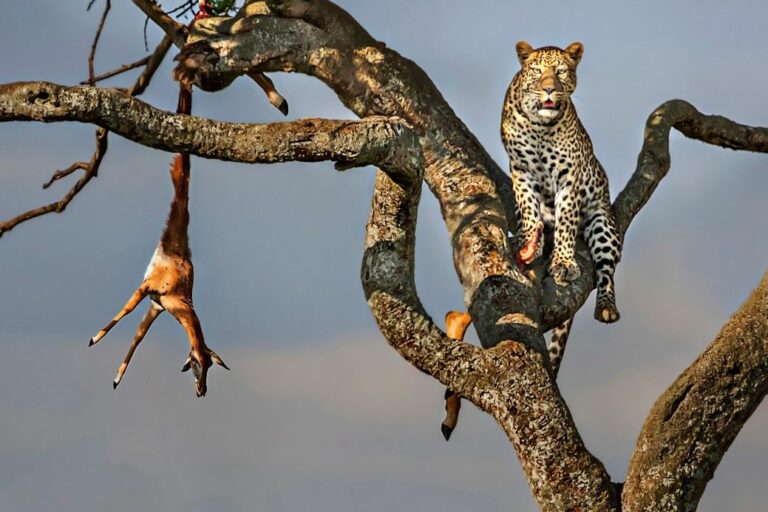
One of Africa’s most dangerous and difficult animals to target during an African hunt is the leopard. A nocturnal member of Africa’s Big 5, the leopard is renowned for its camouflage skills, agility and climbing abilities, often taking to trees to avoid detection.
Conclusion
Leopard safaris remain one of the most demanding and rewarding experiences in African dangerous game hunting. Zimbabwe continues to stand out as one of the continent’s premier destinations, particularly for hunters seeking authentic free-range wilderness areas and experienced Professional Hunters. Regions such as the Omay Concession offer exceptional opportunities for leopard hunting in Zimbabwe, combining rugged terrain, healthy predator populations, and classic bait-and-blind hunting methods that still define traditional African safari hunting.
For hunters researching broader African leopard hunts, Zimbabwe consistently ranks among the top destinations due to its combination of mature trophy potential, large unfenced concessions, and strong dangerous game heritage. Hunters interested in learning more about other renowned safari regions should also explore Leopard Hunting In Zimbabwe: The Save Valley Conservancy, another respected leopard hunting area known for its diverse terrain and strong leopard populations.
Success on leopard safaris often comes down to patience, tracking ability, and understanding leopard behavior in difficult terrain. Hunters wanting a deeper understanding of baiting, tracking, and field tactics can also read The Elusive African Leopard: Tracking and Hunting Strategies, which explores many of the practical challenges associated with hunting this elusive African predator.
Whether pursuing a first leopard safari or returning to Africa for another dangerous game adventure, the Omay Concession remains one of the more respected areas for hunters wanting a realistic and challenging leopard hunting experience in wild Africa.
Author
Pierre van Wyk is the co-founder of Game Hunting Safaris and has spent years hunting dangerous game and plains game across numerous African countries. His experience includes elephant hunting, dangerous game safaris, and working closely with Professional Hunters and safari operators throughout Southern and Central Africa. Pierre’s writing focuses on authentic safari experiences, hunting techniques, wildlife conservation, and the realities of modern African hunting safaris.